A few years ago, after my divorce, I found myself doing what millions of people do every day.
I downloaded dating apps. At first everything looked normal. Create a profile. Upload photos. Verify your identity. Add more photos. Verify again. Complete your profile. Record a facial scan.
Then something happened that made me stop and think - I'm not sure what the ultimate purpose of these apps is
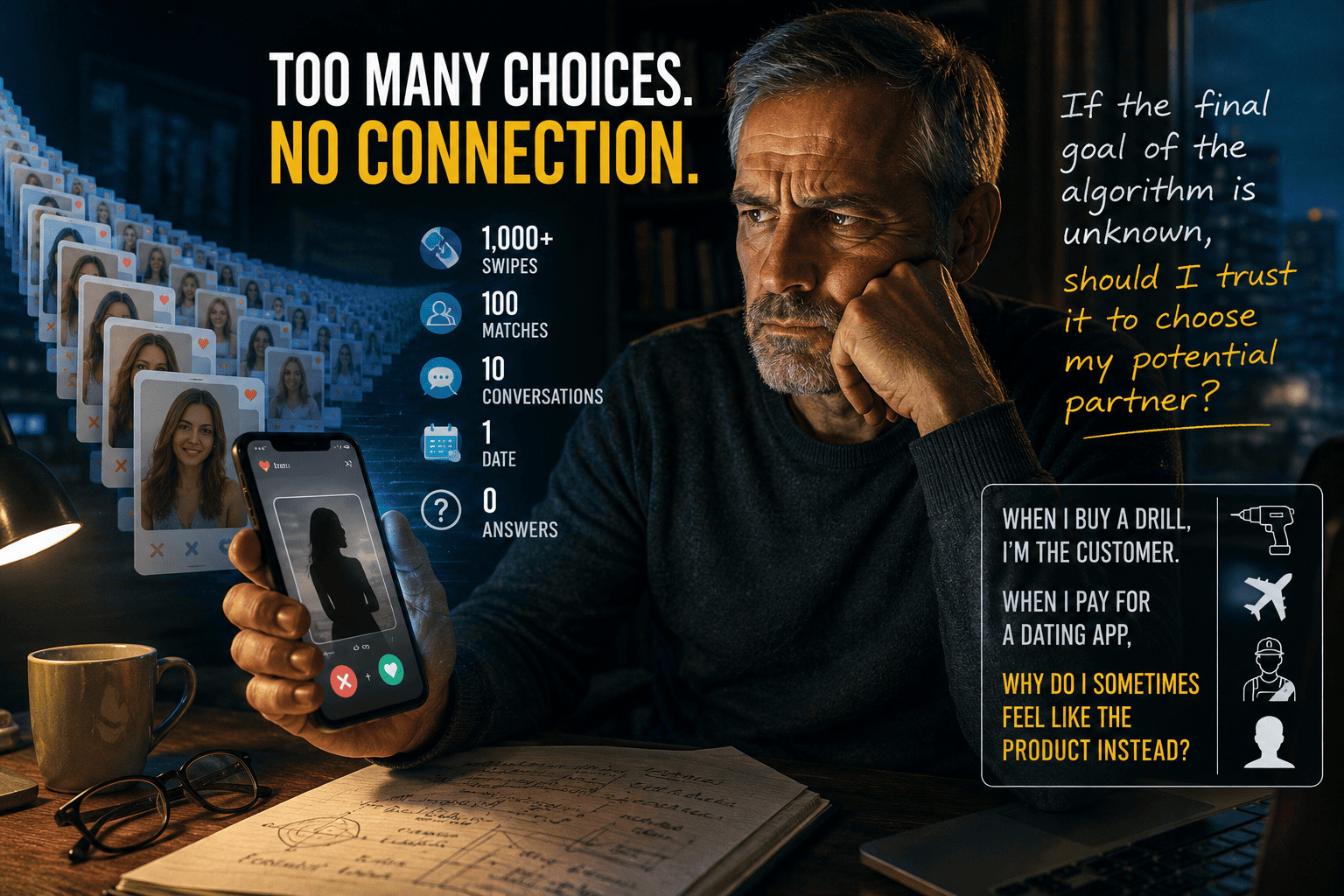
If the final goal of the algorithm is unknown, should I trust it to choose my potential partner?
At the time, I didn't have an answer. Honestly, I still don't.
Observation #1: Before You Meet Anyone, You Become Data
The first thing that surprised me wasn't the matching process. It was the amount of information required before I could even say hello to another human being. Photos. Identity verification. Location data. Personal preferences. Behavior tracking. Facial verification. Another question that remains unanswered is the fate of this information in the future.
Maybe all of it serves a legitimate purpose. Maybe it improves safety. Maybe it improves matching.
But the engineer in me couldn't stop wondering:
How much information does a dating app need before I can simply introduce myself?
Observation #2: The Business Model Is Hard To See
Then came the likes. Or at least notifications about likes.
Someone liked your profile. You can't see who. Unless you pay.
So I paid. I looked. I sent a message. Nothing happened.
No reply.
Maybe she wasn't interested. That is completely fair. Or maybe she never saw my message. I honestly have no idea.
And that uncertainty became more interesting than the rejection itself.
The Question That Refused To Go Away
The more I used dating apps, the more I felt like I was interacting with a system whose objectives I couldn't clearly understand.
Maybe the goal was helping me find a relationship.
Maybe the goal was maximizing engagement.
Maybe the goal was increasing subscription revenue.
Maybe it was all three. I genuinely don't know. But I do know this:
When I buy a drill, I'm the customer.
When I buy a plane ticket, I'm the customer.
When I hire a plumber, I'm the customer.
But when I pay for a dating app, why do I feel like the product instead?
That question stayed with me for months.
The Real Cost Wasn't Money
Eventually I stopped thinking about subscription fees. What bothered me more was time. Time is the one thing nobody can refund.
But then I started wondering about something else entirely.
Out of those 1,000 swipes, how many were actually seen by real people?
Maybe my messages disappeared into accounts created for entertainment. Maybe they went to people bored on their lunch break with no intention of ever responding. Maybe they vanished because the recipients never paid for premium features to see them.
Or maybe I'm just terrible at this.
But here's what I can't stop thinking about: Did I spend an hour of my life trying to connect with someone, or did I just become traffic and noise for the application?
That question has no answer either.
A Thought Experiment
Then I asked myself a different question.
What if the problem wasn't me? What if the problem wasn't my profile? What if the problem wasn't my photos?
What if the problem was the model itself? And what if I removed the algorithm from the equation entirely?
Once, people chose what books to read.
Then television chose what to show them.
Then the internet gave choice back.
And now?
Every platform seems determined to decide what we should see, who we should hear, what we should buy, what we should watch, and sometimes even who we should date.
Maybe the recommendations are useful. Maybe they are not.
But somewhere along the way, many of us stopped making our own choices and started accepting the choices made for us.
I realized that wasn't what I wanted anymore.
I didn't want another boost. I didn't want another premium tier. I didn't want another hidden ranking system deciding whether someone would ever see my profile.
I simply wanted to choose for myself.
- Browse profiles myself.
- Decide who interested me.
- Write first.
- Start conversations directly.
- Accept the results, whatever they might be.
Not because my choices would be perfect. But because they would be mine. Like adults did before algorithms became matchmakers.
Why I Eventually Looked Beyond Local Dating Apps
That decision eventually led me toward international dating.
Not because I was specifically looking overseas. Not because I had some grand plan. I simply wanted to test a different model.
One where communication mattered more than swiping.
One where I chose who to contact.
One where I felt more like a customer than inventory.
The experience changed the way I think about online dating.
One Final Question
I am not here to tell you what platform to use. I am not here to tell you that every dating app is wrong.
I am simply sharing the question that changed my perspective.
If you don't know the true objective of the algorithm, how much trust should you place in its decisions?
For me, that question was worth more than another thousand swipes.