
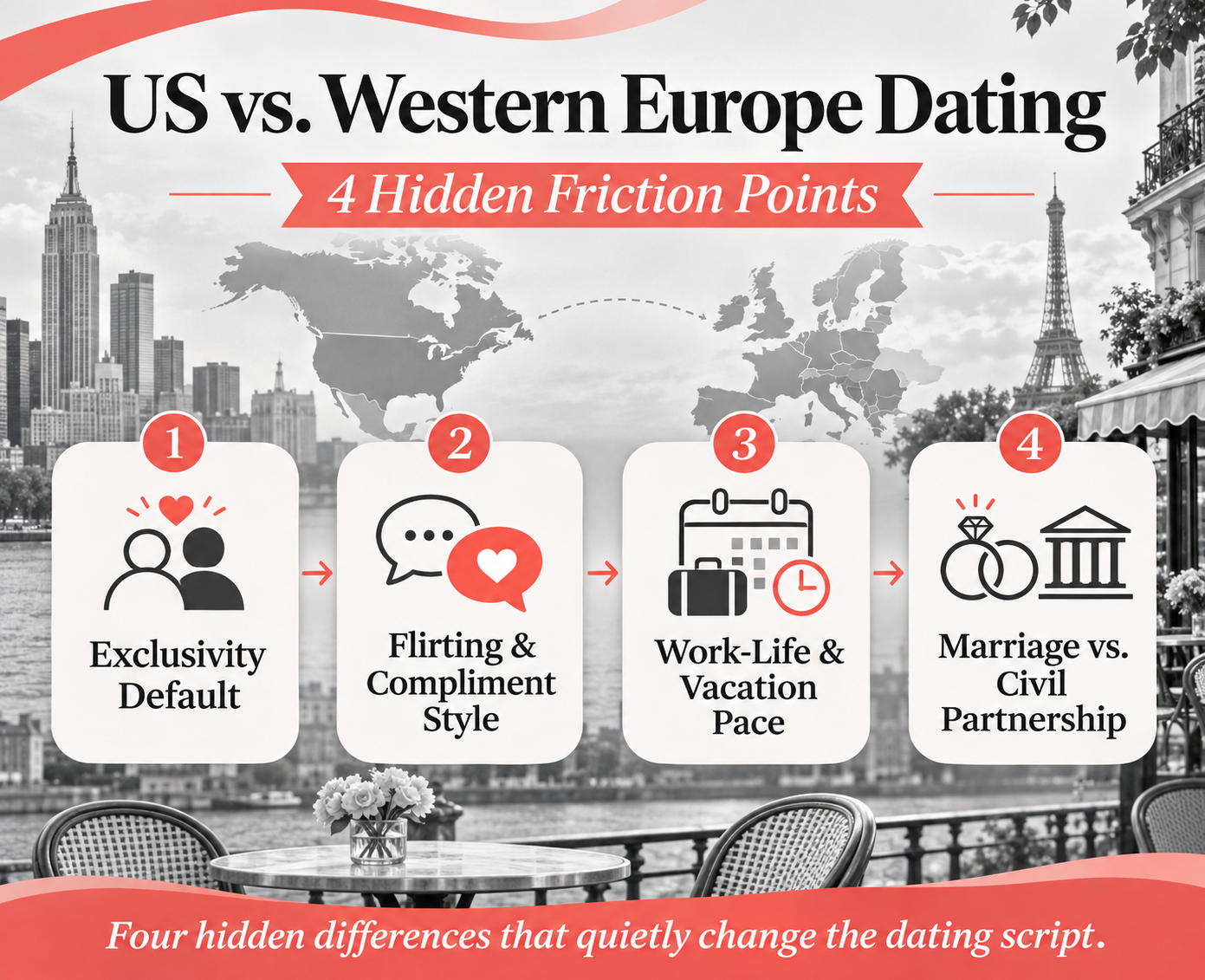
This is the transatlantic chapter of the Global International Dating hub guide (2026), and it exists because cultural differences US and Europe dating couples face are invisible at first and structural by month six. When an American dating European woman meets her in Paris, Milan, or Berlin, there is no language barrier to blame, no visa shock to explain the tension — only two sets of defaults that never needed to be spoken at home, and now must be.
The "Exclusive" Trap (American Dating Stages vs. European Exclusivity)
American romance runs on a funnel: several people date simultaneously, exclusivity is a negotiated status, and until "the talk" happens, seeing others is socially permissible. The talk is a milestone — a conversation with an outcome. In France, Italy, and Spain, the funnel does not exist. Mutual attraction, a kiss, and continued presence are the relationship. There is no talk because there is nothing to negotiate: from the second or third weekend together, you are a couple, and asking "are we exclusive?" three months in does not sound like caution. It sounds like a confession that you were keeping options open.
Now run the collision in both directions. The American who asks the question at month three watches his French partner's face close: in her grammar, he just admitted parallel dating. The European woman who assumes exclusivity from week two discovers his dating-app profile still active "until we define things" — and reads it not as cultural default but as betrayal. Neither is wrong. Both are fluent in different rulebooks, and dating French women vs American dating scripts is exactly where this gap bites hardest, because French courtship treats ambiguity as seduction while American courtship treats it as a liability.
The fix costs one uncomfortable week-one conversation: "In my culture, X is normal until we talk. What is normal in yours?" Couples who have it in week one never need it in month three.
The exclusivity trap is not a values conflict.
It is two honest people reporting different weather: one describes a negotiation, the other describes a fact.
Flirting, Directness, and Compliments Across the Atlantic
The second friction layer is tonal. American flirting runs on enthusiasm: superlatives, fast self-disclosure, the default smile, "you're amazing!" as punctuation. French seduction runs on restraint and intellect: compliments are rare, precise, and therefore valuable; over-praise reads as insincerity or salesmanship; and debate — real, sharp disagreement at dinner — is flirtation, not conflict. Italian courtship is expressive and public: warmth performed visibly, gestures as vocabulary, family aware of you early. German courtship is the mirror image of the American one: clarity over charm, "I find you attractive" stated plainly, small talk viewed with mild suspicion, punctuality as the first compliment.
Each style misreads the others on contact. The American in Paris hears restraint as coldness and debate as hostility; the Parisian in Boston hears enthusiasm as emptiness. The Milanese woman's public warmth reads to a Bostonian as intensity; his reserved handshake reads to her as absence. The Berliner's direct "that dress does not suit you" lands in Chicago as an insult and in Berlin as proof of trust.
| Dimension | United States | France | Italy | Germany |
|---|---|---|---|---|
| Exclusivity default | Negotiated via "the talk" | Assumed from mutual presence | Assumed from visible courtship | Assumed after a few dates, stated plainly |
| Compliment style | Frequent, enthusiastic superlatives | Rare, precise, earned | Warm, public, expressive | Sparse, literal, sincere |
| Debate at dinner | Often avoided (conflict-averse) | Flirtation; intellectual sport | Passionate, gestural, loud | Welcome if factual and direct |
| First-date bill | Split or alternating common | Payer-host or alternating | Traditionally payer-led, evolving | Often split (getrennte Kassen) |
| August | Work month with scattered days off | Sacred, offline, family or travel | Sacred (Ferragosto); cities empty | Sacred: 3–4 continuous weeks |
| Commitment institution | Marriage-default + wedding industry | Marriage or PACS, both respectable | Late marriage; unioni civili accepted | Cohabitation normal; marriage optional |
Work-Life Balance, Money, and Marriage Attitudes
The third layer is economic, and it surprises couples later — usually around the first summer. European statutory vacation runs four to five weeks, and August is not a month but an institution: offices close, cities empty, phones go dark. An American partner who texts "quick work question" into her Provençal holiday is not being diligent in her eyes; he is committing a category error about what life is for. Conversely, her expectation of a three-week disconnected August can read to his employer-shaped calendar as abandonment.
Money follows the same split. German couples commonly run getrennte Kassen — separate purses — with shared costs negotiated like a household treaty; French couples alternate or follow payer-host logic; Italian norms lean traditional but evolve fast in the north. The American assumption that "whoever invites, pays" or that splitting signals equality lands differently in each city, and the bill on date two is often the first real cultural test of the relationship.
Then comes the institution question, and it is the deepest of the transatlantic relationship challenges. In the US, marriage is the default endpoint with a wedding industry attached. In France, a large share of committed couples chooses PACS — a civil solidarity pact with real legal and tax weight — and treats it as fully respectable, sometimes preferable. In Italy, marriage happens late or yields to civil unions; in Germany, long cohabitation without registration is ordinary. So when your Parisian partner says "I want a PACS, not a wedding," she is not refusing commitment. She is offering the commitment her culture invented — and the translation work has only just begun.
Case Study: The "Are We Exclusive?" Misunderstanding in Lyon
📋 Case Study: One Question, Two Rulebooks, and a Letter in Franglais
Caleb (39, Boston) and Claire (35, Lyon) matched on a verified platform and built five months of daily calls before he flew out. By his third visit they had spent two weekends together, met her sister, and — in her mind — been a couple since the second one. Then, over dinner in a bouchon, Caleb asked the question his culture had taught him to ask: "So… are we exclusive?" Claire went very quiet. In her grammar, the question was not caution; it was evidence. Evidence confirmed when, a week later, she learned his dating-app profile had stayed active "until we define things." She left the restaurant politely, which in Lyon is the coldest possible exit.
The repair took a letter — half English, half schoolbook French — in which Caleb explained the American funnel as a default, not a desire: "I was following a rulebook I didn't know I was carrying." Claire answered with her own list: five French defaults she had never questioned, from August silence to PACS-as-commitment. They read both lists aloud on a video call and laughed for the first time in three weeks. The rule they wrote that night still governs them: whenever confusion strikes, one of them asks, "Which culture is talking right now?" They married civilly at Lyon's city hall — her institution — and held the family celebration in Boston — his. "We never had a compatibility problem," Claire told us. "We had a time-zone problem. Cultural time zones."
Transatlantic Visa & Relocation Realities
When the relationship turns logistical, the transatlantic corridor reveals its asymmetries. An American sponsoring a European spouse uses the standard CR-1 or K-1 pipeline — no exoticism, no legalization marathons, Hague apostilles everywhere. But the European partner faces a cost no visa fee captures: leaving the EU means leaving free movement, portable healthcare, and pension continuity. Many European professionals hesitate at exactly this point, and the hesitation is rational, not romantic — discuss it before the petition, not after.
The reverse direction is its own maze. A European sponsor bringing an American partner home encounters either EU free-movement simplicity (if he qualifies as a mobile citizen) or national rules with income and integration requirements — and the United Kingdom, post-Brexit, runs one of the world's strictest family-visa income thresholds plus English-language evidence even for native speakers. The full map of those thresholds, language tests, and timelines lives in our legal cluster's chapter on the income thresholds and language tests of European family reunification.
And whichever direction the move runs, the arrival itself carries the same psychology as every relocation: the golden cage, the lost professional identity, the four-stage culture shock. Our cross-cultural cluster's relocation guide covers the support protocol that keeps the first year from becoming the last.
Frequently Asked Questions
Is dating a European woman really that different from dating an American?
Surface similarities hide structural differences: exclusivity defaults, compliment culture, vacation rhythm, and commitment institutions (marriage vs PACS vs cohabitation). The friction typically appears around month three to six, exactly when both partners stop performing and start assuming their home defaults.
What is PACS and should I accept it instead of marriage?
PACS is the French civil solidarity pact: a contractual union with real legal, tax, and housing rights that many French couples treat as a fully respectable commitment. Discuss what each institution symbolizes to each of you. For cross-border relocation, marriage usually carries stronger immigration weight — plan the sequence accordingly.
Who pays on dates in France, Germany, or Italy?
It varies: Germany leans toward splitting (getrennte Kassen culture), France alternates or follows the payer-host logic, Italy remains more traditionally payer-led though evolving. The safe move is to offer once, observe her response, and ask directly by date three — never assume the American script runs abroad.
How do we handle the August vacation gap in a transatlantic relationship?
Plan around it early. In France, Italy, Germany, and Spain, August is sacred: offline, family-bound, often abroad. Schedule your visits before or after it — or join it if invited. An American who respects the shutdown earns more trust in one summer than in a year of texts sent through it.
Conclusion: Same Ball, Different Sports — Learn the Rules
Western-to-Western couples do not fail from exotic mismatches; they fail from unexamined similarities. The kiss that meant marriage in Lyon meant a good Tuesday in Boston. The PACS that meant forever in Paris meant paperwork in Boston. The August silence that meant love in Lyon meant distance in Boston. None of it was incompatibility — all of it was untranslated defaults. So translate early: name your rulebooks in week one, ask "which culture is talking?" in month three, and choose your institutions together, in writing, before the institutions choose for you. Do that, and the transatlantic relationship stops being a paradox. It becomes what it always looked like from the outside: two people from similar worlds, building one of their own.