This is the Latin-America-beyond-Colombia chapter of our Global International Dating Guide (2026), the seven-article atlas mapping regions and perspectives. Here we cover the three countries most Western men consider after Colombia — Brazil, Mexico, and the Southern Cone — and we do it honestly: Portuguese is not Spanish, dating in Brazil as a foreigner runs on different emotional physics, and the difference between Mexico City and Guadalajara is bigger than the difference between Chicago and Denver. If you are going to show up in Curitiba or Oaxaca, show up prepared.
Brazil vs. Hispanic Latin America (Why Language & Temperament Differ)
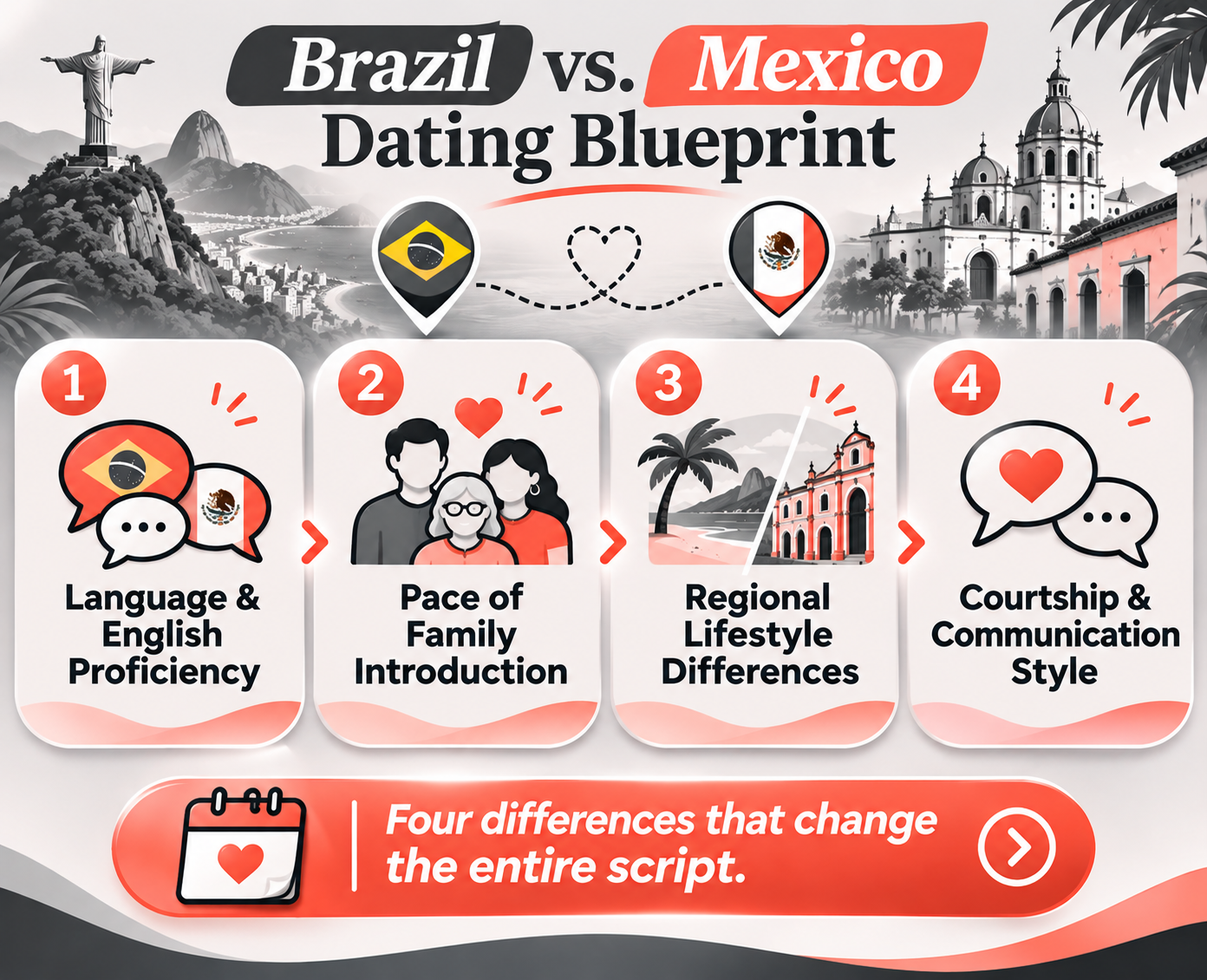
Start with the language, because it is not just vocabulary. Brazil runs on Portuguese, and the gap between Portuguese and Spanish is wide enough that a man fluent in one does not casually converse in the other. More importantly, the emotional cultures diverged centuries ago. Brazilian culture carries saudade — a specific, untranslatable form of tender longing — and a level of everyday physicality (hand on the arm, a kiss on both cheeks, shared personal space) that surprises even men who have dated across Hispanic Latin America.
Dating Mexican women culture, by contrast, carries a more formal politeness inherited from colonial Mexico City's courtly traditions. "Mi amor" on a first message reads warm in Medellín and presumptuous in Guadalajara. Mexican flirtation is often playful but circumspect; Brazilian flirtation is open and embodied. Neither is wrong; both will punish a man who uses the same script in both.
English proficiency also differs sharply. São Paulo and Rio have professional-class English; Curitiba and Florianópolis less so. Mexico City and Monterrey are similarly English-friendly; smaller cities and the Yucatán interior are not. In both countries, learning the local language visibly is the single highest-leverage investment a foreigner can make — and women on verified platforms consistently describe it as a green flag on par with financial stability.
Brazil is not Spanish Latin America with a tan.
Treat Portuguese as a different emotional operating system — and treat Mexican formality as a sign of respect, not coldness.
Regional Geography Matters (Megacities vs. Traditional States)
The single biggest mistake Western men make in both countries is treating the capital as the country. It is not. São Paulo is a global business metropolis with São Paulo values; Curitiba is a planned southern city with German and Ukrainian immigration, colder winters, earlier dinners, and a much more traditional family rhythm. Rio is beach-culture cosmopolitan; Florianópolis is island-small-town intimate; the interior states of Minas Gerais or Bahia run on entirely different social clocks.
Mexico replicates the pattern. Mexico City is a 22-million-person megalopolis where cosmopolitan women date like their peers in Barcelona or Buenos Aires. Guadalajara and Monterrey are prosperous, family-embedded, and Catholic-traditional in ways the capital often is not. Mérida and the Yucatán carry Mayan heritage and a slower social rhythm; Tijuana and the border cities read culturally as a different region entirely.
| Country | Megacity Profile | Traditional-State Profile | What Changes for a Foreign Partner |
|---|---|---|---|
| Brazil | São Paulo, Rio: cosmopolitan, late-night, English-accessible | Curitiba, Floripa, Salvador: family-first, earlier dinners, traditional courtship | Language barrier rises outside megacities; family introduction accelerates |
| Mexico | CDMX: cosmopolitan, international, progressive | Guadalajara, Monterrey, Mérida: Catholic-traditional, family-embedded | Courtship formality rises sharply; parental approval is decisive |
| Southern Cone (Argentina, Uruguay, Chile) | Buenos Aires, Santiago, Montevideo: European-inflected, late social hours | Interior provinces: gaucho/estancia culture, direct communication | English proficiency highest here; European sensibility; less religious |
The practical lesson: choose the city as deliberately as you choose the country. A man who thrives in São Paulo may struggle in Curitiba's quieter, more traditional rhythm — and vice versa. Our navigator chapter on choosing the right region for your personality covers how to test this before you book a flight.
Catholic Traditions, Family Sunday, and Courtship Pace
What unites Brazil and Mexico across their internal diversity is the Catholic calendar's invisible architecture. Sunday lunch is a weekly institution in both countries — multi-generational, loud, alcohol-adjacent, and non-negotiable. Being invited to Sunday lunch is the single most decisive signal in Latin American courtship: it means the family is evaluating you as a future in-law, not as a visitor. Men who treat it as a casual meal miss the entire subtext.
Courtship pace in both countries is faster than Western men expect. Meeting the parents typically happens within the first two to four months of serious courtship — sometimes on the second in-person visit — and the conversation about marriage begins explicitly within six to twelve months. This is not pressure; it is clarity. Women in their late twenties and thirties who join verified international platforms are not dating for recreation. They are dating with a calendar.
Catholic feast days structure the year in ways foreigners routinely underestimate: Carnival in Brazil (the week before Lent), Semana Santa across both countries, the December posadas in Mexico, and the cascade of patron-saint festivals in smaller towns. These are not optional social events; they are family obligations. A serious partner integrates into them.
Case Study: Navigating Portuguese and Family Sundays in Curitiba
📋 Case Study: The Man Who Learned "Feijoada" Before "I Love You"
Nathan (42, Seattle) met Beatriz (34, Curitiba) on a verified platform after his previous relationship in Medellín ended amicably. The contrast hit him immediately: Beatriz spoke less English than his Colombian ex, Curitiba was colder and more reserved than he expected, and her family's Sunday lunches ran four hours with fifteen relatives at a table where he understood perhaps one word in three. The first visit was, by his own admission, a linguistic and cultural humiliation — he left feeling like a child.
What he did next is the reason they are married today. Before the second flight, Nathan committed to ninety days of daily Portuguese lessons on a structured app and hired a Curitiba-born tutor on a weekly video call to correct his pronunciation. He memorized the entire Sunday-lunch cast — names, relationships, who drinks coffee and who drinks guaraná — and arrived with a small gift for the grandmother that Beatriz's mother had mentioned in passing three weeks earlier. By the third visit, he could follow most of the lunch conversation; by the fifth, he was arguing about football with Beatriz's older brother in passable Portuguese. "The first visit I felt like a tourist," he told us. "The third visit I felt like a boyfriend. The seventh visit I felt like a family member. None of it happened because I was charming. It happened because I did the homework."
Travel Logistics, Safety, and Visa Routes
Logistics are the quiet hero of Latin American courtship — or its quiet villain, depending on whether you plan them. From the United States, Brazil is the longest flight of the three (10–12 hours from the East Coast, 14+ from the West); Mexico is the shortest (3–5 hours); Argentina and the Southern Cone sit in between (10–11 hours). Visa policy for US citizens is straightforward in all three: tourist stays of 90 days, no advance visa, which makes repeat visits easy — but also tempts men into the "endless boyfriend" trap without a marriage conversation.
The legal path to marriage runs through the same K-1 or CR-1 routes as every other region for US sponsors, and document legalization benefits from the Hague Apostille Convention in all three countries — meaning translations and certifications move faster than in non-Hague regions like parts of Southeast Asia. For the complete line-item budget across every phase, including flights, hotels, documents, and government fees, our chapter on the real cost of international dating prices the Latin corridor specifically and compares it against Eastern Europe and Southeast Asia.
Safety follows the standard mutual protocol — independent hotel, ride-hail transport, public venues for the first 48 hours, trusted-contact check-ins. The specific risks in Latin America are district-specific rather than country-specific: some neighborhoods in São Paulo or Mexico City require local knowledge to avoid; others are as safe as any American suburb. Her local advice, taken seriously, is worth more than any travel blog.
Frequently Asked Questions
Is dating in Brazil different from dating in Colombia or Mexico?
Yes — the language difference alone (Portuguese vs Spanish) reshapes communication, and Brazilian emotional culture carries its own rhythm: more openly tactile, shaped by saudade, and less formal than Mexican courtship. Regional differences within each country often matter more than country-to-country ones.
Do Brazilian and Mexican women speak English?
Proficiency varies sharply by city and generation. São Paulo, Mexico City, and Monterrey have strong professional English; smaller cities and traditional states have modest everyday exposure. Learning basic Portuguese or Spanish phrases is a visible investment that women on verified platforms consistently reward.
How quickly does a serious relationship move toward meeting her family?
Across Latin America, family introduction happens early — typically within the first two to four months of serious courtship, sometimes on the second visit. Sunday lunches with parents and siblings are a central institution; treating them seriously is a faster trust-builder than any grand gesture.
Are Brazil and Mexico safe for a foreign man visiting his girlfriend?
Safety is district-specific, not country-specific. Follow the standard mutual-safety protocol: independent hotel, ride-hail transport, public venues for the first 48 hours, and local advice from her about which neighborhoods to avoid. The vast majority of visiting partners experience nothing worse than aggressive hospitality.
Conclusion: Choose the City, Not Just the Country
The men who thrive in Latin America beyond Colombia are the ones who stop treating "Latin" as a single destination and start treating each city as its own culture. Curitiba is not Medellín. Guadalajara is not Bogotá. Florianópolis is not Buenos Aires. The women you meet there are not variations of a template — they are products of specific neighborhoods, families, and social rhythms. Choose the city the way you choose a partner: carefully, deliberately, and with your eyes open to what it actually asks of you. Then do the homework Nathan did. The language, the Sunday lunch, the grandmother's name — that is where the real relationship begins.