This is the Southeast-Asia-beyond-the-Philippines chapter of our Global Regions & Perspectives atlas (2026), the seven-article map of where and how international love actually happens. Here we decode the two neighbors the Philippines-trained playbook fails at: Theravada Buddhist Thailand and Confucian Vietnam — their face culture, their marriage rituals, their family mathematics, and the document chains that catch unprepared couples for months.
Why Thailand and Vietnam Are Not "Just Like the Philippines"
The difference starts with history. The Philippines spent three centuries under Spain and half a century under American administration; the result is a Catholic, English-fluent society whose courtship vocabulary translates almost directly into Western dating. Thailand was never colonized. Vietnam absorbed a millennium of Chinese Confucian statecraft and a century of French administration — but no English legacy. Those historical forks produce three practical gaps every foreign partner meets within a month.
The ethical gap. Thai social calm runs on Theravada Buddhist norms: merit, non-confrontation, emotional equilibrium. Raising your voice does not just upset a Thai partner; it violates a social ethic. Vietnamese family life runs on Confucian lineage logic: ancestor rites, filial hierarchy, and the family's collective face matter more than any individual preference — including, sometimes, yours.
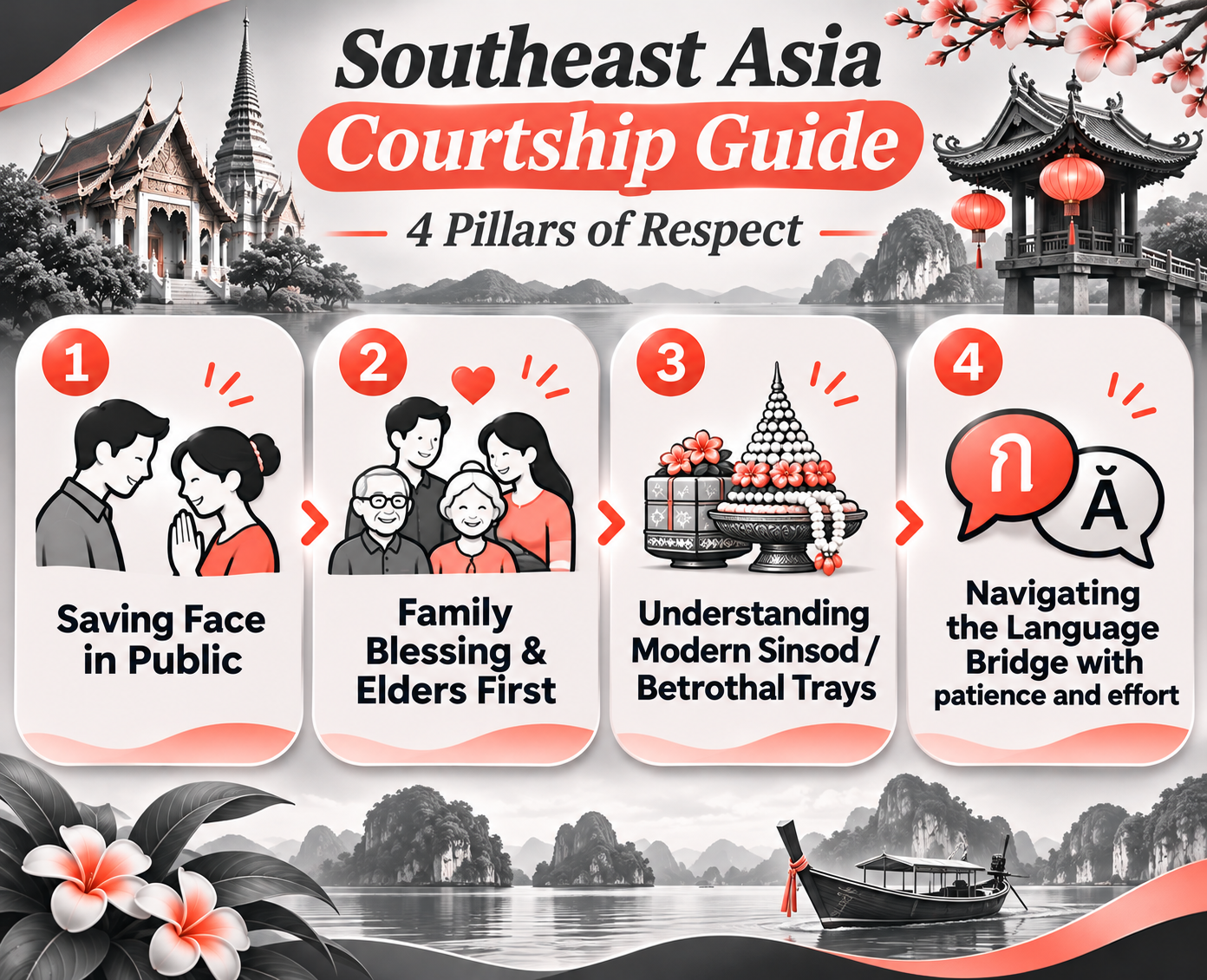
The language gap. English in Thailand and Vietnam is a learned skill, not an institutional inheritance. Urban professionals speak it well; households do not. Daily romance therefore requires a translation bridge — apps, patience, and eventually your own effort in Thai or Vietnamese. Men who dated in Manila and expect the same linguistic ease in Da Nang discover the hard way that dating in Vietnam culture means learning a tonal language's basics or hiring your humility full-time.
The ritual gap. Neither country inherited the Western church-wedding template. Marriage here is a family ceremony with its own economics and choreography — sinsod in Thailand, lễ ăn hỏi in Vietnam — which we decode fully below.
| Dimension | Thailand | Vietnam | Philippines (baseline) |
|---|---|---|---|
| Ethical foundation | Theravada Buddhism; merit & equilibrium | Confucian lineage ethics; ancestor rites | Spanish Catholic + American legacy |
| Everyday English | Learned skill; moderate in cities | Learned skill; rising among youth | Institutional; widely spoken |
| Marriage ritual | Sinsod bride-price + district office registration | Lễ ăn hỏi betrothal trays + provincial registration | Church or civil wedding; no bride-price |
| Family structure | Close-knit, often matrilocal residence | Patrilineal rites, lineage-first decisions | Bilateral, godparent networks |
| Face culture | Kreng jai: considerate deference | Giữ thể diện: protecting family face | Pakikisama: smooth relations |
| Document legalization | Consular legalization (non-Hague) | Consular legalization (non-Hague) | Hague apostille (member since 2019) |
Understanding "Face" (Kreng Jai) and Indirect Communication
If one concept decides whether your relationship thrives here, it is face. In both cultures, a person's social standing is shared property — held partly by their family — and public embarrassment damages not just the individual but the household's reputation. This is why a Thai partner practices kreng jai: a considerate deference that avoids imposing, avoids refusing bluntly, and avoids conflict in shared spaces. A Vietnamese partner practices giữ thể diện: keeping face for themselves and for you, even when the truth is uncomfortable.
For a low-context Western man, this produces three classic misreadings. Her hesitant "maybe" is often a polite no. Her silence after your joke is not shyness but protection of the room's equilibrium. And her refusal to correct you in public — even when you are visibly wrong — is not agreement; it is mercy, delivered in the only currency her culture approves.
The operating rules that follow are simple but non-negotiable: never correct or criticize her in front of others; ask open, indirect questions when the answer might embarrass ("What would your family prefer?" instead of "Do you disagree?"); treat silence as data, not as absence; and deliver every difficult conversation privately, softly, and face-to-face. These are the same high-context mechanics our cross-cultural cluster maps in detail when explaining how high-context and low-context cultures collide at home — in Southeast Asia they simply run at full volume.
In face cultures, the messenger matters as much as the message.
The same words, said privately with a smile, build a marriage; said publicly with a frown, they end one.
Marriage Traditions Explained: Sinsod in Thailand & Lễ Ăn Hỏi in Vietnam
Now the rituals Western men fear most — usually because they have been described to them as "buying a bride." They are not. Both are family-honor ceremonies with deep economic history and flexible modern practice.
Sinsod: The Thai Bride-Price, Honestly Explained
Sinsod dowry explained in one sentence: a sum of money and gold presented by the groom to the bride's family at the engagement, historically compensating the household for raising her and proving his capability to provide. In 2026 practice among urban, professional families, sinsod is frequently symbolic: displayed on a tray at the ceremony, photographed, and returned to the couple afterward. Traditional or provincial families may expect a real amount — commonly discussed in the range of 100,000–500,000 THB plus gold, scaled to the family's standing and the bride's education — and the number is negotiated between families, not demanded from a stranger. The fatal error is treating the conversation as a transaction; the correct move is letting her parents frame it, asking what is customary in their family, and responding with respect even when the answer surprises you. Marrying a Thai woman traditions reward the man who understands that sinsod buys nothing except the family's public blessing — which, in this culture, is everything.
Lễ Ăn Hỏi: The Vietnamese Betrothal Ceremony
Vietnam's engagement is a procession, not a payment. On an auspicious date chosen by both families (often after consulting the couple's birth elements), the groom's party arrives bearing tráp — lacquered gift trays holding betel leaves, tea, wine, fruit, and wedding cakes, in an odd number (five, seven, or nine). The trays are presented to the bride's ancestors' altar, the families exchange formal speeches, and the betrothal is sealed. Only afterward come the civil registration and the wedding feast. Modern urban couples adapt the ritual gracefully: trays reduced from nine to five, contents partially symbolic, timing coordinated with the groom's visa calendar — but the ceremony itself is rarely skipped, because skipping it would mean the ancestors were never informed.
Case Study: Modernizing the Engagement Ceremony in Ho Chi Minh City
📋 Case Study: The Nine Trays That Became Seven — and a Father's Tears
Marcus (45, Melbourne) and Thao (33, Ho Chi Minh City) had been together for fourteen months when her family raised the lễ ăn hỏi question: nine trays, full procession, four months of preparation. Marcus, raised on Australian directness, heard "nine trays" and felt his wallet tense — until Thao arranged a video call with her father, who explained, slowly and in careful English, that the trays are not payment: they are the family's announcement to the ancestors that their daughter is entering a new household with honor. "You are not buying her," the old man said. "You are introducing yourself to people who died before you were born."
Marcus flew in early and did something no one expected: he asked to carry the lead tray himself. The families negotiated the modernization together — nine trays became seven, the wine tray swapped for a Australian wine Marcus's own father had bottled, and the civil registration was scheduled for the following week so the visa timeline stayed intact. At the altar, presenting the trays with both hands and a bow he had practiced in his hotel room, Marcus looked up to see Thao's father wiping his eyes. "I thought the tradition was a tax," Marcus told us later. "It was a language. Once I stopped counting the trays and started learning the words, everything — the family, the paperwork, even the embassy interview — got easier."
Practical Travel and Visa Nuances for Southeast Asia
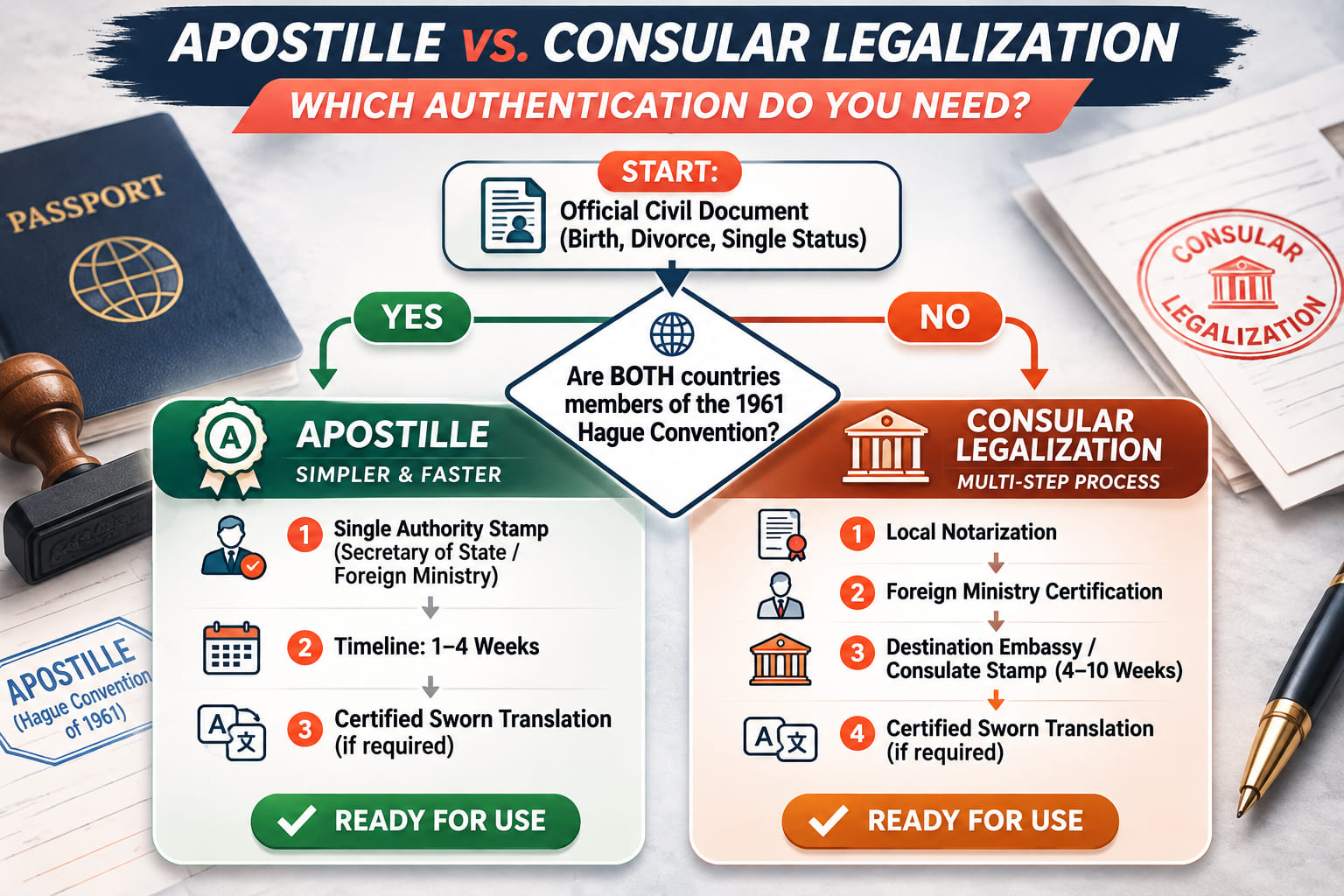
The logistics layer here has one trap that costs couples months: neither Thailand nor Vietnam belongs to the Hague Apostille Convention. Where a Philippine document needs a single apostille stamp, Thai and Vietnamese civil documents — and your own home documents presented there — must travel the consular legalization chain: certification by the issuing country's foreign ministry, then legalization by the destination country's embassy, then certified translation. Each link adds days to weeks; the full chain for a marriage file routinely adds one to two months versus an apostille country.
On the ground: Thailand registers foreign marriages at district offices (amphoe) once your legalized, translated documents are assembled — often within days of appointment. Vietnam registers at the provincial People's Committee and includes a brief joint interview; processing commonly runs two to four weeks. Tourist entries are easy in both (Thailand's extended visa-exemption windows and Vietnam's 90-day e-visa make repeat visits practical), which helps couples stage the relationship properly: visits first, family blessing second, registration third.
Because the legalization chain is where most Southeast Asian files stall, we keep a dedicated decision tree for it: our document guide walks through the apostille versus consular legalization decision tree country by country, with validity windows and translation standards included.
Frequently Asked Questions
What is sinsod and do I have to pay it?
Sinsod is a traditional Thai bride-price presented to the bride's family, historically symbolizing capability and gratitude for raising her. In modern urban families it is often symbolic — displayed at the ceremony and returned to the couple — though traditional families may expect a real amount. Discuss it early, through her parents, with respect; never treat it as a purchase price.
Are Thailand and Vietnam Hague Apostille countries?
No. Neither Thailand nor Vietnam is a member of the Hague Apostille Convention, so marriage and civil documents require the longer consular legalization chain: certification by the issuing country's foreign ministry, then legalization by the destination embassy. Budget extra weeks and fees compared to apostille countries like the Philippines.
How important is meeting her parents before proposing?
Decisive. In both Thailand and Vietnam a proposal without family blessing risks quiet but durable resistance that can shadow the marriage for years. Meet the parents first, bring appropriate gifts, let the family set the pace, and only then discuss engagement rituals like sinsod or lễ ăn hỏi.
Can foreigners legally marry in Thailand or Vietnam?
Yes. In Thailand, foreigners marry at a district office (amphoe) with legalized, translated documents, often within days once papers are ready. In Vietnam, marriage is registered at the provincial People's Committee and includes a short interview; processing commonly takes two to four weeks. Both require the consular legalization chain for your home documents.
Conclusion: Two Civilizations, One Rule — Respect First
Thailand and Vietnam ask more of a foreign partner than the Philippines does: more language effort, more ritual literacy, more patience with indirectness, more paperwork. What they return is proportional — families who adopt you completely once adopted, ceremonies that bind two lineages rather than two individuals, and relationships whose foundations were poured in public, with ancestors watching. Come with respect, learn the words before you count the trays, and the traditions that frightened you at first will become the stories you tell at your tenth anniversary.