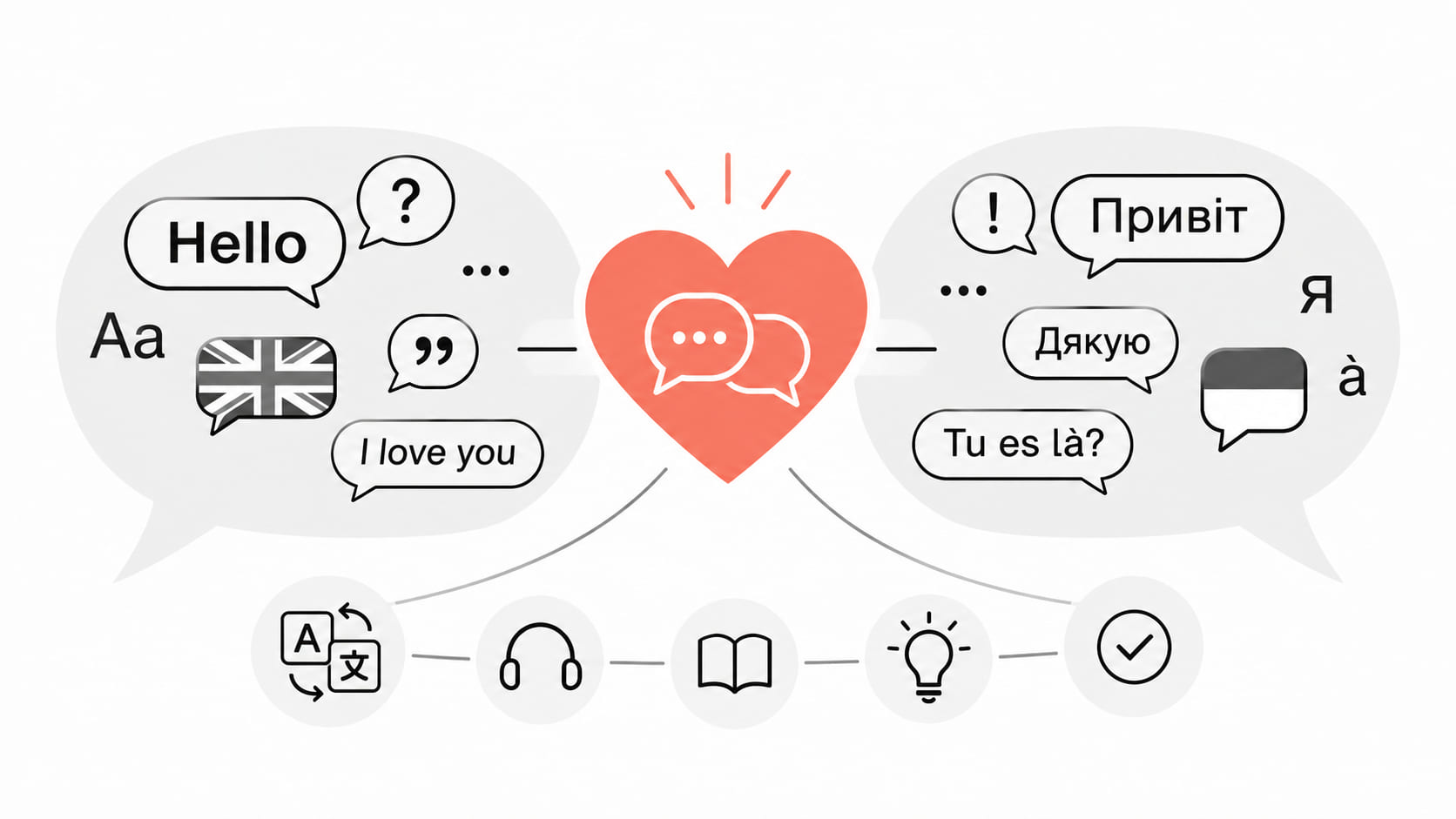
This is the closing chapter of the hub article of our Cross-Cultural Psychology & Daily Life cluster, and it deals with the smallest, most dangerous layer of intercultural life: the household default. Living with a foreign partner means two invisible rulebooks sharing one address. The skill that saves such couples is not compromise on every point — it is authorship: writing a third rulebook that belongs to neither childhood and fully to both of you.
Directness vs. Politeness (Low-Context vs. High-Context)
Anthropologist Edward Hall split cultures into two communication families, and every intercultural couple lives inside his diagram. Low-context cultures — the US, Germany, the Netherlands, the Nordics — put meaning in the words: "no" means no, "maybe" means maybe, and an invitation is a literal plan. High-context cultures — Latin America, much of Asia, and the Slavic family sphere — put meaning in tone, situation, and relationship: the words are only the visible tip of the message.
In high context vs low context culture relationships, the classic collisions look like this:
- The polite lie. Your American "Let's grab coffee sometime!" is a warm goodbye. To her high-context ear, it is a commitment — and when the coffee never happens, you have broken a promise you never made.
- The honest slap. Her Slavic "This dress does not suit you" is trust made audible: family tells the truth because strangers flatter. To your ear, trained on compliment-sandwiches, it lands as cruelty.
- The invisible no. Her "We'll see" or "Maybe" is often a gentle no, delivered to protect your face. You hear possibility, keep pushing, and accidentally commit the rudest act in her culture: forcing a direct refusal.
None of this is deception or rudeness. It is direct vs indirect communication — two honest systems producing opposite readings of the same sentence. The household fix is one question, asked early and often: "In your family, how was this usually said?" You are not learning her language here. You are learning her dialect of intent. And when the conversation happens in a second language, these mismatches multiply — which is exactly why our chapter on why fights in a second language escalate faster belongs on the same shelf as this one.
Time Perception: Monochronic vs. Polychronic
The second invisible rulebook is the clock. Monochronic cultures — Germany, Switzerland, the US professional world — treat time as a container: "at 19:00" means arriving at 18:55, and lateness is a withdrawal from the respect account. Polychronic cultures — Latin America, the Middle East, parts of Southern Europe and the post-Soviet social sphere — treat time as a flow: "at 19:00" means "in the evening, around seven," and relationships routinely outrank schedules.
Now watch this collide at a family dinner. He arrives exactly at 19:00 to her parents' home — and finds the kitchen still smoking, the hostess in an apron, and quiet panic: in her family, guests arrive "when everything is ready," which is 19:45. Next month, she arrives at his colleagues' party "at seven" — meaning 19:40 — and reads his frozen smile as oversensitivity, not as a man whose culture just watched him lose face in front of his boss.
The protocol that works is linguistic, not moral:
- Whose event, whose clock. Her family's gatherings run on her culture's time code; your professional events run on yours. Announced in advance, never argued in the doorway.
- Arrival windows replace points. "Come between 7 and 7:30" removes the ambiguity that "at 7" creates across cultures.
- Translate the lateness, not the person. Forty minutes late from a polychronic culture is punctuality in its native grammar — and your 18:55 arrival is, in hers, a mild invasion of the kitchen.
Everyday Household Friction Points
Beyond words and clocks, the third rulebook is physical: the house itself. These are the six friction points our reader couples report most often — each trivial alone, cumulative enough to produce the sentence "maybe we're just incompatible":
- Shoes at the door. Across the Slavic world, Asia, and much of Europe, outdoor shoes inside are dirt made visible; guests remove them without being asked. In many American homes, shoes travel freely from porch to sofa. The doormat becomes a border checkpoint.
- Drafts vs. sealed air. Daily window-opening ("provetrivanie") is health doctrine in Eastern Europe; sealed, climate-controlled air is comfort doctrine in the American South. Each side genuinely believes the other's habit causes illness.
- Spontaneous guests. In collectivist cultures, a relative dropping by unannounced is love in motion; calling first can read as formality. In individualist cultures, an unannounced visit is a boundary event requiring recovery time.
- Emotional volume. A Slavic or Latin family dinner at full volume signals engagement and joy; the same decibels in a Nordic or Japanese household signal loss of control. Conversely, your calm quarter-tone reads to her relatives as coldness or concealed anger.
- Mess visibility. Who "sees" the full dish rack, and when cleaning happens — before guests, before sleep, or before madness — is culturally programmed and morally charged.
- Food physics. Open shelves vs. closed cabinets, bread in the fridge or on the counter, soup as dinner or as starter: the kitchen runs on inherited law.
| Dimension | Low-Context / Monochronic Default (US, DE, Nordics) | High-Context / Polychronic Default (LatAm, Asia, Slavic family sphere) | How It Looks at Home |
|---|---|---|---|
| Saying "no" | Directly, in words | Indirectly: "maybe," "we'll see," silence | He hears "maybe" as yes; she hears his "no" as rejection of her |
| Invitations | "Coffee sometime" = friendly closing | Any invitation = a commitment | She waits for the coffee; he believes he was merely polite |
| Punctuality | 19:00 means 18:55 | 19:00 means "evening, roughly 19–20" | He is early to her parents' chaos; she is "late" to his calendar |
| Guests | Plan visits, text ahead | Relatives drop by = love | His shock at the unannounced aunt; her shock at "booking" family |
| Emotional volume | Calm = rational; loud = loss of control | Loud = engaged; calm = cold | Her family dinner sounds like a fight to him; his quiet sounds like ice to her |
| Home physics | Shoes inside normal; sealed climate | Shoes off; daily window-opening | The doormat and the thermostat become border disputes |
Case Study: The Air Conditioning War
📋 Case Study: Three Weeks of Silent Thermostat Diplomacy
Andrei (41, Chicago, raised in Kyiv) and Megan (39, raised in Houston) married in 2024 and met their first summer as a household. Andrei's doctrine: windows open every morning and every night — "the house must breathe"; sealed, recycled air was, in his childhood vocabulary, how people get sick. Megan's doctrine: AC at 70°F with windows shut — open windows meant humidity, bugs, and a bedroom that felt like neglect. For three weeks they fought without words: he opened the windows at 6 a.m.; she closed them by 8; he reopened them at noon; she discovered them at 6 p.m. and cried — not about temperature, though neither could say what about. The fridge acquired passive-aggressive notes. The war ended in a therapist's office with one sentence that rearranged the marriage: "We were never arguing about air. We were arguing about whose childhood house gets to be the default." The treaty that followed was half page long: bedroom = Megan's climate code, living room = Andrei's thirty-minute morning airing, and a new house rule neither family had ever used — "any comfort dispute gets one calm sentence before any window moves." The AC still runs. The windows still open. Nobody keeps score anymore.
Read the case again and notice the structure: the object (thermostat) was never the conflict. The conflict was two unvoiced defaults meeting without a negotiation protocol. That structure repeats in every household friction point above — which is why the fix below is not about temperature, shoes, or guests at all.
How to Build Your Own "Third Culture" at Home
Successful intercultural households stop asking "whose norm wins" and start writing a third one: the culture of this specific house, authored by two people, binding on both. The protocol takes one evening and one page:
- Inventory the defaults. Separately, each partner writes ten rules that feel "obvious" at home — shoes, windows, volume, guests, lateness, dishes, greetings, goodnight rituals. Ten minutes each, no consulting.
- Sort into three piles. Compare lists and mark every rule: keep (adopted as house law), drop (neither wants it), or merge (needs a hybrid version).
- Write five to seven house rules in plain words. Not principles — sentences: "Shoes off at the door." "Bedroom climate is Megan's zone." "Guests text before visiting, except Sunday afternoons." "Voices down after 10 p.m." "Sunday is varenyky-and-arepa day."
- Post them. One page on the fridge door. Visible law ends repetitive litigation; nobody re-argues a posted rule, they amend it.
- Review quarterly, with humor. New life stages — children, pets, in-law visits, relocations — add rules. The review dinner is where the third culture grows instead of calcifying.

The goal of a third culture is not to win the rules.
It is to own the rulebook together — so that no habit in your house ever again has the power to say "my childhood was normal, yours was wrong."
Frequently Asked Questions
What is the difference between high-context and low-context communication in relationships?
In low-context cultures (US, Germany, Nordics) meaning lives in the words: "no" means no, and an invitation is literal. In high-context cultures (Latin America, Asia, Slavic family sphere) meaning lives in tone, situation, and relationship: "maybe" often means no, and polite phrases can be social glue rather than promises. Most cross-cultural misunderstandings are collisions between these two systems.
Is my partner's lateness a sign of disrespect?
Usually not. In polychronic cultures time is a flow, and "at seven" means "in the evening around seven"; in monochronic cultures it means 18:55. The fix is linguistic, not moral: agree on arrival windows ("between 7 and 7:30") and let the host culture set the time code for family events.
How do we stop fighting about tiny household things?
Reframe first: name the habit as cultural, not personal. Then run a defaults inventory — each partner writes ten "obvious" home rules — and convert the overlaps into five to seven written house rules. Couples who write the rulebook stop defending it.
What if our habits clash on something non-negotiable, like hygiene or safety?
Third-culture building covers preferences, not values. Hygiene, safety, finances, and fidelity are values: they are discussed as non-negotiables, with compromise allowed only in method, never in principle. If a "habit" argument is really a values conflict, escalate it to a calm sit-down conversation — or a counselor — immediately.
Conclusion: The House Rules Nobody Gave You
Love signs the lease; culture decides whether the house feels like home. Every friction point in this article — the window, the shoes, the clock, the volume, the thermostat — was never about the object. It was about two people discovering that "normal" is the most culturally loaded word in any language. So stop defending your normals. Inventory them, laugh at them, merge them, and post the result on the fridge. The couples who do are not compromising their cultures. They are doing something rarer and stronger: building a new one, with two authors, one address, and a rulebook that finally belongs to both.