This is the family chapter of our cross-cultural relationships master guide (2026), and it exists because meeting foreign parents etiquette is the single highest-stakes social exam of an international relationship. Get it right and you gain lifelong allies: childcare, advocacy, a home away from home. Get it wrong and you inherit silent resistance that will surface at every future decision — weddings, visas, children, money.
If you are dating someone from a family oriented culture, understand this before you book the flight: in her world, parental approval is not an opinion. It is a social license. Couples who treat the first dinner as "just meeting the folks" arrive unprepared; couples who treat it as a diplomatic mission arrive with flowers in the right number.
Individualism vs. Collectivism: You Are Marrying the Family
In the individualist West — the US, UK, Australia, Northern Europe — the couple is the basic unit of society. Parents advise; they do not approve. An adult child can marry against parental wishes and lose nothing but a few awkward holidays.
In collectivist cultures — Eastern Europe, Asia, Latin America, the Mediterranean — the family is the unit. Marriage is not two people choosing each other; it is two systems forming an alliance. Her parents read your handshake, your shoes, your gift, and your answer to "what are your plans?" as data points in a single question: is our daughter safe with this man?
This is why the interrogation that feels rude to Western ears — salary, apartment, five-year plans — is actually care in its native grammar. A father asking about your income is not auditing you; he is checking whether his daughter will ever stand in a queue for bread. Answer concretely, without defensiveness, and you pass half the exam on the spot.
The second half is hierarchy. In a family hierarchy cross cultural marriage, age orders everything: whom you greet first (the eldest), where you sit (where the host places you), when you speak (after the elders), and whose glass you refill before your own (everyone's). None of this is written down. All of it is scored.
In individualist families, you win over two people.
In collectivist families, you join a system — and systems remember first impressions for decades.
Regional Cheat Sheet: Gifts, Dress Code, and Table Manners
Below is the compressed field manual of cultural gifts for parents and first-dinner behavior across the three regions our readers visit most. Treat it as a baseline, not scripture — every family bends its own culture slightly.
Eastern Europe (Ukraine, Poland, Moldova)
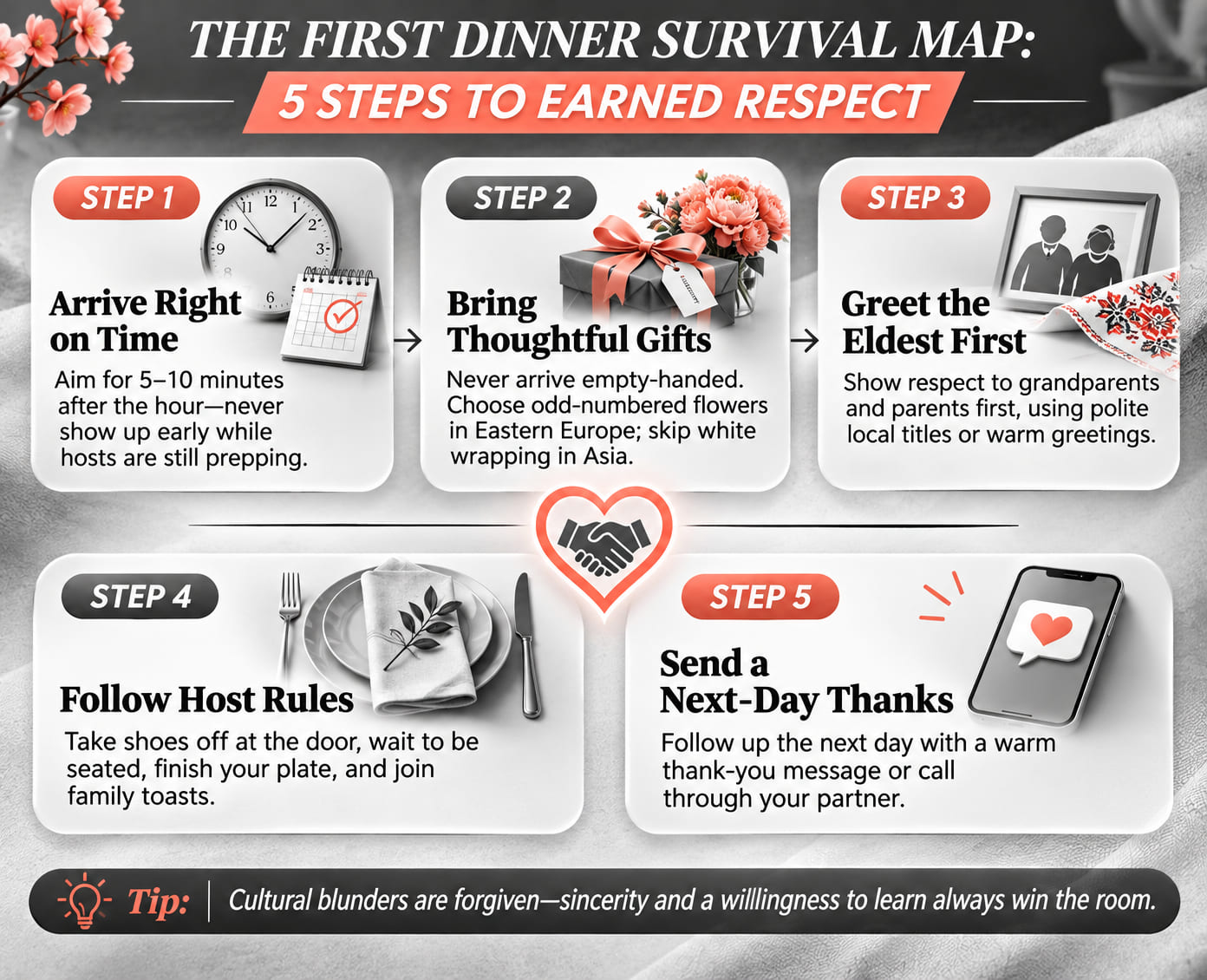
- Flowers for the mother — odd numbers only. Three, five, seven. Even-numbered bouquets are for funerals; this is the most common foreigner blunder in the region.
- Never arrive empty-handed. A cake, good chocolates, or wine for the father completes the trio with the flowers.
- Shoes off at the threshold unless firmly insisted otherwise; accept the offered slippers with a smile.
- Finish everything on your plate. Leaving food reads as rejection of the host's care; a second helping is the highest compliment available.
- Toasts are ritual. Stand for the family toast; if you don't drink, say so once and raise juice — never lecture about alcohol at a Slavic table.
- Dress: smart casual plus one notch. Overdressed is safe; underdressed is a statement.
Southeast Asia (Philippines, Vietnam, Thailand)
- Greet the eldest first, with a slight nod or bow; use titles — "Uncle," "Auntie" — even for non-relatives.
- Gifts: a fruit basket, fine sweets, or a specialty from your home country. Give and receive with both hands. Avoid white wrapping (mourning colors); choose bright paper.
- Alcohol only if you know they drink; in many households it is simply absent, and bringing it creates quiet awkwardness.
- At the table: wait to be seated and to begin; take modest portions and finish them; never point chopsticks or stick them upright in rice.
- Public displays of affection toward your partner: minimal. Holding hands in front of her parents can embarrass everyone at the table.
Latin America (Colombia, Mexico, Brazil)
- Accept the warmth. A hug or cheek kiss from her mother is a greeting, not an invasion; a handshake offered in return reads as coldness.
- Court the mother through her kitchen: compliment specific dishes and ask for the recipe — the region's highest form of respect.
- The dinner is long. Schedule nothing after it. Leaving when the food ends skips the real exam: the hours of conversation and coffee that follow.
- Gifts: dessert, wine, flowers — ideally something from your country that becomes a story.
- Dress: polished but warm; head-to-toe formal black can read as funeral-cold in a culture that dresses joyfully.
| Region | First Greeting | Best Gifts | Taboo Gifts & Acts | Key Table Rule | Dress Code |
|---|---|---|---|---|---|
| Eastern Europe | Handshake with father; kiss on cheek with mother (her lead) | Odd-numbered flowers + cake/chocolates + wine | Even bouquets; white lilies; empty hands | Finish your plate; accept seconds | Smart casual +1 notch |
| Southeast Asia | Slight bow/nod; eldest first; titles | Fruit basket, sweets, home-country specialty | White wrapping; alcohol (unless known); PDA | Wait for elders to start; both hands | Modest, neat, conservative |
| Latin America | Hug/cheek kiss — accept it warmly | Dessert, wine, flowers, story-worthy imports | Leaving early; refusing the mother's food | Stay for the after-dinner conversation | Polished, warm, colorful OK |
Case Study: How a British Guest Saved a Dinner in Kyiv
📋 Case Study: Eight Roses, One Removed Stem, and a Toast in Broken Ukrainian
Oliver (39, Manchester) flew to Kyiv to meet Iryna's parents and committed three classic errors in ninety minutes. He brought eight roses — an even number; the mother's smile froze at the doorway until Iryna quietly pulled one stem out in the hallway, whispering the rule. At the table he left half his cutlet on the plate and declined the father's first toast with a polite "I don't drink, sorry." The room went archaeological.
Then Oliver did the thing that saved the evening. He stood up, apologized in three broken Ukrainian sentences he had rehearsed on the plane, explained that in England an empty plate means "I'm still hungry" and a full one means "thank you," and asked — sincerely, in front of everyone — to be taught the rules "so I get them right next time." He raised his juice glass properly for the family toast and complimented the mother's borscht by name, twice. By 1 a.m. the father had produced homemade salo and was teaching Oliver a drinking song he would never actually use. "The mistakes were forgivable," Iryna told us later. "What won them over was that he wanted to learn instead of defending himself."
The lesson generalizes perfectly: in collectivist households, a cultural blunder costs you points; defensiveness costs you the game. Teachability converts embarrassment into respect faster than any perfect performance could.
Navigating Boundaries After the Wedding
Approval earned, you graduate from guest to family member — which sounds like a promotion and often feels like a merger. Collectivist in-laws assume access: unannounced visits, opinions on child-rearing, questions about your budget. None of it is malice; all of it can suffocate a young family if left unstructured.
The couples who keep both the marriage and the in-laws intact run five protocols:
- Gratitude first. Name the love behind the interference before limiting it: "We know you want the best for us — that's exactly why we need to decide this one ourselves."
- The united front. Every boundary is announced as "we decided," never "she wants" or "I think." A divided couple is a door; a united one is a wall with a kind gate.
- The channel rule. Each partner is the diplomat to their own parents. Sensitive topics travel through the bloodline, not the marriage.
- Scheduled closeness. Sunday calls, monthly dinners, holiday rotations — involvement planned in advance satisfies the family's need for connection and eliminates the need for ambushes.
- Hard lines, drawn once. Parenting overrides, financial demands, disrespect: addressed calmly, together, one time. Repetition erodes the line; consistency holds it.
And when the boundary conversations inevitably touch money — support expectations, loans to relatives, "just this once" emergencies — the framework from our chapter on how financial expectations differ across cultures keeps the family peace and the household budget alive at the same time.
Frequently Asked Questions
What gifts should I bring to my foreign partner's parents on the first meeting?
It depends on the region. Eastern Europe: an odd-numbered flower bouquet for the mother plus cake or quality chocolates for the table. Southeast Asia: a fruit basket or fine sweets, given with both hands; alcohol only if you know they drink. Latin America: dessert, wine, or flowers, ideally something from your home country. Everywhere: never arrive empty-handed, and avoid even-numbered bouquets and white lilies.
Is it rude if I don't speak her parents' language?
No — but effort is expected. Learn five phrases (hello, thank you, it was delicious, a simple toast, and how to address them properly). Your partner translates; your sincerity carries. Parents remember the man who tried three words far longer than the man who stayed comfortably silent.
Should I expect an interrogation about my income and intentions?
In collectivist cultures, yes — and it is care, not rudeness. Questions about your job, housing, and plans are how parents vet stability. Answer honestly and concretely, with a clear "plan story": what you do, where you live, and how your daughter fits into that future.
How soon after meeting the parents is marriage expected?
It varies. In the Philippines and much of Latin America, being introduced to parents already signals serious intent, and timelines may be assumed. Agree with your partner beforehand on what the introduction means and what you will tell the family, so expectations never collide at the dinner table.
Conclusion: The Dinner Is an Interview You Pass by Being Teachable
No checklist survives first contact with a real family: someone's uncle will break every rule in this article, and your flowers will still be slightly wrong. That is fine. What parents across every culture actually evaluate is not your performance — it is your posture. The man who arrives with gifts in the right spirit, eats what he is given, asks to be taught, and loves their daughter visibly in small gestures passes in any language. Everything else is just table manners.