This is the money chapter of our hub guide on cross-cultural relationships and daily life, and it exists because financial expectations in cross cultural relationships are rarely about amounts. They are about meanings. A remittance to her mother, a split restaurant check, a joint savings account — each is a sentence in a language each of you learned differently. This guide translates.
Here is the working principle for everything below: in mixed-culture couples, money conflicts are almost never arithmetic problems. They are unspoken-contract problems. The couple that writes the contract down — early, calmly, in numbers — wins. The couple that relies on "we'll figure it out as we go" pays interest on silence for years.
Dating Etiquette: The 50/50 Rule vs. Traditional Chivalry
Start with the first date, because it is where the mismatch detonates earliest. In the US, Canada, Northern Europe, and Australia, offering to split the bill is a respect signal: it acknowledges her autonomy and refuses to purchase obligation. Many Western women genuinely prefer it, and many Western men have been taught that reaching for the whole bill is patronizing.
Now land that same gesture in Kyiv, Bogotá, or Manila. In traditional dating cultures, the man paying is not a purchase and not a power move — it is a declaration of serious intent and capability: "I can provide, I am here for more than coffee." When he offers to split, she does not hear "equality." She hears: "I am not investing in this," or worse, "I cannot afford to be here." The research on paying on dates different cultures shows the same pattern repeating across Eastern Europe, Latin America, and Southeast Asia: the bill is a proxy for intention.
And her acceptance of your payment is not greed — it is allowing you to play your part. Refusing to let her contribute can feel as rude to her as her refusing your payment feels to you.
The practical bridge, date by date:
- Dates 1–2: pay gracefully, without ceremony or commentary. Do not perform generosity; simply handle it.
- Dates 3–5: let reciprocity appear in her currency — she covers dessert, brings wine, plans an outing. Acknowledge it warmly; that is her half of the dance.
- By date 5: say the sentence out loud: "In my culture we often split — I'd love to know what feels right to you." One question, asked once, prevents a decade of quiet scorekeeping.
Household Budgets Across Cultures
Move in together, and the second script activates: how a household holds its money. Three dominant models exist, and each feels like "normal" to the people raised inside it.
The joint pot. All income merges into one family budget, frequently managed by the wife — the classic Eastern European arrangement where "family money" is a moral unit and separate accounts read as secrecy. The separate-accounts model. Each partner keeps income distinct and an agreed share to common costs — the Northern European and urban-Western default, where autonomy is love's proof. The provider model. The man covers the base (housing, utilities, major costs); her income remains hers for personal and discretionary spending — common across Latin America, parts of Asia, and Gulf-adjacent cultures.
| Region | Default Date-Paying Norm | Typical Household Model | View of Separate Accounts | Classic Friction Point |
|---|---|---|---|---|
| West (US, CA, UK, Nordics) | Split or alternate; equality signal | Separate accounts + shared costs | Healthy, standard | Partner reads separation as emotional distance |
| Eastern Europe | Man pays; serious-intent signal | Joint pot, often wife-managed | Suspicious: "what is he hiding?" | Western partner feels loss of financial autonomy |
| Asia (PH, VN, CN) | Man pays; provider proof | Joint pot or provider model | Unusual before marriage | Remittances to parents seen as "leak" by Western partner |
| Latin America | Man pays; chivalry baseline | Provider model with shared extras | Rare, sometimes offensive | Extended-family obligations vs. couple-first budgeting |
Notice what the table does not contain: a best model. There isn't one. The predictor of failure is not which system you choose — it is choosing nothing and discovering your defaults differ during a fight.
Supporting Extended Family (Understanding Filial Piety)
Now the third script, and the most explosive: sending money to partner family. In the Philippines, remittances are not a family habit — they are a national institution, and a daughter's monthly transfer to her parents is honor made visible. Across Latin America, Asia, and much of Eastern Europe (where state pensions barely cover medicine), adult children supporting parents is a sacred, lifelong obligation known in Confucian cultures as filial piety. Entering a filial piety marriage means marrying a budget line that existed before you and will exist after any argument about it.
Western partners typically experience this as a leak: unstructured, unquantified, discussed only when it hurts. Her experience of the same transfers is identity: "They raised me; now I hold them." Both are true. Neither is a financial argument — which is exactly why financial arguments about it go nowhere.
The critical skill is distinguishing duty from exploitation. Four tests separate them:
- Disclosure: cultural support is open and explainable; abuse hides transfers until they surface as surprises.
- Sustainability: duty fits inside a percentage of income that leaves your shared goals intact; abuse escalates until the household itself is at risk.
- Request vs. demand: duty asks and accepts "not this month"; abuse attaches guilt, ultimatums, or invented emergencies.
- Timing: family support begins in established relationships. Recurring cash requests before you have even met in person are not culture — they are romance scam red flags, full stop.
Culture explains why the transfer exists. Transparency decides whether it strengthens or corrodes the marriage.
The amount is rarely the problem. The silence around it always is.
Case Study: Setting a "Family Support Cap" Without Resentment
📋 Case Study: The $400 Line That Saved a Marriage
Jason (47, Toronto) and Liza (35, Cebu) married in 2024. From month one, Jason watched irregular transfers leave their joint account: $300 for her mother's hypertension medicine, $450 for a nephew's tuition, $600 for roof repairs after a storm. Nothing was hidden — but nothing was planned, either. By month eight, Jason felt like an ATM with no vote; Liza felt surveilled in the most sacred duty of her life. The fights were never about money. They were about who decides.
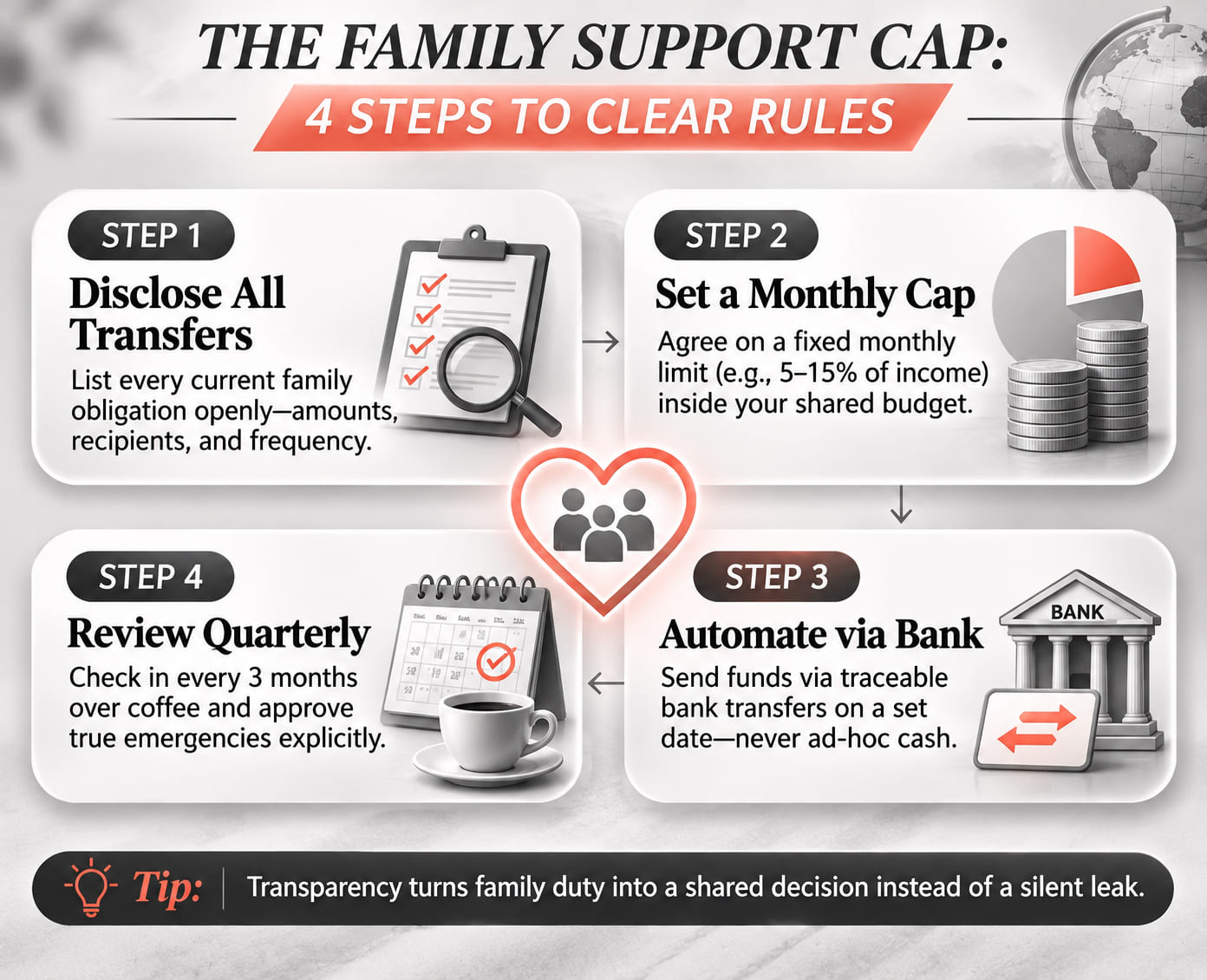
Their fix became a household institution: the Family Support Cap. One evening, with paper and no accusations, they listed every transfer of the past year, then agreed: a fixed $400 per month inside the joint budget, bank transfers only (never cash, always traceable), emergencies handled as separate, explicitly approved line items — and a quarterly 20-minute review over coffee. When a typhoon hit Cebu fourteen months later, the exception took four minutes to approve because the rule already existed. "The cap didn't make me less generous," Jason told us. "It made my generosity a decision instead of a leak. And it gave Liza something better than money: certainty."
How to Have "The Money Talk" Before Marriage
Every couple in this article that thrived did one thing early: they converted silence into sentences. Here is the five-question protocol — answer separately, in writing, then compare over a calm dinner:
- Which budget model feels like "home" to you? Joint pot, separate accounts, or provider model — and what did your parents run?
- What family support currently exists, and what is the five-year expectation? Names, amounts, frequencies, and the events that would change them.
- What purchase threshold requires joint approval? Pick a number. Anything above it gets a conversation first.
- What does debt mean to you? A normal tool, a necessary evil, or a moral failure? Neither answer is wrong; mismatched answers are landmines.
- If one of us loses income tomorrow, what changes first? The order of cuts reveals the hierarchy of values better than any love letter.
Two rules make the talk safe: schedule it neutrally (never right after a transfer or a bill), and ban the words "your culture" as an accusation — culture explains, it does not excuse.
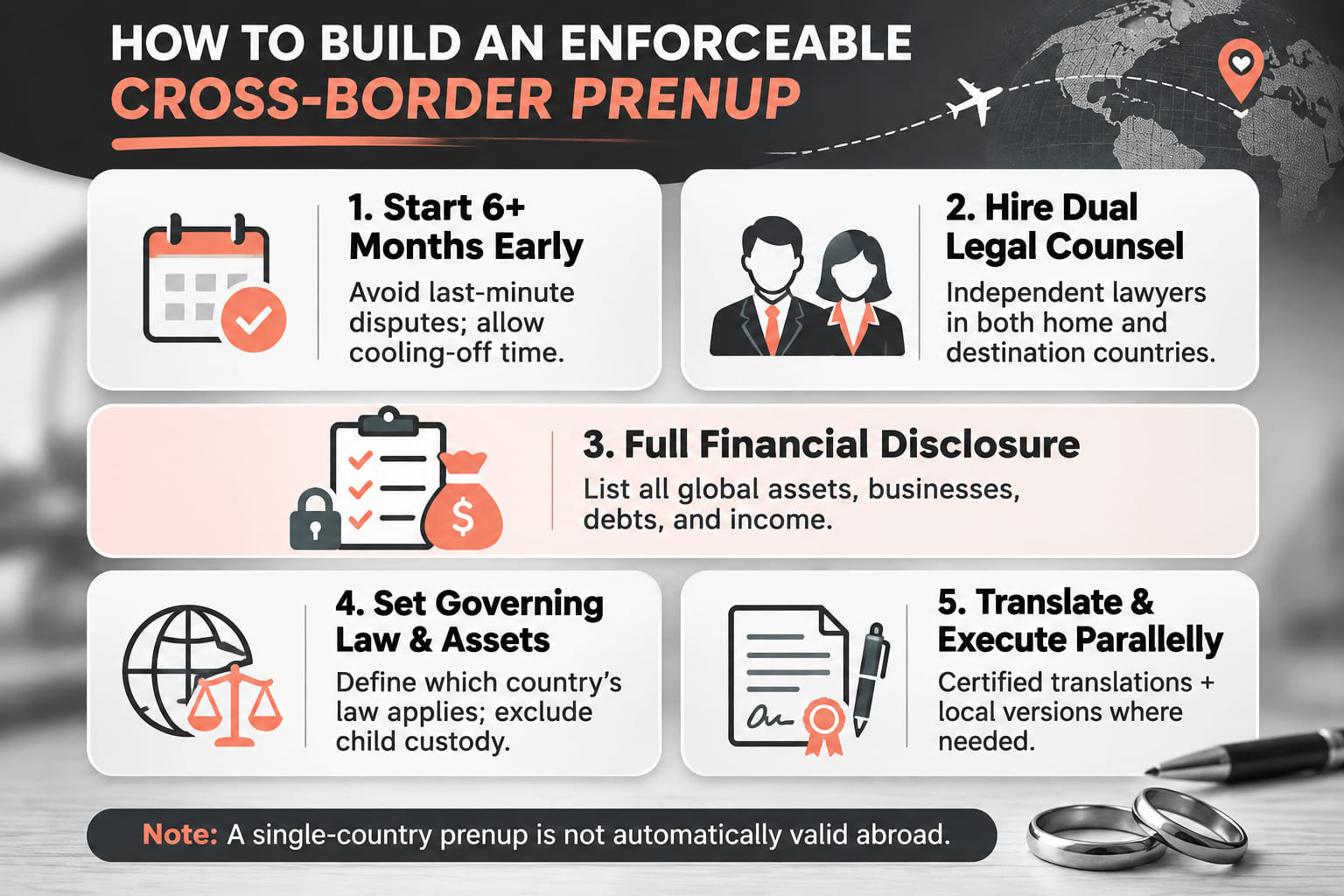
And when assets, businesses, or children from previous relationships enter the picture, this conversation deserves a legal wrapper. Understanding how an international prenuptial agreement protects both partners reframes it correctly: a prenup is not distrust of her — it is this exact money talk, written down while everyone still likes each other.
Frequently Asked Questions
Is it offensive to offer to split the bill on a first date with a Ukrainian or Colombian woman?
Not offensive, but often misread. In many traditional dating cultures the man paying is a signal of serious intent and capability, so offering to split can be interpreted as lack of interest. The graceful move: pay the first bill without ceremony, let her reciprocate in her own way, and discuss preferences openly by the third or fifth date.
How much money is normal to send to a partner's parents?
There is no universal number. In remittance cultures a fixed, disclosed amount — often in the range of 5–15% of household income — is considered normal and honorable. What matters is not the size but the transparency: agreed together, documented, and sustainable without endangering your shared goals.
Should I financially support my girlfriend's family before marriage?
Pre-marriage support is a generous choice, never an obligation. Occasional gifts are courtship; recurring cash transfers before you have even met in person are a classic romance scam red flag, not a cultural norm. Culture begins where transparency begins.
What if her parents expect the couple to live with them?
Multi-generational living is normal across Latin America, Asia, and parts of Eastern Europe. Decide it early and in writing: duration, privacy rules, and the household's financial contribution. Couples who postpone this conversation inherit it as a crisis later.
Conclusion: Money Is a Dialect — Write Your Own Dictionary
No culture owns the correct way to hold money in a marriage. What every culture owns is the illusion that its way is simply "normal." The couples who thrive across borders treat money the way they treat language: as a dialect to be translated, checked, and occasionally laughed about. Pay the first bill gracefully. Name the remittance before it names you. Write the cap, the threshold, and the five answers down. Do that, and your budget stops being a battlefield — it becomes what it was always meant to be in a family: a shared map, drawn by two hands.