This is the traditions chapter of the central hub of our cross-cultural relationships cluster, and it treats interfaith relationship challenges the way engineers treat load-bearing walls: identify them early, reinforce them deliberately, and never remodel in a hurry. The good news first: mixed-culture households that survive the first three Decembers usually emerge with something rare — a family culture of their own, richer than either original.
The practical interfaith marriage tips below are organized the way real conflicts arrive: calendar first, kitchen second, children third. Each layer has its own rules, its own table, and its own failure mode.
Merging Two Calendars Without Burning Out
Every culture runs on a hidden operating system of sacred dates, and cross cultural holiday traditions collide the moment two systems boot on one household. A Western couple argues about whose family gets Christmas Day; an intercultural couple first discovers that Christmas itself is two different days — December 25 on the Gregorian calendar, January 7 on the Julian one used by Orthodox churches in Ukraine, Serbia, and elsewhere. Easter drifts apart by one to five weeks. Lunar New Year ignores the Christian calendar entirely. Ramadan moves eleven days earlier every year. Thanksgiving belongs to no religion at all — which, as we will see, makes it priceless.
Mixed households that thrive use exactly three strategies, and choose consciously between them:
- Celebrate both (addition). Two Christmases, two Easters. More cost, more cooking, double the joy for children. Works when both partners view holidays as family culture rather than exclusive truth.
- Alternate (rotation). This year his calendar, next year hers. Fair, cheap, and quietly corrosive if one side always gets the "off" years of the children's memories. Use with caution.
- Hybridize (invention). Build a new family tradition that belongs to neither origin: a fusion dish, a custom date, a ritual of your own. The strongest long-term option — but it requires the first two years of trial and error.
| Celebration | Typical Dates | Origin | Common Mixed-Household Compromise |
|---|---|---|---|
| Christmas | Dec 25 (Gregorian) / Jan 7 (Julian) | Western vs. Eastern Christian | Celebrate both: Dec 25 as "Western Christmas," Jan 6 evening as the Holy Supper; or alternate family visits by year |
| Easter | Movable; often 1–5 weeks apart | Gregorian vs. Julian computus | Two festive dinners; children get two egg hunts; joint family call on the later date |
| Lunar New Year | Late Jan – Feb (movable) | Chinese, Vietnamese, Korean | Adopt as a "bonus" celebration: red envelopes, family dumplings, no conflict with Christian dates |
| Ramadan & Eid | Movable (lunar year) | Muslim | Fasting partner sets the household rhythm: no daytime eating in shared spaces; Eid becomes the big joint feast |
| Thanksgiving | 4th Thursday of November | Secular American | The perfect "third culture" holiday: no religious owner — invite her family and add her dishes to the table |
| Civic & family days | Fixed (e.g., Aug 24, national holidays) | Cultural, not religious | Celebrate lightly at home: a flag-colored dessert, a video call with her relatives |
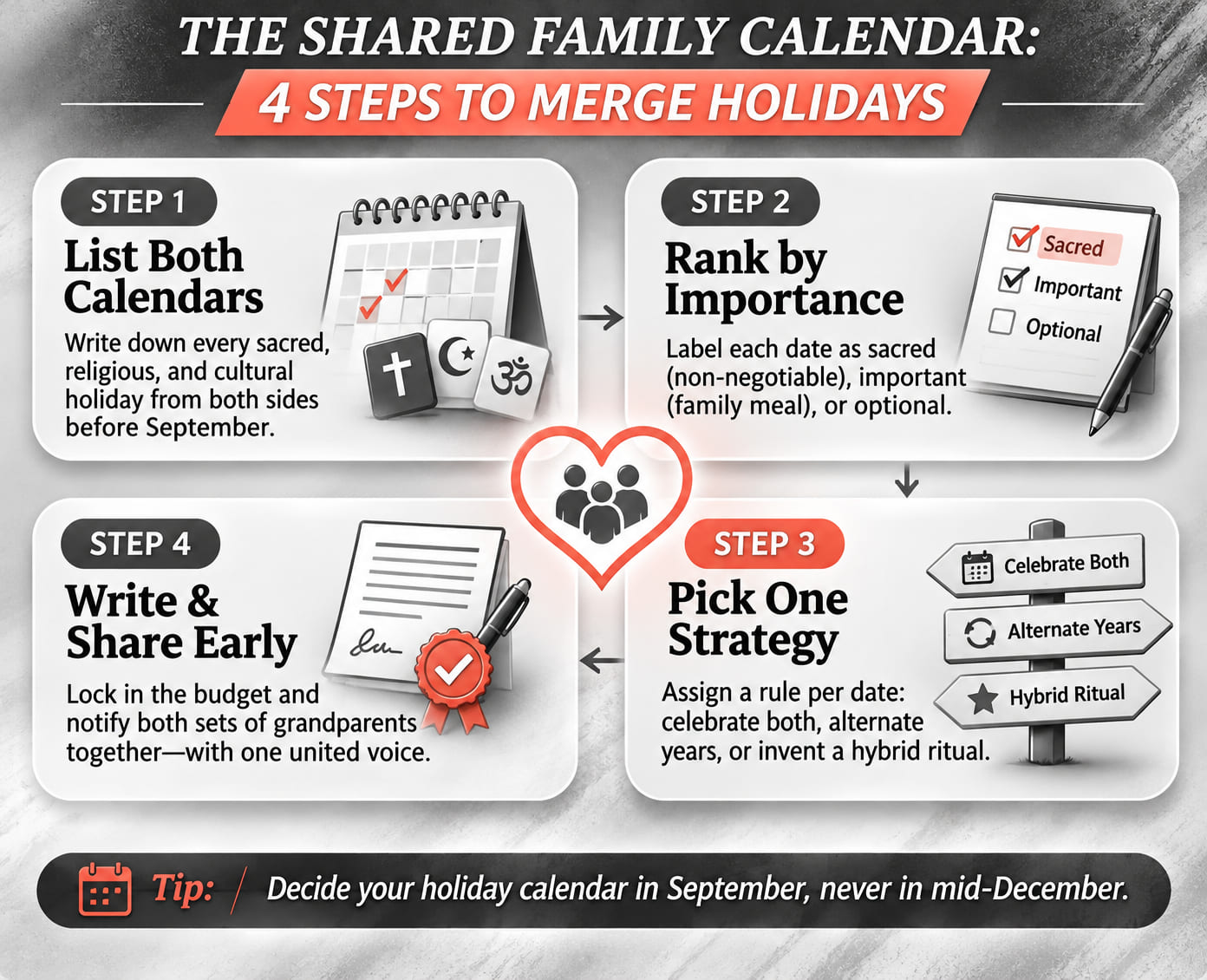
The one rule above all rules: decide in September, not in December. Calendar conflicts negotiated during the season itself always end with someone crying near a tree.
Food, Alcohol, and Dietary Boundaries at Home
The kitchen is where theology becomes logistics. Mixed households manage three overlapping systems: dietary law, fasting seasons, and hospitality culture.
Dietary law is the easiest layer when handled physically: halal, kosher, or vegetarian households solve it with zones — separate shelves, separate cutting boards, sometimes separate pots. The rule is not "convert the kitchen," it is "never make her police your plate."
Fasting seasons are the middle layer, and the most misunderstood. When an Orthodox partner fasts before Easter or Christmas, or a Muslim partner keeps Ramadan, the non-fasting partner's job is not to join and not to comment — it is to adjust the shared space: no demonstrative daytime eating, dinner scheduled after sunset, the fasting partner's menu planned with the same care as your own.
Hospitality culture is the deepest layer. In Slavic, Middle Eastern, and Latin households, a guest who leaves hungry has been insulted; portion abundance is love made visible. In Northern European and American households, forced feeding reads as boundary violation. The compromise that works: the host culture rules when her family visits; the guest culture rules when yours does; and both are explained to the guests in advance, with humor, by your partner — never by you.
And alcohol: wine-with-dinner cultures and dry households can share one roof peacefully if the rule is explicit — what is served, where it is stored, and what happens when relatives from the "toast culture" arrive. Silence on this topic is not neutrality; it is a deferred argument.
The Biggest Test: Raising Children in Two Cultures
Children convert abstract differences into concrete decisions, and every decision has a deadline. Raising kids in two religions forces three conversations that cannot be postponed:
The name. It must survive both languages: pronounceable by her mother and his colleagues, with no unfortunate meanings in either tongue. Many couples choose a name with natural variants — Sofia/Sophie, Ivan/John, Maria/Mary — giving the child a bridge built into their identity.
The rites. Baptism, naming ceremony, aqiqah, or none at all — this decision must be made before pregnancy, not in a hospital corridor with both sets of grandparents present. If one faith requires the rite and the other forbids it, the compromise is usually sequence and ownership: the rite of the believing parent's family is performed, the other family's blessing ritual follows, and neither is framed as "winning."
The teaching. The evidence-backed approach is heritage literacy without competition: children learn both traditions as history and belonging — stories, songs, fasts, feasts — and are allowed to choose their practice as adults. The same logic governs language: the "one parent, one language" method gives each child two native tongues and two cultural doors, provided neither parent sabotages the other's hour. Our language chapter explains how to keep both tongues alive under one roof without turning dinner into a classroom.
Children are never confused by two traditions.
They are confused only by parents who compete over them. Present duality as abundance, and it becomes exactly that.
Case Study: Two Christmases and One Kitchen in Chicago
📋 Case Study: The December That Nearly Broke Them — and the Treaty That Saved Them
Daniel (41, Chicago, raised Irish-Catholic, now secular) and Yulia (33, Kyiv, practicing Orthodox) married in June and met their first December as a household. Daniel put the tree up on December 1, as his childhood demanded. Yulia went quiet: in her world December is Advent — fasting weeks before the January 7 Christmas — and a tree before New Year felt like celebrating someone else's life. The kitchen followed: her lenten suppers of beans and beetroot against his family's expectation of a ham-and-whiskey Christmas dinner. By December 26 the silence in the apartment had its own weather system.
The reset came in January, over paper and tea: the Two-Christmas Treaty. December 25 became "Western Christmas" — tree, ham, carols, his side of the family. January 6 evening became Sviata Vecheria — the Holy Supper with twelve lenten dishes, no tree but a didukh wheat sheaf, her side on video call from Kyiv. During fasts, her fasting pots got their own shelf, and Daniel stopped eating ham "for visibility" in shared space. And one hybrid was invented purely for fun: varenyky — Ukrainian dumplings — served at Thanksgiving, a holiday with no religious owner. Both grandmothers now claim, competitively, to have invented the tradition. "We didn't split the holidays," Yulia laughs. "We doubled them. Our son believes every family gets two Christmases — and honestly, who are we to tell him otherwise?"
Four Questions to Agree On Before Engagement
Every couple in this article that thrived answered these four questions in writing before the ring, not after the first crisis:
- Which holidays are non-negotiable for each of us — and what exactly are we celebrating: the faith or the family? Belonging and belief are different loads; most conflicts dissolve when one partner admits their Christmas is about their grandmother, not their theology.
- Which rites will our children receive — baptism, naming ceremony, or none — and who decides, and when? The answer must exist before pregnancy. "We'll see later" is a loan taken at predatory interest.
- What will our children be taught about both heritages, in which language, and by whom? A one-paragraph faith-literacy plan prevents a decade of improvised contradictions.
- How will we announce our decisions to both sets of parents — together, in one voice? A united script stops grandparents from applying the oldest pressure in history: divide, then persuade.
Write the answers down. Not as a contract — as a memory. In year six, at 11 p.m. on December 23, with two families on the phone and a child asking why Santa comes twice, that page will feel like a love letter.
Frequently Asked Questions
Can an interfaith marriage work long-term?
Yes. Long-term success in interfaith couples correlates not with shared belief but with shared agreements: how holidays are celebrated, which rites children receive, and how decisions are announced to both families. Couples who make these agreements before crises thrive as well as same-faith couples.
Whose Christmas do we celebrate in a mixed marriage?
You have three workable options: celebrate both dates (December 25 and January 7), alternate years between families, or build a hybrid tradition of your own. The only failing strategy is deciding in mid-December — the agreement must be made before the season begins.
Do I need to convert to marry my partner?
It depends on the denomination. Most mainstream Christian churches marry mixed couples without conversion, though some branches require it or require a promise about children's upbringing. Civil marriage sidesteps the question entirely. Discuss expectations with both families early — surprises here are expensive.
How do we raise kids in two religions without confusing them?
Teach both heritages as history and belonging, not as competing truths. Consistency matters more than quantity: fixed rituals, honest answers, and no parental competition. Children handle duality well when parents present it as abundance; they struggle when parents present it as a contest.
Conclusion: One Home, Two Calendars, Zero Competition
An interfaith home is not a compromise between two pasts. It is a third culture, written in real time by two authors who never fully agree — and never stop co-signing. Keep the calendar decided in September, the kitchen zoned with respect, the children's heritage taught as abundance, and the grandparents addressed in one voice. Do that, and your house will hold more holidays than either of you grew up with — and every one of them will be yours.