This is the relocation chapter of our seven-chapter cross-cultural relationships guide, written for the partner who stayed home: you. Expat spouse homesickness is real, measurable, and — here is the good news — largely logistical. Helping your spouse adjust to a new country is not about grand gestures; it is about restoring, one by one, the things relocation took from her: mobility, income, community, and identity.
The Four Stages of Partner Relocation
Relocation psychology follows a remarkably consistent curve across cultures and countries. Knowing which stage your household is in converts panic into patience:
| Stage | Typical Timing | What She Feels | What You See | Best Support Move |
|---|---|---|---|---|
| 1. Euphoria | Weeks 1–8 | Adventure, gratitude, dopamine; everything is new and photogenic | A honeymoon partner; plans for everything | Enjoy it — but start building structures now, while energy is high |
| 2. Shock & Regression | Months 3–9 | Irritability, tears, nostalgia, anger at the host country — and at you | Mood swings, withdrawal, "why did we do this?" | Do not take it personally. Restore mobility, money, and community (see protocol below) |
| 3. Adjustment | Months 9–18 | First routines, first local friends, language confidence returns | Laughter comes back; she leaves the house alone | Amplify wins: celebrate small victories loudly, delegate household authority |
| 4. Integration | Year 2+ | Bicultural identity; "home" means two places | She mentors newcomers; hosts her parents confidently | Protect both roots: annual visits, her language at home, dual traditions |
The regression stage is not evidence that the marriage failed.
It is evidence that the relocation is proceeding exactly as psychology predicts. Couples who know the map stop blaming each other for the terrain.
The "Golden Cage" Syndrome (Why Comfort Isn't Enough)
Here is the mechanism most loving husbands miss completely. You worked hard to give her a safe house, a full fridge, and peace after years of uncertainty. She looks around the same house and sees something else: a cage lined with gold. Because comfort was never the missing ingredient — agency was.
Within her first year, a relocated partner typically loses, all at once:
- Professional identity: her degree, license, or certification does not transfer; the engineer becomes "the wife";
- Mobility: no driver's license valid in your state, no car, no ability to leave the house without asking;
- Income: on the US K-1 route, legal work is impossible until the Employment Authorization arrives — months of enforced financial dependency, a structural flaw we analyze in detail when explaining why the K-1 work-permit waiting gap shapes her first year;
- Community: the friends, cousins, and colleagues who knew her before she was yours;
- Status: at home she was the daughter who helps; here she is the newcomer whose grammar gets corrected.
Now add the humiliation math: a woman who managed her own budget at 32 must ask her husband for grocery money at 34. Every request, however kindly you answer it, deposits a grain of resentment. This is the engine of relocation depression marriage counselors see most often — and it runs on logistics, not on lack of love.
Comfort without autonomy is confinement. The fix is not more comfort. It is more control.
What the Local Partner Can Do (Actionable Support)
The support protocol below is assembled from relocation therapists and from couples who crossed the regression stage without losing each other. Order matters:
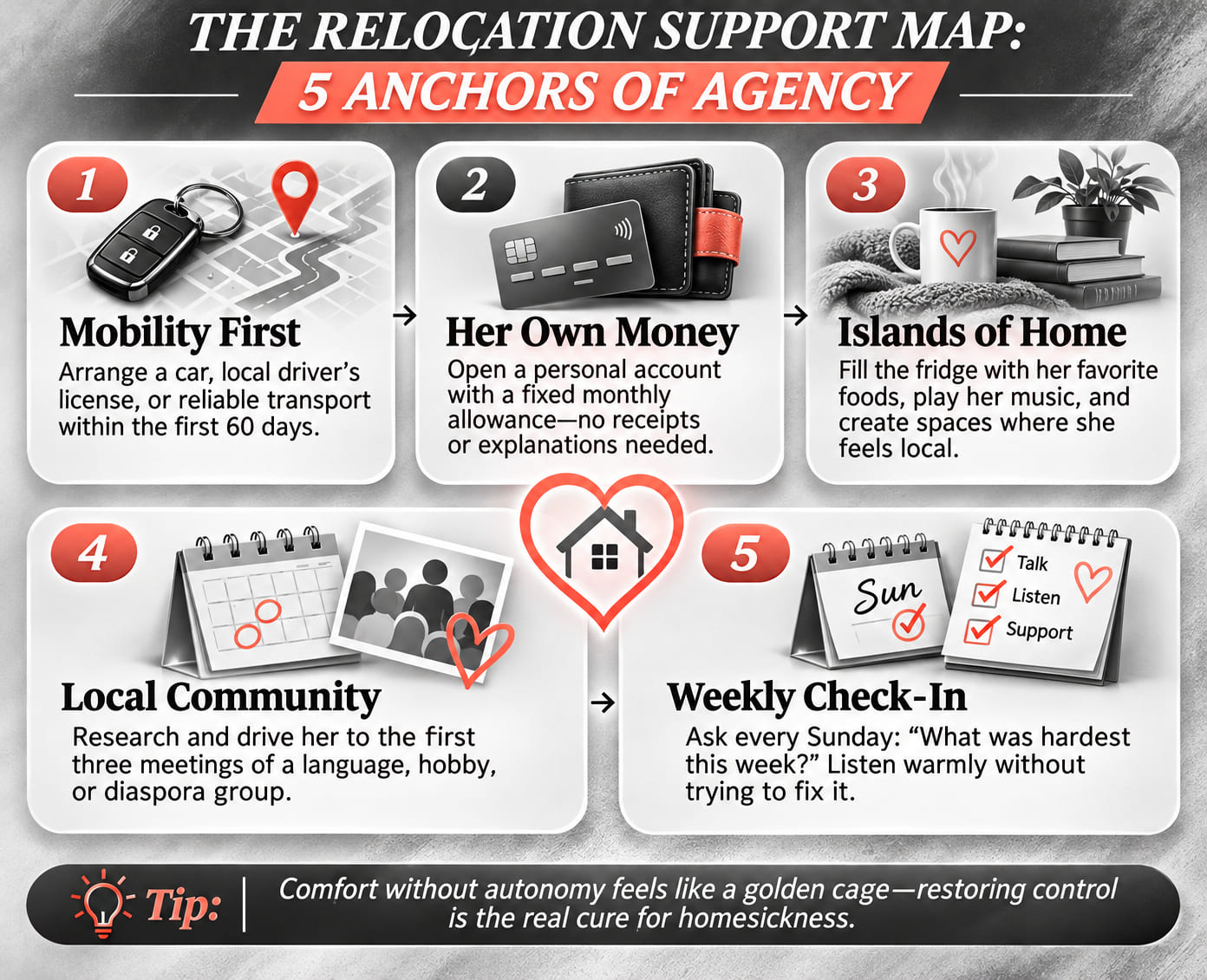
- Mobility first. Car, license, or a guaranteed ride network within the first 60 days. A woman who can leave the house alone is a different psychological person than one who cannot.
- Her own money from day one. A personal account with a fixed monthly amount she never has to justify. Not "family money" — hers. Autonomy in pocket precedes autonomy in spirit.
- Islands of home. Her food in the fridge, her music in the kitchen, her corner with her things, her radio station on preset one. The house must contain at least three rooms where she is the local, not the foreigner.
- Community onboarding, first three appointments together. You research and drive her to: a diaspora or language group, a hobby club, a volunteer slot. Attend the first meeting of each with her, then disappear. Handover, not abandonment.
- Language environment without correction. Never fix her grammar in public or in front of friends. Low-stakes practice (cashiers, neighbors, parents at the park) builds confidence faster than any course.
- The weekly check-in question. Every Sunday: "What was the hardest part this week?" Listen without solving. Fixing is for Mondays; Sundays are for witnessing.
- Shield her from your family's advice. Well-meaning relatives will diagnose her within a month. One calm sentence from you — "She is in the normal adjustment stage; we have it handled" — closes the topic permanently.
Case Study: Six Months of Tears in Suburban Texas
📋 Case Study: The Pantry, the Car Keys, and the Arepa Sundays
Chris (46, Plano, Texas) married Valentina (33, Medellín) in 2024 and brought her home on a K-1 visa. The house was beautiful. The silence was lethal. Plano is a car city; Valentina had no license and no work permit. Her English was professional-grade on paper and useless at the neighborhood small talk that fills a suburban day. By month four she cried daily — in the pantry, with the door closed, so Chris wouldn't hear. Chris, wounded, read it as ingratitude: "I gave her a house, safety, everything." The marriage survived the year only because a therapist named the pattern in session two: her grief was logistical, his defense was moral.
The turnaround was unromantic and precise. Chris bought a used sedan and paid for driving lessons in month five. He opened a personal account with $600 a month and one rule: never explain a purchase. Valentina joined a Colombian community group in Dallas (first meeting: Chris drove her and waited in the café across the street) and, the day her EAD arrived, restarted her graphic-design freelance with two former clients. At home, two rituals anchored her: Colombian radio in the kitchen every morning, and "arepa Sundays" where she cooks and teaches Chris's family Spanish words for everything on the table. By month fourteen she had three local friends, four clients, and a driver's license she frames jokingly as "my real green card." "I didn't stop loving him in that pantry," she told us. "I stopped being anyone. He gave me back a car, a card, and a community — and I gave him back his wife."
Red Flags of Clinical Relocation Depression
Adjustment pain is normal. Clinical depression is a medical condition, and the two require different responses. Watch for these markers — especially in combination, and especially beyond six to eight weeks:
- Persistent anhedonia: nothing brings pleasure, not even video calls with her mother or her favorite dishes;
- Sleep and appetite disruption: insomnia or sleeping 12+ hours; eating almost nothing or compulsively;
- Total withdrawal: refusing community invitations she previously accepted, stopping language classes mid-course;
- Hopeless language: "nothing will ever get better," "I ruined my life," "you'd be happier without me";
- Substance use as a daily coping mechanism;
- Any mention of self-harm — treat as an emergency, same day, no exceptions.
Your role at this stage is not therapist but bridge: find a telehealth specialist who works in her native language (stigma and vocabulary both shrink dramatically), make the first appointment together, drive or sit nearby, and frame it as strength: "You carried us across an ocean. Let someone carry you for an hour a week." Couple counseling is a support tool here, not a verdict on the marriage.
Frequently Asked Questions
How long does culture shock last after marriage immigration?
The acute phase typically peaks between months 3 and 9 after the move. Most partners reach adjustment by months 12–18 and full integration by year two or three. Timelines shorten dramatically with three factors: a car or independent mobility, a local community, and a path back to professional work.
Is it normal for my spouse to cry daily in the first months after relocation?
Within the regression stage (months 3–9), frequent tears, irritability, and nostalgia are normal and expected. The line to watch: if daily crying persists beyond six to eight weeks together with sleep or appetite changes, withdrawal, or hopelessness, screen for clinical depression rather than treating it as "just adjustment."
Should I push my partner to socialize even when she doesn't want to?
Use gentle structure, not force: arrange the first three appointments (community group, language class, hobby club), drive her there, then step back. Small consistent steps beat big pushes. Isolation feeds on avoidance; every attended meeting shrinks it a little.
Can online therapy in her native language really help?
Yes — often it is the fastest route. Telehealth therapists from her home country remove the language barrier and much of the stigma, and sessions fit around childcare. Combine it with local support: therapy stabilizes, community integrates.
Conclusion: The Visa Brings Her Home. Only You Can Make It a Home.
No embassy stamp can grant what relocation actually requires: the daily, unglamorous restoration of a person's control over her own life. A car key, a personal account, a radio preset, a seat at a community table, a Sunday question asked without fixing — these are the real immigration documents of the heart. Walk her through the four stages with the map in hand, protect her agency like you protected her visa, and the woman who cried in the pantry will become the woman who shows the next newcomer where to buy the good coffee. That is not just adjustment. That is arrival.