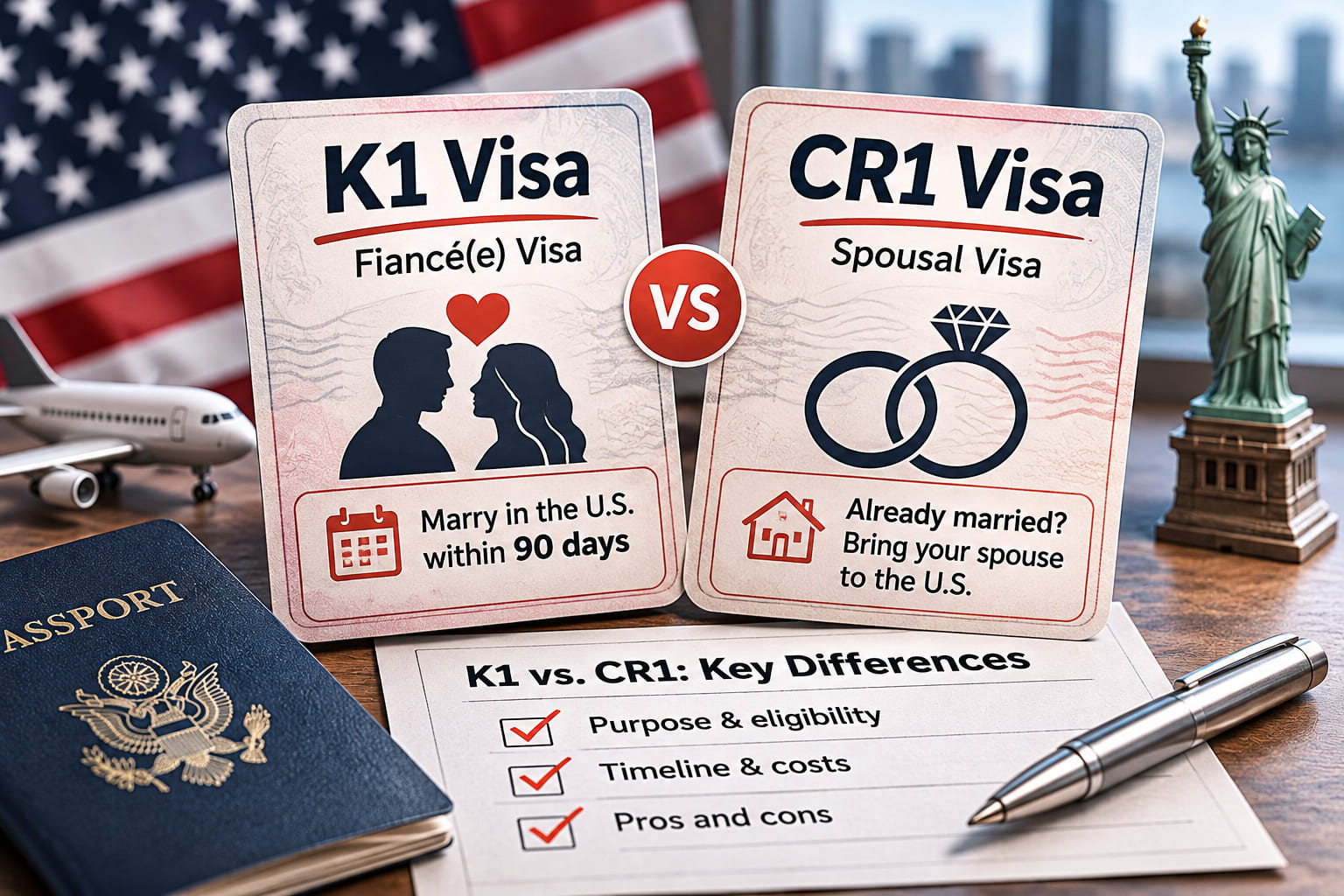
If you are a US citizen planning a life with a foreign partner, every spreadsheet and late-night forum thread eventually collapses into one question: the K1 vs CR1 visa dilemma. Which petition do you file today? This article is part of our complete International Marriage and Immigration Guide, and it answers that question with 2026 processing data, true fee totals, and a real couple's story — including the eight months of income their "fast" route quietly erased.
Framing the US fiance visa vs spouse visa decision as "which is faster?" is the first mistake. The honest framing is: faster at what? Entry? Work authorization? The green card? Total cost? The two routes win at different stages — and your household's finances and tolerance for separation decide the winner.
The Core Difference: Marry First or Move First?
Every distinction between the two visas flows from a single structural fact: the order of the wedding and the move.
The K-1 is a nonimmigrant fiancé visa. You, the US citizen, file Form I-129F before you are married. Your partner enters the United States on the condition that you marry within 90 days. Only then does the second act begin: Form I-485 (Adjustment of Status), together with the I-765 work permit and I-131 travel document applications. Until that paperwork matures, your spouse lives in a legal in-between: present, married, but not yet a resident and not yet employable.
The CR-1 is an immigrant visa for people who are already married. You wed first — at home, in her country, or in a neutral jurisdiction — then file Form I-130. When the consular process ends, your spouse enters the United States as a lawful permanent resident: green card in the mail, work rights from the first hour, freedom to travel. (Married two years or more at entry? The visa becomes an IR-1 and skips the conditional-residence stage entirely.)
So the K-1 front-loads the reunion and back-loads the bureaucracy. The CR-1 front-loads the bureaucracy and back-loads nothing. Everything below is footnotes to that sentence.
K1 vs CR1 Visa: The 2026 Comparison Table
Here is the entire decision compressed into one scannable view. All ranges reflect typical 2026 service-center and consular pipelines.
| Criterion | K-1 Fiancé Visa | CR-1 Spouse Visa |
|---|---|---|
| When you marry | After entry, within 90 days | Before filing, anywhere legal |
| Time to US entry (2026) | 12–15 months | 18–24 months |
| Status at entry | Nonimmigrant fiancé | Lawful permanent resident (conditional if marriage <2 yrs) |
| Right to work | Not until the EAD approves — typically 4–8 months after the AOS filing | Immediately, from day one |
| International travel after entry | Restricted until Advance Parole approves | Unrestricted with the green card |
| Green card arrives | 10–18 months after entry (AOS approval) | At entry |
| Approx. total government fees | $2,200 – $2,900 (including post-arrival AOS/EAD) | $1,200 – $1,800 |
| Paperwork stages | Two (visa + adjustment) | One (visa), then I-751 if conditional |
| Ideal for | Couples who want a US wedding and can absorb a single-income gap | Couples who need dual income, travel freedom, or are already married |
K1 Visa Processing Time 2026: Where the Months Actually Go
Processing snapshots change quarterly, but the 2026 shape of the pipeline is stable. For the K-1: Form I-129F adjudication runs roughly 8–12 months depending on the service center, followed by 2–4 months of National Visa Center routing, medical examination, and embassy interview. Realistic entry: 12–15 months from filing.
For the CR-1: Form I-130 takes about 12–16 months, then 3–6 months of consular processing. Realistic entry: 18–24 months.
Now the twist beginners miss. The K-1's winner's circle is only the entry. After the wedding, the Adjustment of Status stage adds another 10–18 months before a green card exists — and during that window your spouse's work and travel permissions depend on separate approvals. The CR-1 holder receives the green card at the airport. Measured start-to-green-card, the "slower" visa frequently finishes first.
The K-1 wins the sprint to the doorway. The CR-1 wins the marathon to the green card.
Decide which race your family is actually running.
The Hidden Cost of "Faster": Work Rights and the AOS Gap
Money is where the abstract comparison gets concrete. A K-1 holder cannot work legally until the Employment Authorization Document arrives — typically 4–8 months after the I-485 filing, sometimes longer. She also cannot leave the country without an Advance Parole document, which means no visits to aging parents and no home-country family weddings during that window. A CR-1 holder faces neither restriction: the temporary green card is a work permit and a re-entry permit in one piece of plastic.
For dual-income households — which describes most couples buying a home or raising children — that gap is not a footnote. It is a five- to eight-month hole in the family budget, on top of the K-1 route's higher total fee load.
📋 Case Study: The Eight-Month Paycheck Gap
Mark (46, Ohio) and Olena (34, Kyiv) optimized for speed: they filed the I-129F, celebrated the K-1 approval, and Olena landed in March 2025. They married in April and filed the I-485 with the work-permit request in May. The EAD arrived in January 2026 — eight months after the wedding, during which the household ran on one salary while Olena's nursing credentials sat idle. The couple's own math: roughly $2,900 in total government fees (including the adjustment stage) versus about $1,500 they would have paid on the CR-1 route, plus eight months of foregone income. "We bought speed," Mark told us, "and paid for it twice." Their advice to other couples: run the full budget, not just the calendar.
True Cost Comparison: What Each Route Really Bills You
- K-1 route: I-129F petition + DS-160 visa fee + panel medical exam ≈ $1,000–$1,500 before entry; then the I-485 adjustment with work and travel permits ≈ $1,200–$1,440 after the wedding. Total ≈ $2,200–$2,900.
- CR-1 route: I-130 petition + DS-260 immigrant visa fee + panel medical ≈ $1,000–$1,400; plus the USCIS immigrant fee (about $220) before the green card mails. Total ≈ $1,200–$1,800.
Ranges reflect the 2024–2026 fee revisions and typical medical-exam pricing abroad; always confirm current numbers on official government sites before budgeting. Translations, apostilles, and flights apply to both routes equally.
Which Visa Fits Your Situation? A Decision Framework
Choose the K-1 if:
- You want the wedding on American soil with your family present;
- You are not yet married and marrying abroad is logistically difficult;
- Your income can carry a single-salary household for 6–10 months;
- Your partner has no urgent need to work immediately or travel internationally.
Choose the CR-1 if:
- You are already married, or can marry quickly in a friendly jurisdiction;
- The household needs two incomes from the day she lands;
- Your partner must keep travel freedom for family or professional reasons;
- You prefer one immigration stage instead of two and can endure a longer separation.
There is no shame in either column. There is only cost in choosing blindly.
The Interview Is the Same Battle for Both Visas
Whichever petition you file, the case is won or lost at the consular interview. Officers apply identical bona fide standards to K-1 and CR-1 couples: a coherent relationship timeline, continuous communication history, proof of in-person meetings within the two-year rule, and consistent knowledge of each other's daily lives. Our neighboring guide in this cluster explains exactly how to prepare for the embassy interview and prove your relationship is genuine — the evidence checklist is shared by both routes.
And if your fiancée is Ukrainian, layer this comparison with the regional specifics — Embassy Kyiv logistics and the rules for displaced applicants under Temporary Protection in Europe — in our K-1 visa guide for Ukrainian citizens in 2026.
Frequently Asked Questions
Can we switch from K-1 to CR-1 after filing?
Not mid-stream. If you marry before the K-1 visa is issued, the I-129F petition dies and you start over with an I-130/CR-1 case. Some couples deliberately let this happen after weighing the work-rights math — but budget for the reset clock.
Does the K-1 holder get a green card faster than the CR-1 holder?
Almost never. The K-1 enters sooner but waits 10–18 months after entry for the Adjustment of Status green card. The CR-1 holder is a permanent resident at entry. Start-to-green-card, the CR-1 usually finishes first.
Can my K-1 fiancée work while the EAD is pending?
No. Working without authorization violates status and can jeopardize the adjustment case. The EAD — usually issued as a combo card with Advance Parole — is the only gate to legal employment.
What happens to status if we divorce?
On a K-1, divorce before the 90-day marriage deadline ends the path entirely. After an AOS filing, divorce generally terminates the case with narrow exceptions. A CR-1 holder who divorces during conditional residence must seek an I-751 waiver: difficult, but possible.
The Verdict: Speed to Entry vs. Speed to Stability
The K-1 is a loan against the future: it hands you reunion now and bills you later in fees, paperwork, and an income gap. The CR-1 is a savings plan: it charges you separation now and pays out permanence the moment your partner lands. Run the full family budget — calendar, cash flow, and travel needs — and the correct petition usually selects itself. And whichever you choose, remember: the evidence file you build today is the visa approval you receive tomorrow.