The Four Pillars of Evidence
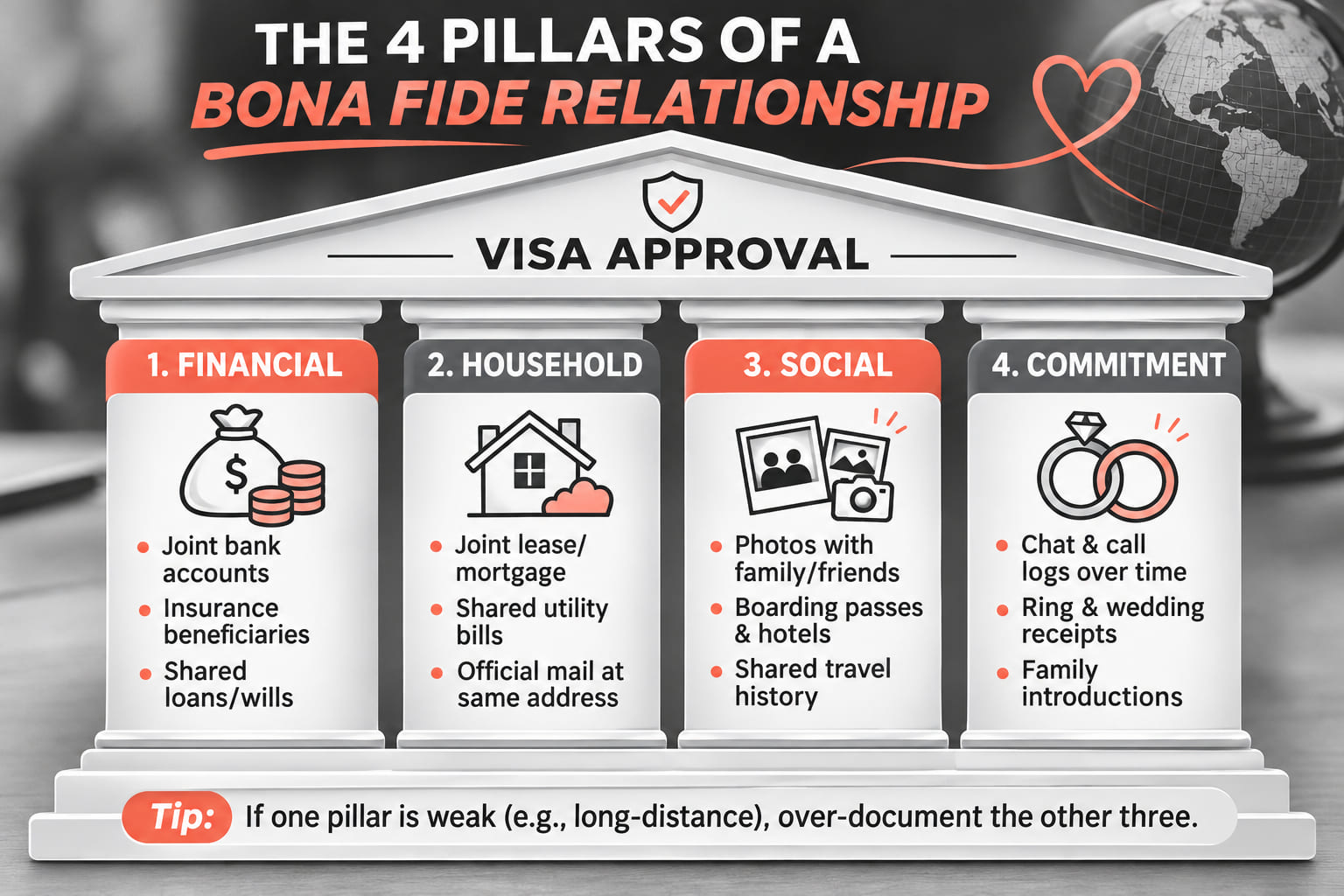
Whether you are filing for a US CR-1, a UK Partner visa, or Canadian spousal sponsorship, immigration systems evaluate your relationship across four distinct categories. A strong file does not just have some evidence; it has balanced evidence across all four pillars.
Pillar 1: Financial Co-mingling
This is often considered the strongest objective proof. It shows you trust each other with your livelihood. Ideal documents include:
- Joint bank account statements showing regular activity.
- Joint credit cards or loans (mortgage, auto, personal).
- Life insurance, health insurance, or retirement accounts naming the spouse as the primary beneficiary.
- Wills or powers of attorney.
- Remittance receipts (if living apart, showing regular financial support).
Pillar 2: Cohabitation and Household
Officers want to see that you share a domestic life. If you live together, provide:
- A joint lease or mortgage deed with both names.
- Utility bills (electricity, water, internet) in both names, or one name with the other listed as an occupant.
- Official mail (government letters, bank statements, medical bills) showing both names at the exact same address.
- Renter's or homeowner's insurance policies.
Note for long-distance couples: If you have not yet lived together, you must provide a detailed statement of intent to cohabitate immediately upon visa approval, supported by evidence of a shared home (like a lease signed in the sponsor's name for the incoming spouse).
Pillar 3: Social Recognition
This pillar proves your relationship is recognized by your community. It includes:
- Photographs together at various events (weddings, holidays, family gatherings) spanning the entire length of your relationship. Avoid submitting only selfies; include wide shots with family and friends.
- Boarding passes, hotel receipts, and itineraries from trips taken together.
- Social media posts or announcements (though these are considered weak on their own).
- Affidavits (sworn letters) from friends and family. Warning: Affidavits are the weakest form of evidence. They should only supplement hard documents, never replace them.
Pillar 4: Communication and Commitment
This shows the emotional depth and continuity of your bond:
- Chat logs (WhatsApp, Telegram, WeChat) spanning months or years. Do not print every single message; provide a representative sample from the beginning, middle, and recent times, along with call history logs.
- Email threads.
- Engagement ring receipts or wedding planning documents.
- Correspondence showing you have met each other's families.
Quality and consistency beat volume every time.
A neatly organized, chronological binder with 50 pages of diverse evidence is far more convincing than a shoebox of 500 random chat screenshots.
The Embassy Interview: What Officers Actually Look For
The interview is not designed to trick you; it is designed to verify the story your paperwork tells. Officers are trained to spot rehearsed answers. The best strategy is radical, unpolished honesty.
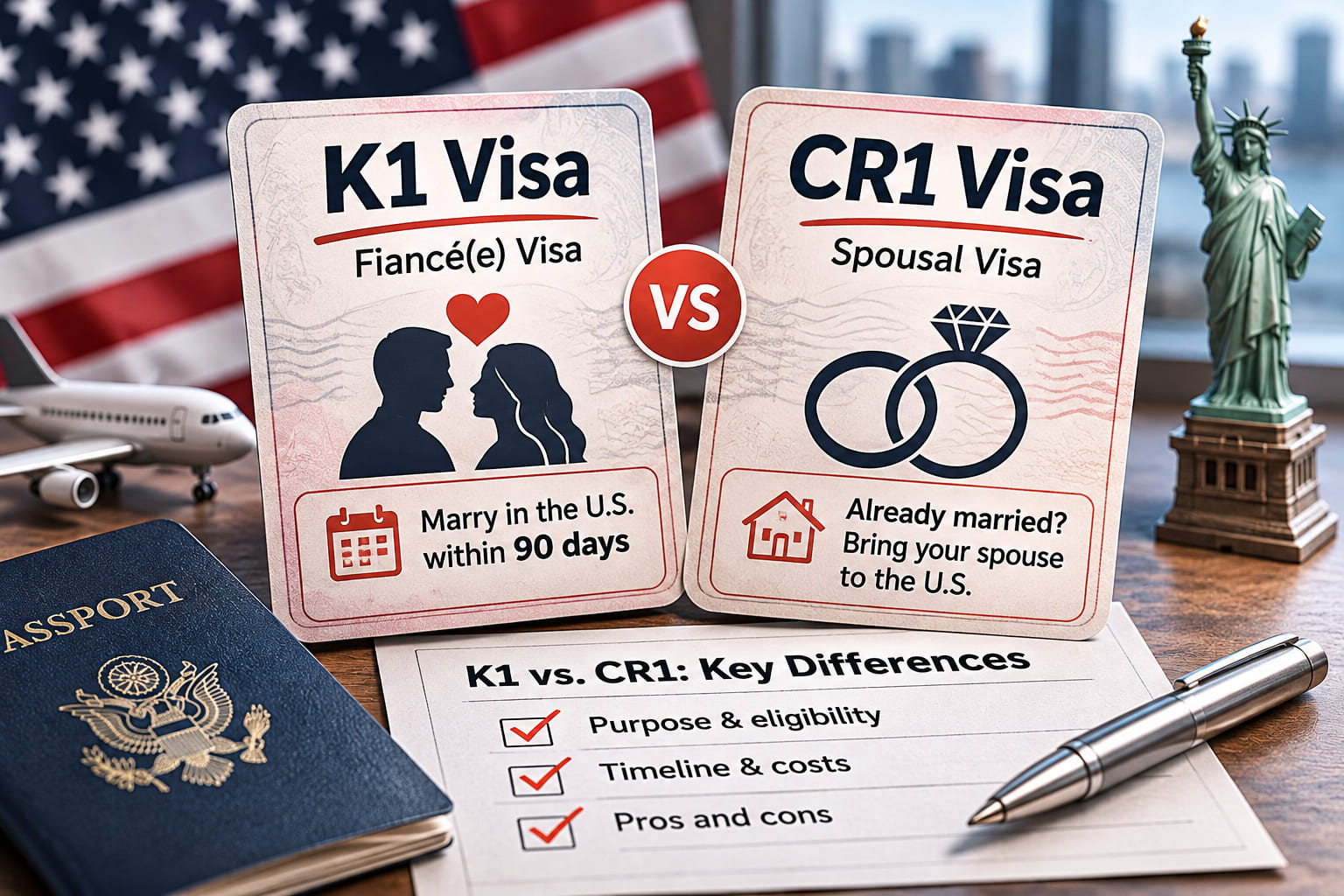
For couples on the US track, understanding the difference between the initial consular interview and the adjustment of status interview is crucial, as detailed in our K-1 vs CR-1 visa comparison. Regardless of the specific visa, the core principles remain the same:
- Know your partner's daily life: Be prepared to answer mundane questions. What did they eat for breakfast? What side of the bed do they sleep on? What is their mother's maiden name?
- Bring originals: Never bring only photocopies. Officers may ask to see the original marriage certificate or birth documents.
- Do not argue: If you disagree on a minor detail (e.g., the exact date of your second meeting), say so calmly. "I believe it was in May, but she might be right that it was June." Perfect, robotic agreement is more suspicious than natural human memory lapses.
Red Flags That Trigger Secondary Review
If the interviewing officer has doubts, they will flag your case for a "Stokes interview" (in the US) or a similar secondary integrity interview. This involves separating you and your spouse and asking identical, highly detailed questions to find contradictions.
Common red flags that trigger this level of scrutiny include:
- Significant age differences: While legal, a gap of 10+ years automatically invites closer inspection.
- No common language: If you cannot speak to each other without a translation app, officers will question how you built a deep relationship.
- Rushed timeline: Meeting, getting engaged, and marrying within a few weeks.
- Lack of knowledge about each other's families: Inability to name siblings or describe parents' professions.
- Inconsistent backgrounds: Vastly different educational, religious, or cultural backgrounds with no explanation of how you connected.
In systems like Canada and Australia, where the sponsor's history is also scrutinized, a thin evidence file can trigger integrity interviews, much like the rigorous checks in Canadian and Australian spousal sponsorship.
Case Study: The Long-Distance Couple Who Won
📋 Case Study: Overcoming the "No Cohabitation" Red Flag
Thomas (42, London) and Amina (31, Casablanca) had a beautiful, genuine relationship, but they had only met in person four times over 18 months. They had no joint finances and had never lived together. Their initial file was rejected for "insufficient proof of a subsisting relationship."
The Fix: They reorganized their evidence strictly by the Four Pillars. Since Pillar 2 (Cohabitation) was weak, they overcompensated in Pillars 3 and 4. They submitted a 40-page chronological PDF of their WhatsApp history (translated), boarding passes for all four visits, photos with each other's parents, and a detailed statutory declaration explaining their cultural and religious reasons for not cohabitating before marriage. They also included a signed lease in Thomas's name, ready for Amina's arrival. The second application was approved in six weeks. The lesson: if you are weak in one pillar, you must be overwhelming in the others.
Frequently Asked Questions
What is a bona fide relationship in immigration terms?
A bona fide relationship is a genuine, good-faith marriage or partnership entered into for love and companionship, not primarily to obtain immigration benefits. The burden of proof lies entirely on the couple to demonstrate this through documented evidence.
What if we don't have joint bank accounts or shared finances?
While financial co-mingling is strong evidence, it is not strictly mandatory. If you lack joint accounts, you can compensate with robust evidence in the other three pillars: extensive communication logs, proof of cohabitation (like a joint lease), and social recognition through photos and travel records.
What happens during a Stokes (secondary) interview?
If an officer suspects fraud, you and your spouse will be separated and asked identical, highly detailed questions about your daily life (e.g., "What color are the bathroom towels?" or "Who took out the trash yesterday?"). Inconsistencies in your answers can lead to a visa denial.
Are letters from friends and family enough to prove our relationship?
No. Affidavits from friends and family are considered the weakest form of evidence because they are subjective and easily fabricated. They should only be used to supplement hard evidence like financial documents, leases, and official travel records, never as your primary proof.
Conclusion: Build the File Before You Need It
The biggest mistake couples make is waiting until the visa application is due to start gathering evidence. By then, the early, most romantic phase of your relationship is undocumented. Start your "evidence folder" on day one. Save your boarding passes, screenshot your best conversations, and take photos with each other's families. When it is time to prove your love to a government official, you will not be scrambling — you will simply be opening a file that tells your story perfectly.