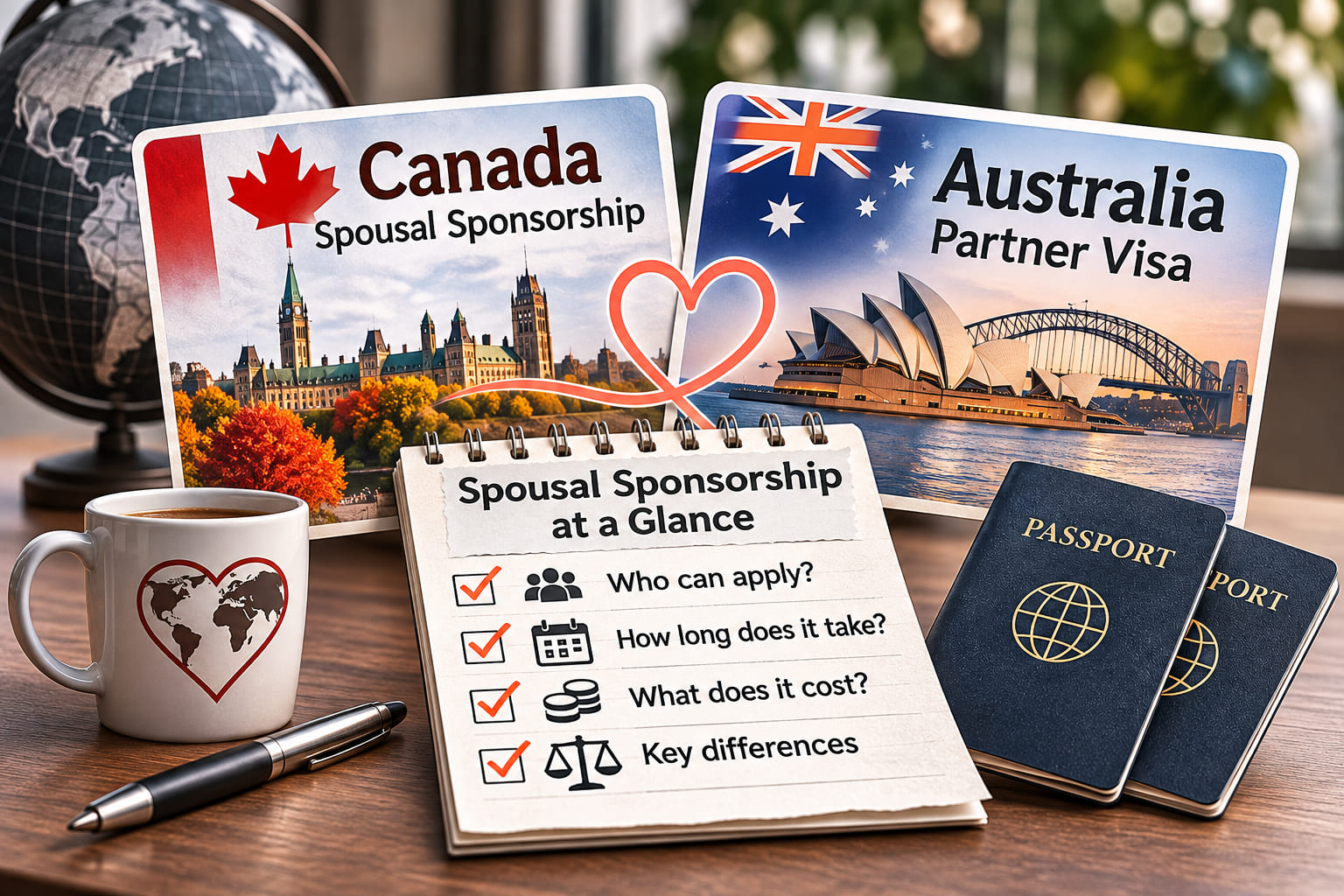
If your relationship is heading toward a Commonwealth destination, this is the chapter of our nine-part International Marriage and Immigration Guide that you need. It walks through both systems stream by stream, compares their true costs and waiting times, and ends with the obligation clause most couples read only after it is too late.
Sponsoring a foreign spouse in Canada or Australia means signing an undertaking: a legally enforceable promise to support your partner financially for years — even if the relationship ends. Understand that sentence and the rest of the process is paperwork. Ignore it, and the paperwork can outlive the marriage.
What "Sponsorship" Actually Means (and Why It Is Not a Form)
In both countries the state transfers its financial risk from the welfare system to you. Before your partner's file is even opened, officials audit you: criminal record, bankruptcy status, social-assistance history, prior sponsorships, and — in Australia — a lifetime cap on how many partners you may sponsor. Only a clean sponsor reaches the second question: is the relationship genuine?
That design has a practical consequence for planning. Sponsorship cases are rarely lost on love; they are lost on sponsor ineligibility discovered late, or on thin relationship evidence. Fix the sponsor file first, then build the proof of partnership.
Canada Spousal Sponsorship: Choosing Your Stream
Canada spousal sponsorship runs on one undertaking but two delivery pipes. The undertaking is identical; the life you live while waiting is not.
The Inland Stream: Together in Canada, With an Open Work Permit
Both partners apply from inside Canada. The headline benefit: the sponsored spouse becomes eligible for an open work permit a few months after submission, and the couple stays together throughout. The trade-offs are real: re-entry to Canada during processing is not guaranteed if the sponsored partner travels, and a refusal carries no appeal — only judicial review at the Federal Court, which is expensive and narrow.
Processing runs near IRCC's twelve-month service standard (in practice, roughly 10–14 months in 2026).
The Outland Stream: The Travel-Friendly Route That Usually Wins
The application is filed through a visa office outside Canada — even if the couple is living together in Canada at the time. The sponsored partner keeps full travel freedom, keeps working in her home country, and a refusal can be appealed to the Immigration Appeal Division, a materially stronger safety net. Processing in 2026 typically lands at 10–12 months, often faster than inland queues.
For couples with stable jobs abroad, children in school, or aging parents to care for during the wait, outland is usually the rational default — a fact forum folklore gets backwards.
The Undertaking: Three Years, No Exit Clause
From the day your partner becomes a permanent resident, you are bound for three years. The undertaking survives divorce, separation, and your own financial hardship. If your ex-spouse receives provincial social assistance during that window, the province bills you — and collects. Quebec layers its own undertaking and contract on top, with provincial review of your financial capacity.
The undertaking does not care why the relationship ended. It only cares that it lasted three years.
Sign it with the same seriousness as a mortgage — because legally, it is one.
Australia Partner Visa 820/309: The Two-Stage Marathon
Australia splits the journey in two visas under one application and one fee: a temporary stage (820 onshore, 309 offshore), then a permanent stage (801 onshore, 100 offshore) roughly two years later. The Australia partner visa 820/309 route tests your relationship twice — at entry and again before permanence.
Stage One: Temporary (820 Onshore / 309 Offshore)
Eligibility requires marriage or a de facto relationship of at least 12 months — documented cohabitation, shared finances, and a shared social life. Couples in long-distance relationships often find registration of the relationship (where an Australian state allows it) or simply marrying to be the cleaner qualification. The sponsor must be approved, and sponsors face a lifetime limit of two partner sponsorships with a five-year interval between them.
Onshore applicants receive a bridging visa with full work rights while waiting. Offshore applicants wait abroad and gain full work rights the moment the 309 is granted and they land. First-stage processing in 2026 commonly spans 12–24 months depending on queue and case complexity.
Stage Two: Permanent (801 / 100)
About two years after the stage-one application date, Immigration reassesses the relationship: still genuine and continuing? Same four pillars of evidence, refreshed. No second application fee is charged — it was included in the first payment. Approval converts the temporary visa into permanent residence.
The Sponsor's Shadow: Obligations From 3 to 10 Years
Australia does not publish a single flat undertaking like Canada's, but its tail is longer. Sponsors must help their partner avoid welfare dependency for the first years; where an Assurance of Support is imposed (discretionary in partner cases, mandatory in the strictest family-stream classes), the commitment and its debt-recovery powers stretch for years — up to a decade in the heaviest categories. Combined with Canada's fixed three-year undertaking, the honest range across the two systems is three to ten years of enforceable financial exposure.
Canada vs Australia at a Glance (2026)
| Criterion | Canada Inland | Canada Outland | Australia 820/309 → 801/100 |
|---|---|---|---|
| Where you apply | Inside Canada | Visa office abroad | Onshore (820) or offshore (309) |
| Stages | One → PR | One → PR | Two (temporary, then permanent) |
| Typical first decision | 10–14 months | 10–12 months | 12–24 months (stage one) |
| Work rights while waiting | Open work permit after submission | Partner keeps home-country job | Bridging visa work rights (onshore); full rights on 309 grant |
| Travel freedom while waiting | Risky (re-entry not guaranteed) | Full | Full after grant; onshore via bridging conditions |
| Government fees (approx.) | CAD ~1,080 + biometrics | CAD ~1,080 + biometrics | AUD 8,085–9,095 (≈ USD 5,300–6,100), both stages included |
| Sponsor financial exposure | 3-year undertaking | 3-year undertaking | Support obligations; Assurance of Support up to 10 years in strictest classes |
| Refusal recourse | Judicial review only | Appeal to IAD | Merits review at the tribunal |
Case Study: The Posting That Made the Decision
📋 Case Study: Choosing Outland Around a Job, Not Around Forum Myths
Chris (41, Vancouver) works in resource-sector engineering with a standing possibility of an overseas posting; Maria (34, Manila) is a registered nurse whose career and income she did not want to pause. The inland stream tempted them with an open work permit — but it would have required Maria to quit her job, move to Canada on maintained status, and risk re-entry problems if Chris's posting landed mid-process. They filed outland instead. Maria kept working (and earning) in Manila for eleven months, visited Chris twice on visitor visas without jeopardizing the file, and when approval arrived she landed in Vancouver already a permanent resident — starting her Canadian nursing registration in week three. "We chose the stream around the job, not around the forum myths," Chris told us. Total government outlay: about CAD 1,165 including biometrics.
The Evidence File: Four Pillars Both Countries Weigh
Australia assesses de facto and married couples against four explicit categories; Canada asks the same questions in different words ("co-mingled affairs"). Your file should be organized under these headings from day one:
- Financial: joint accounts, shared loans or leases, pooled household expenses, named beneficiaries;
- Social: photos with friends and family on both sides, joint travel, events attended as a couple, statements from people who know you;
- Household: proof of cohabitation or, for long-distance couples, documented visits and shared domestic decisions;
- Commitment: the relationship timeline, continuous communication logs, and concrete shared plans for the future.
Long-distance couples are not disqualified — but their file must over-document visits, calls, and joint decision-making to compensate for the missing household pillar. Our neighboring guide in this cluster shows exactly how to build a bona fide relationship evidence file that survives any interview, including the red flags that trigger secondary review in both countries.
Step-by-Step: From Decision to Landing
- Audit sponsor eligibility first: debts, bankruptcy, social assistance, criminal record, prior sponsorships and intervals.
- Fix the relationship status: marry, register the partnership, or complete and document the 12-month de facto period.
- Assemble the four-pillar evidence file covering at least the last 12–24 months.
- File sponsorship and partner application together (Canada: IMM package online; Australia: ImmiAccount, one fee covering both stages).
- Complete biometrics, medicals, and police certificates for every qualifying country of residence.
- Manage the waiting permissions: Canada inland — request the open work permit; Australia onshore — confirm bridging visa conditions.
- First-stage decision: Canada grants PR directly; Australia grants the temporary 820/309.
- Finish the marathon: Australia stage two at ~2 years converts to 801/100 permanent residence; in Canada, calendar the end of your three-year undertaking and plan citizenship timing.
Frequently Asked Questions
Does Canada require a minimum income to sponsor a spouse?
No. Unlike the parents-and-grandparents stream, spousal sponsorship has no minimum income threshold. However, you cannot sponsor if you are receiving social assistance (except for disability), are in undischarged bankruptcy, are in prison, or have defaulted on a previous immigration undertaking or family support order.
Can my partner work while the Australian partner visa is pending?
Onshore applicants (subclass 820) receive a bridging visa with full work rights while waiting. Offshore applicants (subclass 309) wait outside Australia and gain full work rights the moment the temporary visa is granted and they enter the country.
How many times can I sponsor a partner?
Australia caps sponsors at two partner sponsorships lifetime, with a five-year interval between them. Canada has no lifetime cap for sponsors, but a person who was themselves sponsored as a spouse cannot sponsor a new partner for five years, and existing undertakings remain fully enforceable.
What happens to the sponsor undertaking if we divorce?
It survives the marriage. In Canada the three-year undertaking continues even after divorce or separation, and you must repay any provincial social assistance your ex-spouse receives during that period. Australian support obligations and any Assurance of Support likewise remain enforceable.
Conclusion: Two Countries, One Contract With the State
Canada and Australia differ in streams, stages, and fees, but they agree on the principle: the state opens its border to your partner because you close the financial risk behind it. Choose the stream around your real life — jobs, travel, children, career continuity — not around internet folklore. Build the evidence file before you need it. And sign the undertaking with open eyes: it is the price of the promise, and it is worth paying exactly once, for the right person.