Why International Couples Need a Prenup More Than Most
Domestic prenups are complicated enough. Add a second country, and the complexity multiplies. Here is why a prenup for a foreign spouse is not optional for many international couples:
- Different property regimes. Common-law countries (US, UK, Canada, Australia) generally treat assets acquired during marriage as separate unless commingled. Civil-law countries (most of Europe, Latin America) often impose a default "community of property" regime, where nearly everything earned during the marriage is split 50/50 — regardless of who earned it.
- Multiple asset locations. A couple may own a house in one country, a business in another, and retirement accounts in a third. Each jurisdiction has its own rules about which assets are marital and which are separate.
- Inheritance conflicts. Some countries (like France and Germany) have forced-heirship rules that reserve a portion of the estate for children or a surviving spouse, regardless of what a will or prenup says.
- Currency and tax exposure. Divorce in one country may trigger tax events in another. A well-drafted prenup can specify which currency governs asset division and who bears the tax burden.
Without a prenup, you are leaving the most financially consequential decision of your life to a judge who may apply laws you never agreed to.
Why a Prenup Signed in One Country May Fail in Another
This is the single most important concept in cross-border family law: a prenuptial agreement is not automatically portable. A contract valid in New York may be unenforceable in Paris. A document signed in London may be ignored in Moscow. Here is why:
1. Mandatory Matrimonial Property Rules
Many civil-law countries treat their matrimonial property regime as a matter of public policy. Even if you and your spouse sign a prenup choosing separate property, a court in a community-property jurisdiction may refuse to honor it if it violates local mandatory rules. France, for example, allows couples to opt out of the default community regime — but only through a notarized contract executed under French law, with both parties independently advised.
2. Procedural Requirements Vary Wildly
Some countries require prenups to be notarized. Others require them to be executed before a specific type of lawyer. Some demand that both parties receive independent legal advice — and will invalidate the agreement if one spouse did not have their own counsel. The US generally enforces prenups signed voluntarily with full financial disclosure, but states like California have additional procedural safeguards that, if missed, can void the agreement.
3. Public Policy and Fairness Tests
Even a procedurally perfect prenup can be struck down if a court deems it "unconscionable" or contrary to public policy. This is especially true for provisions that waive spousal support entirely or that leave one spouse destitute. Courts in the UK, for example, do not treat prenups as strictly binding — they consider them as one factor among many in a "fairness" analysis.
4. The Choice-of-Law Clause Is Not Magic
Most international prenups include a "choice of law" clause specifying which country's law governs the agreement. This clause is persuasive but not determinative. A court in the country where you divorce may apply its own law if it has a stronger connection to the case — for example, if both spouses have lived there for years, or if the marital home is located there.
A prenup is only as strong as the weakest jurisdiction that might hear your case.
The goal is not to make it enforceable everywhere — that is impossible. The goal is to make it enforceable where it matters most.
How to Structure an International Prenup That Holds Up
Based on how courts actually treat cross-border prenups in 2026, here are the design principles that maximize enforceability:
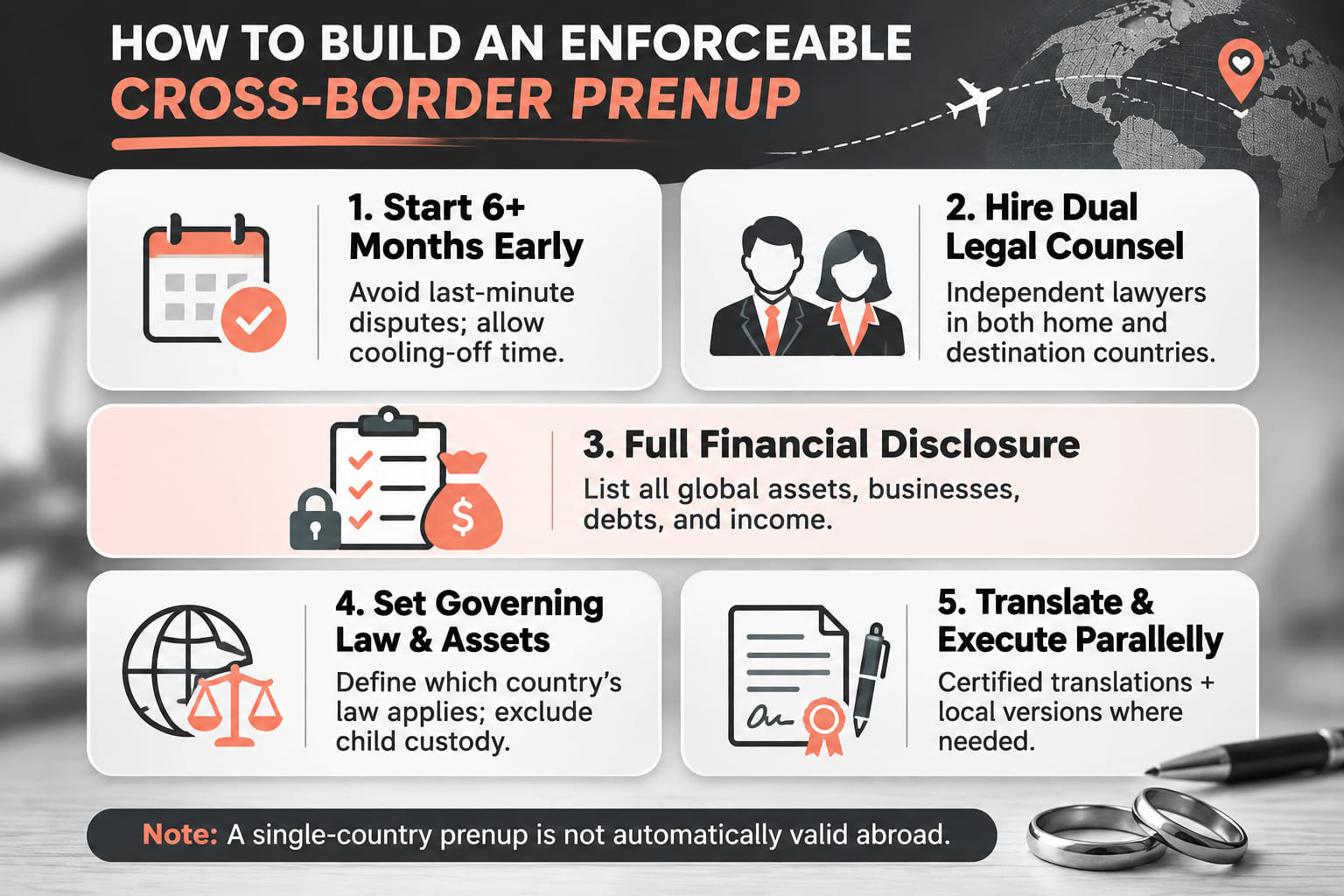
- Dual legal counsel. Each spouse must have their own lawyer — ideally one familiar with the law of the country where the prenup is signed, and another familiar with the law of the country where the couple plans to live. Many courts will not enforce a prenup if one spouse lacked independent advice.
- Full financial disclosure. Both parties must disclose all assets, debts, and income. Hiding assets is the fastest way to invalidate a prenup in any jurisdiction.
- Execute well before the wedding. Most jurisdictions require a "cooling-off" period. Signing a prenup the week before the wedding invites claims of duress. Aim for at least 30–60 days before the ceremony.
- Choose the governing law explicitly. Specify which country's (or state's) law governs the agreement, and which courts have jurisdiction. This does not guarantee enforcement, but it gives courts a clear starting point.
- Include a severability clause. If one provision is struck down, the rest of the agreement should survive.
- Address children separately. Prenups cannot override child support or custody laws. Attempting to do so may invalidate the entire agreement. Keep child-related provisions out of the prenup entirely.
- Translate and localize. If the prenup will be used in a non-English-speaking country, provide a certified translation and consider executing a parallel version under local law.
How to Discuss a Prenup With a Partner From Another Culture
This is where most international prenups die — not in court, but at the kitchen table. In many cultures, particularly in Eastern Europe, Latin America, and parts of Asia, prenuptial agreements carry a heavy stigma. They are associated with divorce, distrust, and the expectation that the marriage will fail. Raising the topic clumsily can wound your partner and damage the relationship before it even begins.
Frame It as Mutual Protection, Not Suspicion
Do not say: "I want to protect my assets from you." Say: "I want to protect us both from the uncertainty of two legal systems. If something happens to either of us, I want to make sure we are both treated fairly — according to rules we both agreed to, not rules a judge imposes."
Explain the Legal Reality
Many foreign partners have never heard of an international prenup because their home country does not use them. Explain that in your country, prenups are common and normal — especially for people with businesses, children from previous relationships, or significant assets. Emphasize that this is about legal clarity, not emotional distance.
Involve a Culturally-Aware Lawyer
A good international family lawyer can mediate the conversation in both languages and explain the legal necessity in terms that respect your partner's cultural background. This removes the burden from you and makes the discussion feel like a professional consultation, not a personal accusation.
Give Them Time
Do not spring the prenup on your partner a month before the wedding. Introduce the idea early — ideally six months or more before the ceremony. Give them time to process, ask questions, and consult their own lawyer. Rushing the conversation is the surest way to create resentment.
Case Study: The Prenup That Survived Two Countries
📋 Case Study: How Choosing the Right Jurisdiction Saved a $2M Estate
Michael (52, Texas) and Elena (38, Kyiv) met in 2022 and married in 2024. Michael owned a successful software company valued at $2 million. Elena had modest savings and no business interests. They planned to live in Texas but spend summers in Ukraine.
Michael's lawyer recommended a Texas prenup. Elena's lawyer in Kyiv warned that Ukrainian courts might not recognize it. The solution: they executed two parallel prenups — one under Texas law, one under Ukrainian law — both with identical substantive terms but tailored to each jurisdiction's procedural requirements. They chose Texas as the governing law for the marriage, but included a clause allowing Ukrainian courts to apply Ukrainian law to assets located in Ukraine.
When the couple amicably separated in 2026, the prenup held up in both jurisdictions. Michael kept his business; Elena received a fair settlement and retained her Ukrainian property. "We did not sign the prenup because we expected to divorce," Elena told us. "We signed it because we respected each other enough to plan for every outcome."
Their success hinged on one decision: where they chose to get married influenced which legal frameworks applied to their prenup. Couples who align their wedding jurisdiction with their prenup strategy avoid the most common enforcement pitfalls.
What an International Prenup Should Cover
While every couple's situation is unique, a comprehensive international prenuptial agreement typically addresses the following cross-border marriage assets and issues:
- Pre-marital assets: Which assets remain separate property, and how will they be tracked?
- Business ownership: If one spouse owns a business, is it separate property? What about income generated during the marriage?
- Real estate: How will property in different countries be treated? Who keeps the marital home?
- Debts: Are pre-marital debts separate? What about debts incurred during the marriage?
- Inheritance: How will inheritances be treated? (Note: forced-heirship rules may override this.)
- Spousal support: Will either spouse receive alimony? If so, how much and for how long?
- Retirement accounts: How will pensions and 401(k)s be divided?
- Tax obligations: Who bears the tax burden for asset division?
- Governing law and jurisdiction: Which country's law applies? Which courts have authority?
- Language: In which language(s) is the prenup executed? Which version controls in case of translation discrepancies?
The Cost of an International Prenup
An international prenup is not cheap, but it is far cheaper than a cross-border divorce without one. Typical costs in 2026:
- Single-country prenup: $1,500–$5,000 per spouse (including legal fees and notarization).
- Dual-country prenup: $5,000–$15,000 per spouse (including parallel execution, translations, and dual legal counsel).
- Complex estates (businesses, multiple properties): $15,000–$50,000+ per spouse.
Compare this to the cost of a contested international divorce, which can easily exceed $100,000 per spouse — and that is before accounting for the emotional toll and years of litigation.
Frequently Asked Questions
Is a prenup signed in one country valid in another?
Not automatically. A prenuptial agreement is governed by the law of the jurisdiction where it was signed, but a court in a different country may refuse to enforce it if it conflicts with local mandatory rules — especially regarding matrimonial property regimes, spousal support, or child-related provisions. Cross-border prenups must be drafted to satisfy the laws of every country where the couple might live or divorce.
How do you discuss a prenup with a partner from a different culture?
Frame the prenup as a mutual protection tool, not a sign of distrust. In many cultures — particularly in Eastern Europe and Latin America — prenups are associated with divorce and can feel offensive. Approach the conversation with empathy, explain the legal realities of cross-border marriages, and involve a culturally-aware lawyer who can mediate the discussion in both languages.
What assets should an international prenup cover?
An international prenuptial agreement should address pre-marital assets, business ownership, inheritances, debts, real estate in multiple countries, retirement accounts, and the treatment of income earned during the marriage. It should also specify which country's law governs the agreement and which courts have jurisdiction in case of divorce.
Do I need lawyers in both countries for an international prenup?
Yes. To maximize enforceability, both parties should have independent legal counsel — ideally one lawyer familiar with the law of the country where the prenup is signed, and another familiar with the law of the country where the couple plans to live. This dual-counsel approach is often required by courts to validate the agreement.
Conclusion: A Prenup Is a Love Letter to Clarity
An international prenuptial agreement is not about planning for failure. It is about planning for reality. When two people from different legal worlds marry, they inherit a complexity that no amount of love can simplify. A prenup is the tool that lets you define the rules together — before a court defines them for you.
Approach the conversation with respect, involve the right lawyers, and give your partner the time and space to understand. Done well, a prenup does not weaken a marriage. It strengthens it — by removing the fear of the unknown and replacing it with the clarity of mutual agreement.