This is the language chapter of our complete guide to cross-cultural relationships, the seven-part cluster on living — not just dating — across cultures. Here we go far beyond "learn basic phrases" advice and enter the real territory: fighting in a second language, rebuilding humor from zero, and the daily habits that keep two people understood.
Here is the first surprise every international couple discovers: the language barrier in relationships does not disappear with fluency. It changes shape. Month one struggles with nouns; year two struggles with nuance. Couples who understand that shift build protocols. Couples who don't quietly stop explaining themselves — and call it "growing apart."
The "Literal Translation" Trap (Why What Sounds Rude Isn't Meant Rude)
Most early friction in lost in translation relationships comes from calques — phrases translated word-for-word from native grammar. They are grammatically English and emotionally foreign. Your partner says something that lands like a slap; in her head, it was a shrug.
The reverse happens too: your idioms ("piece of cake," "break a leg," "let's play it by ear") arrive as literal nonsense or mild threats. Neither of you is being careless. You are both fluent in different dictionaries of intent.
| What She Says (Literal) | How It Lands in English Ears | What She Actually Means |
|---|---|---|
| "What do you want?" | A brusque demand | Neutral offer: "What would you like?" — a calque of Slavic syntax with zero hostility |
| "It is normal." | Dismissive, cold | Reassurance: "Don't worry, this is standard here, nothing is wrong" |
| "I don't care." | Indifference or passive aggression | "Either option makes me happy — you choose, I trust you" |
| "You must come at seven." | A command | Warm insistence: "Please come, we will be waiting for you" |
| "Why did you do it so?" | An accusation | Plain curiosity: "Why did you do it that way?" |
The fix is one habit, practiced until it becomes reflex: the meaning check. Whenever tone spikes, repeat back what you heard before reacting: "What I heard is X — is that what you meant?" One sentence defuses most calque explosions before they become fights.
How to Argue Fairly in a Second Language
Conflict is the heaviest cognitive load a brain can carry, and a second language is the first system to collapse under weight. Under stress, your partner's English degrades to survival vocabulary — or she switches to her native tongue, or goes silent entirely. Silence in a second language is rarely stonewalling; it is a processor at 100% usage.
There is also a quieter effect therapists call the foreign-language distance: emotional words feel weaker in L2, so "I'm hurt" may come out flat, and you may miss the injury entirely. Both distortions cut both ways.
These five rules keep fighting in a second language from becoming fighting about the language:
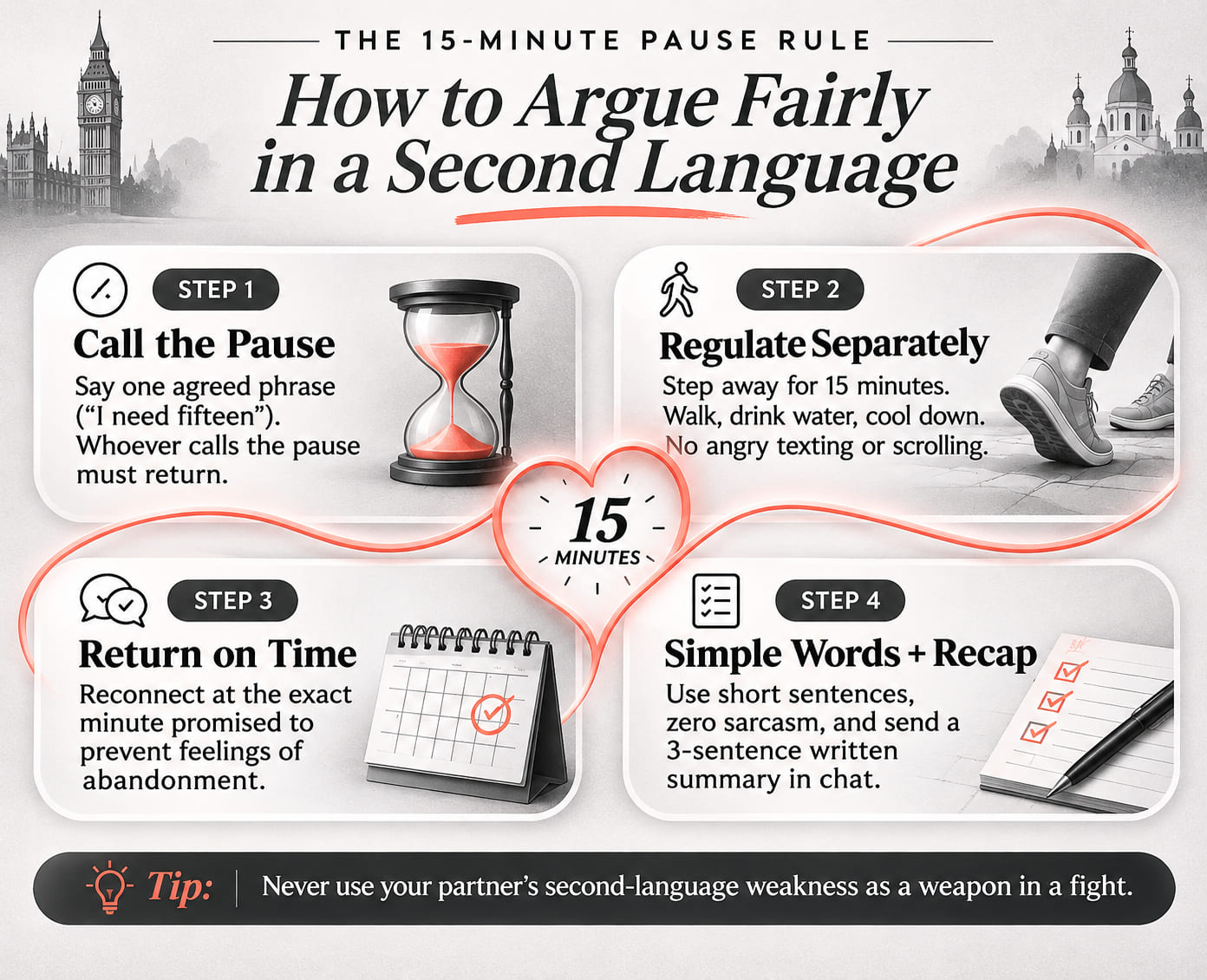
- The 15-minute pause rule. Either partner can call a pause with one phrase ("I need fifteen"). The ritual matters more than the break: whoever calls it must be the one to return. Abandonment is the real damage in cross-cultural fights.
- The native-vent clause. Each partner may vent for two minutes in their mother tongue while the other simply listens. Then both summarize the point together in your shared language. Emotion first, translation second.
- Simple-words rule for fights. No idioms, no sarcasm, one topic per conversation. If a sentence needs a grammar lesson, it needs a rewrite.
- The written recap. After any serious talk, send three sentences in chat: what we discussed, what we decided, how we feel. Memory drifts faster across languages.
- Ban the absolutes. "You always" and "you never" translate as verdicts, not complaints. In L2 they land like courtroom sentences.
And remember: some of what feels like "tone" is not language at all but cultural directness. Before you diagnose rudeness, check whether you are reading a high-context or low-context communicator — our chapter on how directness and politeness differ across cultures explains the difference.
Humor, Sarcasm, and Emotional Nuance
Humor is the last border to open. Jokes run on shared references, timing, and wordplay — the three things a second language cannot supply on demand. Sarcasm is even more fragile: it depends on tone markers that L2 listeners process literally. A deadpan "great job on burning the dinner" is heard, at 11 p.m., as a genuine accusation of arson-level failure.
Teasing is the danger zone. In some cultures, affectionate mockery is intimacy; in others, it is humiliation wearing a smile. Until you know which one your partner grew up in, keep teasing aimed at yourself, never at her — and watch how her family jokes before you join in.
Rebuilding humor is a project with real methods:
- Explain once, laugh forever. The first time a joke lands flat, decode it out loud: "In my culture this is funny because…" You are not killing the joke; you are installing it.
- Keep a shared joke dictionary. A notes-app list of mistranslations, calques, and disasters you survived. Rereading it on a bad day is couple therapy with laughter.
- Favor observational humor. Physical comedy, situational absurdity, and faces travel perfectly. Wordplay does not.
- Learn her emotional diminutives. Every language has tiny word-forms for tenderness that no translation carries. Using one correctly is worth a hundred "I love you"s.
Case Study: The Fight Over the Word "Fine"
📋 Case Study: Three Days of Silence Over Four Letters
Mark (44, Chicago) and Magda (36, Kraków) argued about weekend plans — a small one. At the end, Magda said "Fine," translating the Polish "dobrze," which in her mind meant "okay, agreed, all good." In Mark's American ear, "Fine" is the sound of a door closing: passive-aggressive, conversation over. He withdrew to "give her space." She experienced his withdrawal as sudden, inexplicable coldness. For three days neither spoke, each nursing a completely different story about what had happened.
The mismatch surfaced during a calm written recap — their rule four. Magda had never once meant the American "fine"; Mark had heard it eleven times. Their solution became household law: no one-word answers during conflict. "Fine," "okay," and "whatever" are banned; full sentences only. "We didn't have a communication problem," Mark told us. "We had a dictionary problem — two entries, same spelling, opposite cargo."
Practical Tools and Habits That Bridge the Gap
Technology helps when it is given rules, and hurts when it is not. The habits below are what long-term intercultural couples actually run at home:
- Translator etiquette: machine translation for logistics (appointments, documents, recipes) — never for fights or feelings. Voice input over text when tone matters.
- Video over text for warmth: a 20-second video message carries intonation, face, and pause — the three channels text deletes. On NoLimitsDate, built-in video messaging exists exactly for this reason.
- The 300-word relationship vocabulary: skip grammar perfection; learn the 300 high-frequency words of her daily emotional life first. Recognition beats production.
- Subtitle nights: one evening per week, watch a show in her language with English subtitles; the next week, reverse. Context teaches what dictionaries cannot.
- The native-language hour: sixty minutes weekly where she speaks only her tongue and you answer with what you have. Her brain rests; your ear trains.
- Weekly word exchange: each of you teaches the other one untranslatable word from your language. In a year, you own 100 private concepts no other couple shares.
Fluency is not the goal. Comprehension is.
Couples thrive not when the accent disappears, but when the habit of checking meaning survives every fight.
Frequently Asked Questions
Will the language barrier disappear once my partner becomes fluent?
No — it changes shape. Vocabulary problems fade, but nuance, humor, and cultural references persist even at advanced fluency. Expect a permanent "nuance gap" and build habits (meaning checks, recaps) that bridge it instead of waiting for perfect English.
Is it okay to argue in a language that isn't my partner's native tongue?
Yes, with rules: simple words, one topic at a time, a 15-minute pause option, and permission for each partner to vent in their native language before summarizing together. Never use your partner's second-language weakness as a weapon in a fight.
How do we keep humor alive when jokes don't translate?
Explain a joke once ("in my culture this is funny because..."), keep a shared joke dictionary in your notes app, and favor observational humor over wordplay. Laughing at your own translation mistakes becomes a humor genre of its own.
Should we choose one family language for our future children?
Decide before children arrive, not after. The evidence-backed default is "one parent, one language" at home, with your shared couple language remaining the adults' bridge. Consistency matters more than ambition.
Conclusion: Build a Dictionary of Us
Lost-in-translation relationships are rarely lost to dictionaries. They are lost to assumptions — the belief that a word means what it means in your mouth. The couples who last treat language as shared infrastructure: they check meanings, they pause on schedule, they keep a joke dictionary, and they learn each other's tender words by heart. Do that, and your two languages stop competing. They start co-authoring a third one — the dialect of your house, spoken fluently by exactly two people on Earth.