This is the safety chapter of our From Chat to Real Life pillar guide, the six-article series on turning verified online connection into real life. The international dating safety tips below are symmetric by design: every rule for him has a mirror rule for her, and every transparency requirement runs in both directions. That symmetry is not political correctness — it is engineering. Mutual protocols are the only ones both partners actually follow.
Safety Is a Two-Way Street (What Each Partner Fears)
Start by naming the fears honestly, because unnamed fears become hidden tests.
What he fears: extraction scripts — the "medical emergency" message on day three of the trip; the "guide-translator" who appears at arrivals and bills $100 a day while steering every meal to a cousin's restaurant with a 300% markup; the taxi "friend" whose meter runs on imagination; and the identity mismatch — a profile that borrowed someone else's face.
What she fears: physical vulnerability — being alone with a man twice her size in a place where nobody knows him; reputational exposure in a community where a woman hosting a foreigner is discussed for months; doxxing and stalking after sharing her address or workplace; and financial coercion in its quiet form: "I flew all this way, you owe me."
Notice the structural truth: his risks are mostly financial and logistical; hers are mostly physical and social. A protocol that ignores either half produces exactly the behavior the other side reads as suspicion. The table below maps the six most common threats to the rule that neutralizes each:
| Threat | Primary Target | Early Warning Sign | Protocol Response |
|---|---|---|---|
| Money request ("emergency") | Him | Urgency + secrecy + wire transfer insistence | Zero-money rule: one request ends the process |
| Commission "guide-translator" | Him | Third party insists on joining all meetings | Meet one-on-one in public; translation via app if needed |
| Venue markup collusion | Him | "My friend's restaurant" pushed on days 1–2 | Each partner picks venues from public reviews, alternately |
| Physical / isolation risk | Her | Pressure to leave public space or accept a ride | Public-only first 48h; own transport; code word with friend |
| Doxxing / stalking | Her | Early demands for home address or workplace | Staged contact exchange; geotags stripped; no live posting |
| Identity mismatch (catfish) | Both | Camera "broken" on calls; details shift | Two unfiltered live videos pre-flight; consistency audit |
His fear and her fear are different shapes of the same question: "Can I exit this situation freely?"
Every rule below exists to keep the answer yes — for both of you, at all times.
The Traveler's Safety Protocol (For the Visiting Partner)
Seven rules for the partner who lands with the passport and the budget. They cost almost nothing and remove most of avoiding dating travel scams as a daily concern:
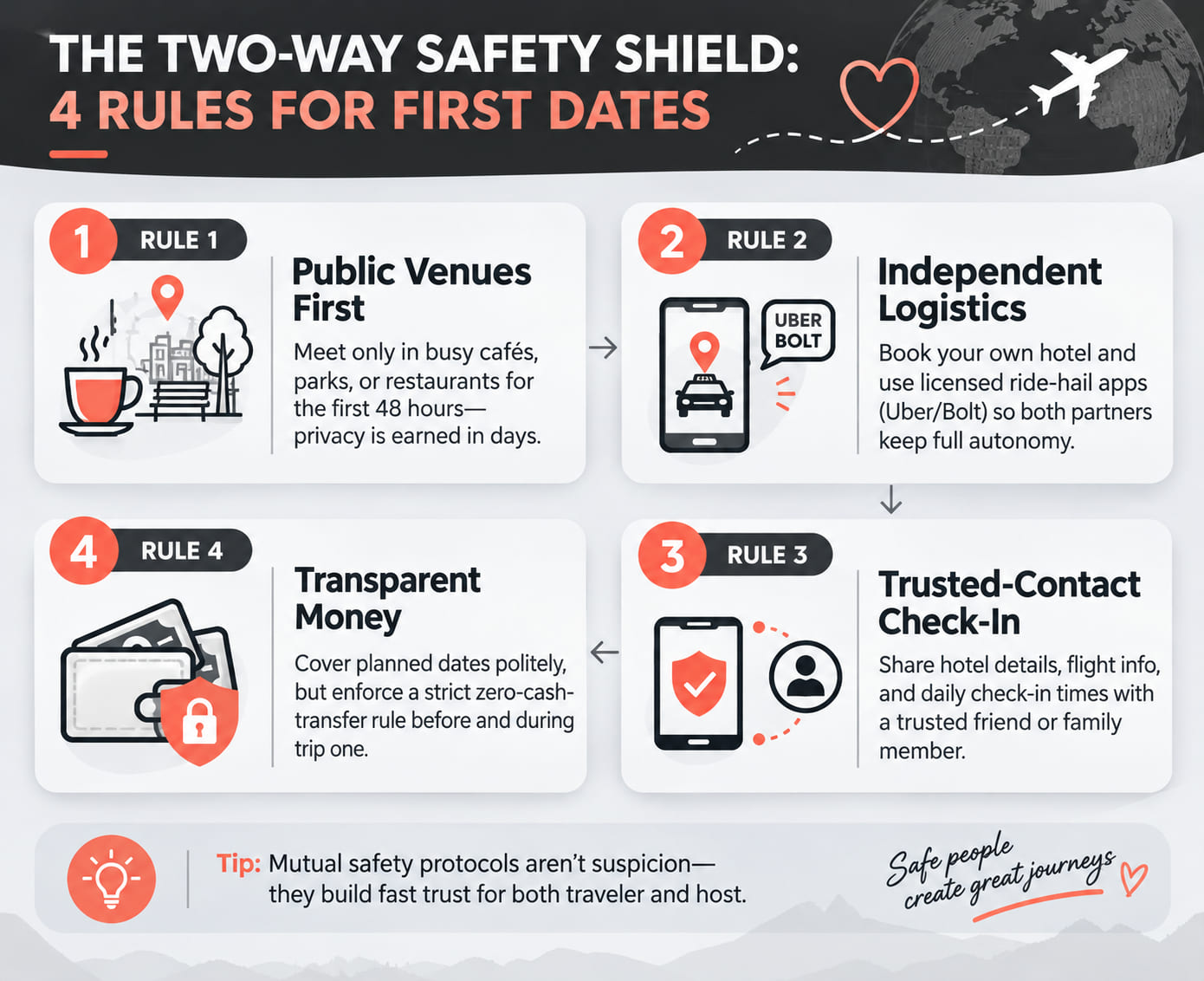
- Book your own hotel, yourself. Official site or major app, refundable rate, central district. Never accept "my cousin's apartment," "our partner hotel," or any lodging arranged by someone you have not met in person.
- Ride-hail only. Uber, Bolt, or the local licensed equivalent — always from the app, never from an airport tout. Share the ride link with your trusted contact at home.
- Venue veto for 48 hours. No restaurant, shop, or "experience" recommended by a new acquaintance during the first two days. You and she alternate choosing public, well-reviewed places.
- Document discipline. Cloud copies of passport, visa, insurance, and return ticket; paper copies stored separately from originals; the nearest embassy or consulate address saved offline.
- Money layering. Card as primary; small cash reserve split between two pockets; no large cash sums carried; zero wire transfers, deposits, or "courier gifts" during the trip.
- Connectivity and coverage. Local eSIM or roaming data active from landing; medical insurance in force; offline maps of the district downloaded before you need them.
- Sobriety budget. Alcohol is capped on meeting evenings — yours and the situation's judgment are part of the protocol, not extras.
The Host's Safety Protocol (For the Local Partner)
Now the mirror half — the safety rules for women meeting foreign men that our community's female members asked us to publish verbatim:
- Public places for the first 48 hours. Cafés, malls, parks, museums. Not your home, not his hotel room, not his rental car, not "a quiet place I know."
- The trusted-contact kit. Your friend or sister holds: his hotel address, a photo of his passport main page (which he provides voluntarily — see the symmetry), your live geolocation during dates, and your check-in times.
- Own transport rule. You arrive and leave every early meeting by your own means — your car, your taxi app, your metro line. His wheels on day one are his logistics, not yours.
- Family knows the schedule. Who, where, until when. Plus a code word that means "call me urgently with a family emergency" — your exit ramp that costs nobody face.
- Money autonomy. Your wallet stays yours. Accepting a coffee or a dinner is courtesy; accepting large gifts, cash, or "help with your rent" on meeting one is a contract you never signed.
- The right to cancel. Any gut feeling is a complete reason. A respectful man treats a cancelled evening as information about comfort, not as an insult about himself. How he reacts to "not today" is itself a verification test.
Case Study: How a Public-First Rule Built Instant Trust in Bogotá
📋 Case Study: The Chaperone Coffee That Never Felt Like One
Greg (48, Denver) flew to Bogotá to meet Camila (36) after ten months of verified calls. Before the flight, something unusual happened: Greg sent Camila his hotel confirmation, his flight number, and a photo of his passport page — unprompted — with one line: "Send this to your sister so she can look me up before I land." Camila's sister, a nurse who had prepared herself to dislike him, ran the details and found a man who had volunteered exactly what a nervous man hides.
The first meeting followed the public-first rule to the letter: a Saturday coffee in Parque de la 93, with Camila's sister joining for the first twenty minutes — not as a chaperone, she insisted, but "as a customer at the next table who happened to say hello." Greg stood when she arrived, asked about her work, and never once suggested moving venues. For forty-eight hours every date was public, every ride was her own app, and every evening ended with a check-in message to two sisters and one brother in Denver. By day four, the protocol had done its quiet magic: with every rule satisfied, there was nothing left to be wary of, and Camila invited Greg to her family's Sunday sancocho. "The rules didn't slow us down," Greg told us. "They were the ramp. Trust arrived exactly as fast as the safety allowed it to."
Digital Privacy and Emergency Check-Ins
Physical safety ends at the airport; digital safety continues for months. The staged exchange below prevents the most common post-meeting harm — doxxing, stalking, and metadata leaks — without slowing the relationship:
- Stage the contact upgrade. Verified platform chat → live video calls → a messenger that hides phone numbers (Signal or Telegram usernames) → home address and workplace details only after in-person trust exists. Each stage earns the next.
- Strip the metadata. Disable geotagging in the camera app before the trip; share photos without location EXIF; post trip pictures after you leave each place, never from inside it.
- The daily check-in. Both partners keep a fixed daily message to a trusted contact during the meeting week — one line, same hour. A missed check-in triggers a call chain, not a panic.
- A shared cloud vault. Both upload passport copies, itinerary, insurance, and hotel confirmations to one encrypted folder, with access granted to exactly one trusted person on each side. In any emergency, someone competent holds the full picture.
- Post-trip permission audit. After the meeting: switch off live location sharing, review tagged photos, and confirm which apps still know where you were. Romance continues; the breadcrumb trail does not.
Frequently Asked Questions
Is it safe to meet someone from a dating site abroad?
Yes — when a protocol is followed: live-video verification before any ticket, public venues for the first 48 hours, independently booked hotels and ride-hail transport, and a zero-money-request rule. Each layer removes a specific class of risk; together they make a first meeting abroad safer than most blind dates at home.
What is the biggest red flag during a first meeting abroad?
Any request for money — an "emergency," a "deposit," a "customs fee," or pressure to pay for a venue recommended by a new acquaintance. One request ends the process, not the conversation. Secondary red flags: pressure to leave public spaces, unregistered taxis, and reluctance to do a live video call before the trip.
Should she share my passport and hotel details with her family? Isn't that distrust?
It is standard two-way practice, not distrust. The protocol is symmetric: you share your hotel address and itinerary with your trusted contact at home, and she shares yours with hers. When both partners volunteer transparency before being asked, safety stops feeling like surveillance and starts building trust.
How do we exchange contacts without doxxing risk?
Move in stages: verified platform chat first, then live video, then a messenger that hides phone numbers (Signal or Telegram usernames), and only after in-person trust — home addresses and workplace details. Strip geotags from shared photos and avoid posting real-time locations during the trip.
Conclusion: Safety Is the Floor, Not the Ceiling
Couples sometimes worry that protocols kill romance — that checking passports and sharing geolocation is the opposite of falling in love. The Bogotá story answers better than any argument: when both people run the same rules, verification stops being suspicion and becomes the fastest trust-builder in international dating. Safety is not the ceiling of your relationship; it is the floor. Build it solid, stand on it together, and everything above — the dinners, the families, the visas, the years — gets to be light.