This is the endurance chapter of our From Chat to Real Life series hub (2026), the six-article path from first message to shared address. The international long distance relationship tips below come from couples who crossed four-to-eight-month visa gaps without losing each other — and from the ones who did lose each other, and explained exactly where the rhythm broke.
Here is the framing that changes everything: the enemy is not distance. Distance is a constant; it cannot be negotiated. The enemy is unstructured distance — love left to improvisation across a nine-hour time gap. Structure is not the opposite of romance. In an LDR, structure is the only form romance can take.
The Time-Zone Trap (8+ Hours Apart Without Burnout)
Do the math before you do the romance. Seattle and Warsaw sit nine hours apart: his 6 p.m. is her 3 a.m. The default solution every couple invents in week one is the heroic one — midnight calls, both partners paying for it in sleep, work performance, and mood. By week six the calls stop being connection and start being a shift at a second job. She falls asleep on camera; he hears himself resenting the woman he loves. This is the time-zone trap: surviving LDR across time zones is impossible on heroism alone, because heroism does not scale past a month.
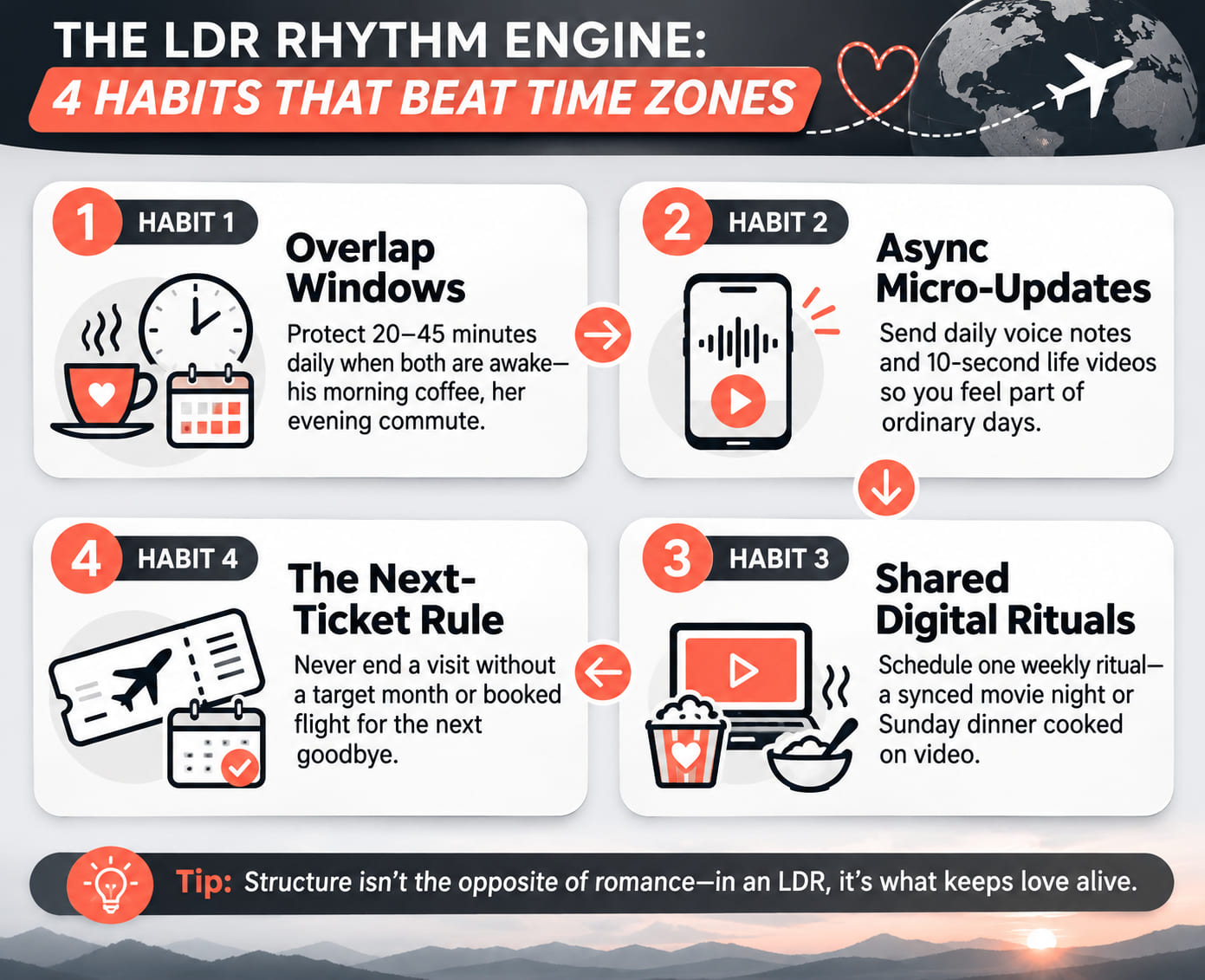
The fix is the overlap window: a fixed 20-to-45-minute band where both partners are awake, fed, and human — typically his morning coffee against her evening commute or kitchen. Protect it like a board meeting: same hours, same days, phone on silent. Alternate the sacrifice occasionally (one late night for him, one early start for her) so the cost never sits on one side permanently.
A rested twenty minutes carries more intimacy than an exhausted two hours. Couples who accept this sentence early never learn the harder version later.
The overlap window is not a compromise with the time zone.
It is the only hour of the day where both of you are actually present — so stop spending it on logistics and start spending it on each other.
Low-Pressure Intimacy: Async Connection vs. Scheduled Calls
Synchronous calls are a scarce resource; asynchronous connection is abundant — and most couples waste it by treating "real communication" as video-only. The texture of a shared life travels perfectly in small, unpolished pieces: a voice note describing the neighbor's dog; a ten-second video of the market queue; a photo of the tram that broke down again. These micro-updates cost thirty seconds and deliver what a two-hour call cannot: the feeling of being inside each other's ordinary day.
On top of the async layer sit the long distance relationship rituals — the scheduled, shared experiences that give the week a skeleton: a synced movie night with a shared commentary chat, a Sunday video dinner where both cook the same recipe, a co-op game on Wednesdays, a shared playlist where each adds one song per day. Rituals differ from calls in one crucial way: they create memories together, not just conversations about separate lives.
| Connection Mode | Best For | Failure Mode If Overused | Healthy Cadence |
|---|---|---|---|
| Scheduled video call | Deep talks, milestones, repair conversations | Becomes an obligation; zoom fatigue; "reporting" instead of relating | 2–4 per week, inside the overlap window |
| Async voice / video notes | Daily texture, humor, tone of voice, presence | One-sided broadcasting if reciprocity dies | Daily, 1–3 per side, zero pressure to reply instantly |
| Shared digital ritual | Couple identity, anticipation, joint memories | Feels forced when the list grows past two rituals | 1–2 per week (movie night, Sunday dinner) |
| Text messaging | Logistics, quick affection, links and memes | Tone collapses across languages; fights escalate in text | As needed — and never for conflict |
The division of labor is simple: async carries the weekdays, rituals carry the week, and synchronous calls carry the moments that matter. Confuse the layers — text an argument, ritualize a logistics call — and the engine starts burning its own fuel.
The "Next Ticket" Rule (Why Open-Ended Waiting Kills LDRs)
Here is the psychological mechanism almost no couple names: the human brain cannot endure "someday." It can endure a countdown. Open-ended waiting — "we'll see each other when the visa comes, when work calms down, when things settle" — converts every small fight into an existential question, because neither partner can see the exit from the distance. Dated waiting does the opposite: it turns endurance into a schedule.
Hence the rule, non-negotiable in every thriving couple we interviewed: at every goodbye, the next meeting already has a month. Ideally a booked ticket; acceptably a price-tracked fare with a decision date; never a vague "soon." The next-ticket rule does three jobs at once: it anchors hope in a calendar, it forces the logistical conversation (budget, vacation days, visa milestones) to happen early, and — quietly — it keeps both partners investing in the same future rather than in parallel fantasies.
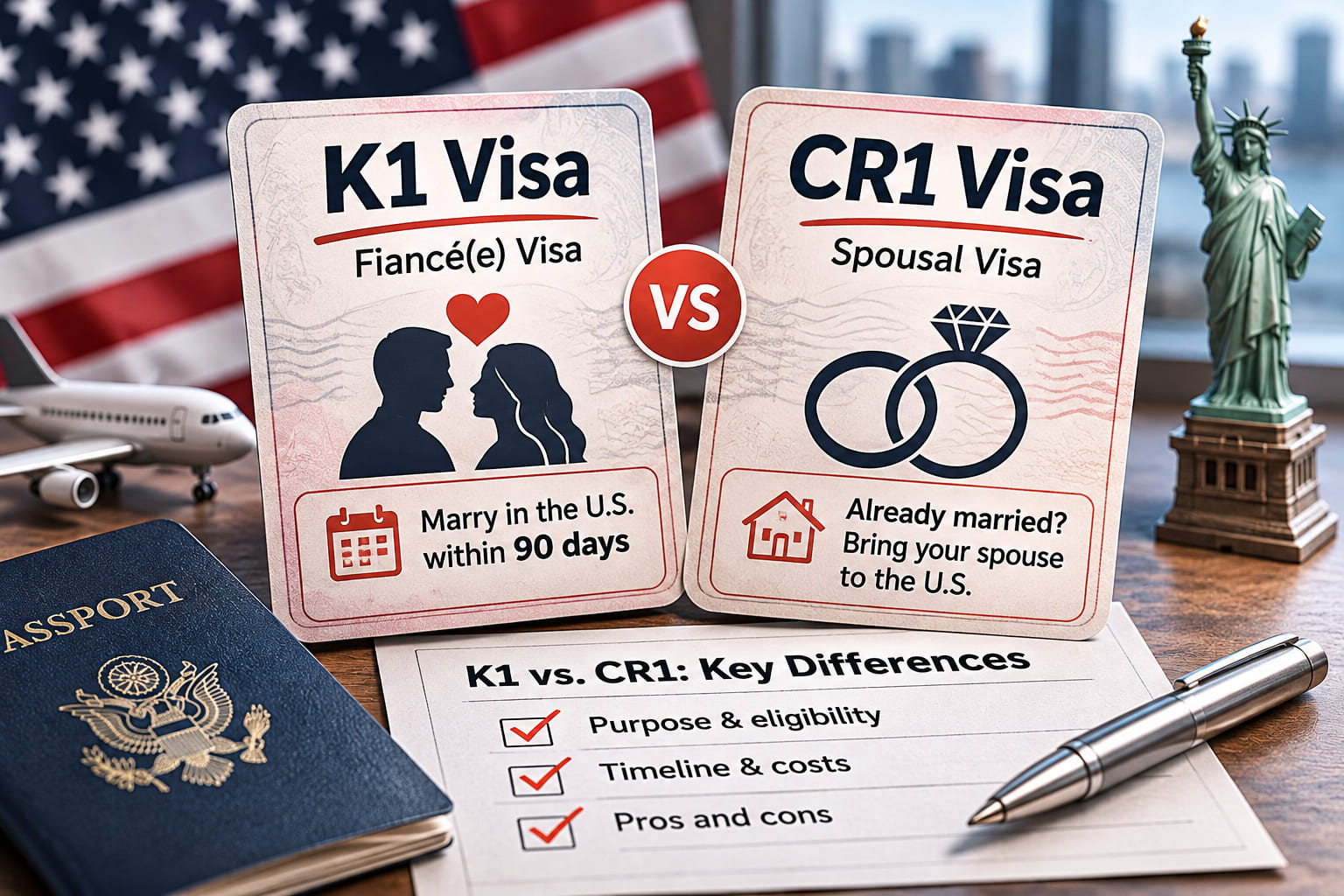
During a visa pipeline this rule becomes even more critical, because the gap is structural: ten to twenty-four months of government processing between "we're filing" and "we're cohabiting." Knowing how long the K-1 or CR-1 pipeline actually takes lets you place visits between milestones — after the I-129F receipt, before the consular interview — so that maintaining connection during visa wait stops being a battle against bureaucracy and becomes a plan inside it. Budget for it explicitly: a shared "next-ticket fund" line item removes the money conversation from the romance conversation, where it does damage.
Case Study: Eight Hours Apart and Nine Months of Visa Processing
📋 Case Study: The Couple That Out-Rhythmed the Wait
Steven (45, Seattle) and Hanna (35, Warsaw) met on a verified platform, met in person twice, and filed the I-129F in March — then faced nine months of processing across a nine-hour gap. Their first system was the heroic one: two-hour calls ending at his 1 a.m., her 10 a.m. commute ruined by sleep debt. By week six, Hanna fell asleep mid-sentence on camera and Steven spent the next day angry at nobody. The relationship was burning its own furniture for heat.
The reset took one Sunday and one sheet of paper. They defined a 20-minute overlap window — his 7 a.m. coffee, her 5 p.m. tram ride home — protected five days a week. Async voice notes carried the rest: Hanna narrated her mornings; Steven narrated his evenings; neither owed instant replies. Sundays became video dinners with the same recipe cooked in two kitchens. And every Friday, they opened the fare tracker together: the "next ticket" ritual that made the wait finite. In month five, during the pending petition, Steven flew to Warsaw for six days — a visit that, in his words, "refueled four months of Tuesdays." When the approval arrived in month nine, Hanna met him at Sea-Tac with a sentence that became the title of their story: "We didn't survive the wait. We out-rhythmed it."
Dealing with Jealousy, Silence, and Zoom Fatigue
Even a perfect rhythm meets three storms. Here is how experienced couples navigate each:
- Jealousy. In LDRs, jealousy is rarely about trust — it is about information scarcity. The fix is voluntary over-context, not permission systems: "tonight I'm at Marta's birthday, six people, photos later" costs ten seconds and preempts ten hours of imagination. Demand transparency and you get reports; offer it and you get closeness.
- Silence. Two quiet days are not a crisis — unless silence has no agreed meaning. Set a floor: at least one async update per day, even a photo of lunch. With a floor in place, silence above the floor reads as life, not as withdrawal.
- Zoom fatigue. Camera-off days are legal. So is "parallel presence": both on video, muted, working — co-existing without performing. Intimacy includes the ability to be boring together.
- The "how was your day?" decay. When conversation flattens into routine questions, upgrade the questions, not the frequency: sensory ("what did your street smell like today?"), specific ("what did your boss say about the report?"), future ("what's the first thing we'll cook together?"). Add a weekly ten-minute "state of us" check-in: what worked, what hurt, what we need next week.
- The red line. Contempt and stonewalling never belong in text. The protocol: switch to an async letter (long-form, edited, kind), then a synchronous repair call within 48 hours. Arguments across languages and time zones need the slowest available channel, not the fastest.
Frequently Asked Questions
How many hours a day should we talk in a long-distance relationship?
There is no healthy quota. Quality and predictability beat volume: one protected overlap window of 20–45 minutes plus asynchronous updates outperforms three-hour midnight marathons, which produce sleep debt, resentment, and calls that feel like shifts at a second job.
Does a big time difference doom a long-distance relationship?
No — it demands structure. Couples with fixed overlap windows and async rituals consistently outperform couples in the same time zone who have no rituals at all. The time zone is a scheduling problem; the relationship dies from unstructured distance, not from distance itself.
How do we keep the spark alive months before the next visit?
Run three systems together: asynchronous intimacy (voice notes, ten-second life videos), shared digital rituals (weekly movie night, Sunday video dinner), and joint planning of the next visit — anticipation itself is a feature, not a placeholder. Surprise physical mail still works miracles.
Is it normal for communication to decline right before visa approval?
It is common: fatigue and paperwork stress compress conversation. Distinguish decline (shorter but warm messages) from withdrawal (cold, avoidant, days of silence). Address the first with a ten-minute weekly "state of us" check-in; the second with an honest repair conversation, not accusations.
Conclusion: Distance Is a Schedule Problem, Not a Love Problem
Every couple in this series who made it across the ocean says the same surprising thing: the distance was never the hard part. The hard part was building a schedule two people could live inside — and defending it from heroism, fatigue, and vagueness. Find your overlap window. Send the thirty-second voice note. Book the next ticket before this one's memory fades. Do that for nine months, and the airport arrival stops being a miracle. It becomes what it was always supposed to be: the next item on a plan two people kept together.