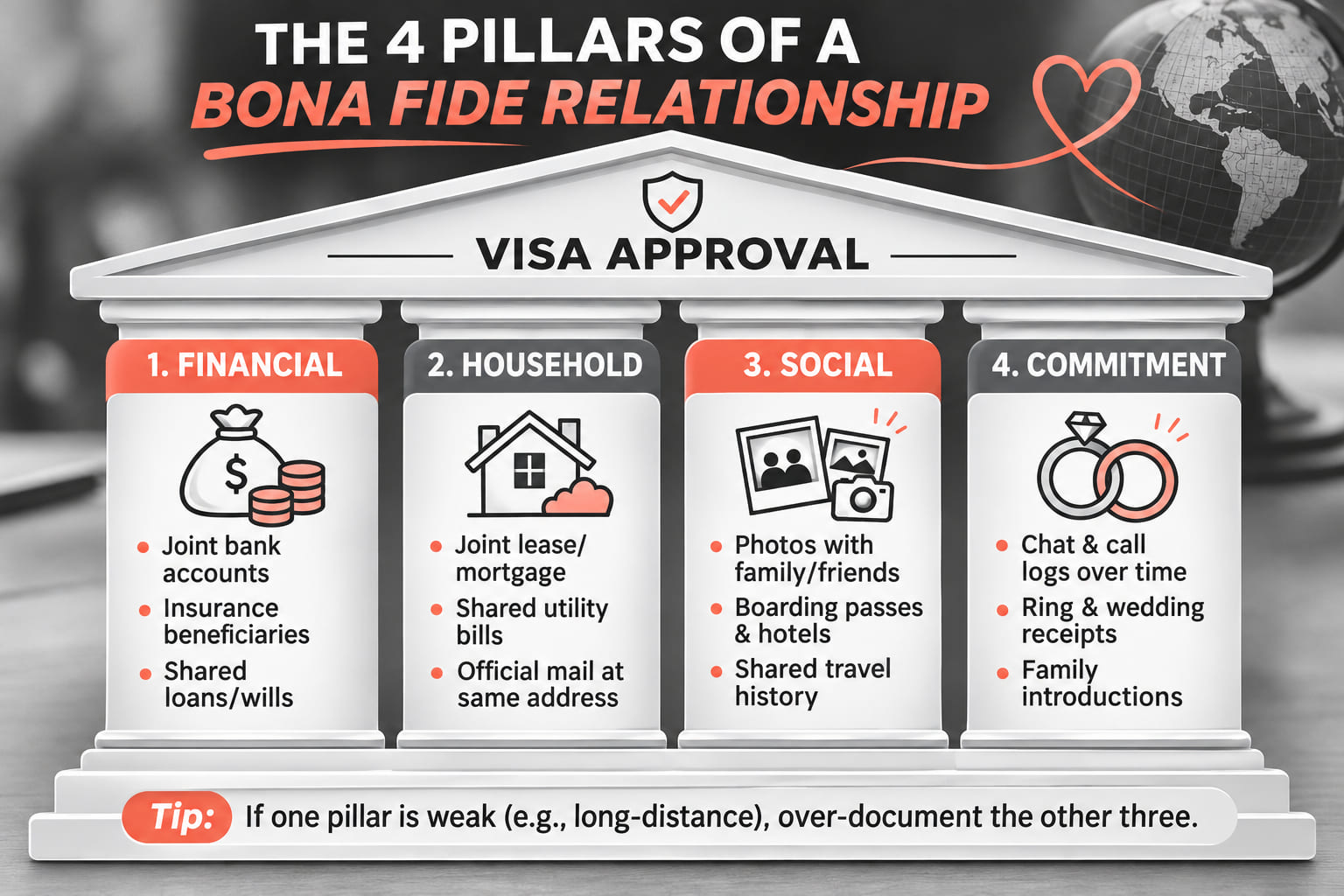
This is the honesty chapter of the central guide of our From Chat to Real Life cluster (2026), and it treats its subject the only useful way: an age gap international relationships discussion without shame and without marketing gloss. The gap is neither a red flag nor a trophy. It is a variable — with social, biological, and financial consequences — and variables can be managed by adults who name them out loud.
Why Age Gaps Are More Common — and Less Taboo — Cross-Culturally
Start with the anthropological fact: age is read differently across cultures because it means different things. In the United States and Northern Europe, a fifteen-year gap is decoded primarily as a power-equity question — who holds the money, the language, the exit options. In much of Eastern Europe, Latin America, and Asia, the same gap is decoded as a life-stage alignment question: is this man at the family-building stage my own peers have not reached yet?
That second reading is not propaganda; it is arithmetic observed on the ground. A 34-year-old woman in Medellín or Kyiv who wants two children and a stable home often finds her local dating pool split between men her age who are "not ready" and men of 45–55 who are. Choosing the latter is not desperation — it is scheduling. This is why older man younger woman cross cultural dating patterns cluster where family timing, not birth year, is the romantic currency.
Honesty requires the other half of the picture too: part of the prevalence is demographic and economic pressure, and pretending otherwise insults the women living it. The distinction that matters — in ethics and in visa files alike — is agency. A woman who chooses a mature partner with open eyes, her own income, and her own veto power is exercising exactly the autonomy the stereotype denies her.
| Region | How a 15–20 Year Gap Reads | Typical Social Reaction | What Offsets Scrutiny |
|---|---|---|---|
| US / Northern Europe | A power-equity question first | Friends polite in person, harsh online | Visible equality: her career, her voice in decisions, joint plans |
| Eastern Europe | Life-stage alignment: maturity + family readiness | Family pragmatic; friends curious | Serious intent, marriage timeline, respect shown to her parents |
| Latin America | Normal if the courtship is formal and family-inclusive | Family watches behavior, not numbers | Chivalry, family introductions, public commitment |
| Asia (PH, VN, TH) | Accepted when provider reliability is proven | Community gossip; family cautious | Stability evidence, marriage rather than dating, respect for elders |
Notice the pattern in the last column: nowhere does the gap itself get forgiven. What gets respected everywhere is structure — plans, family inclusion, and her visible standing as an equal author of the relationship.
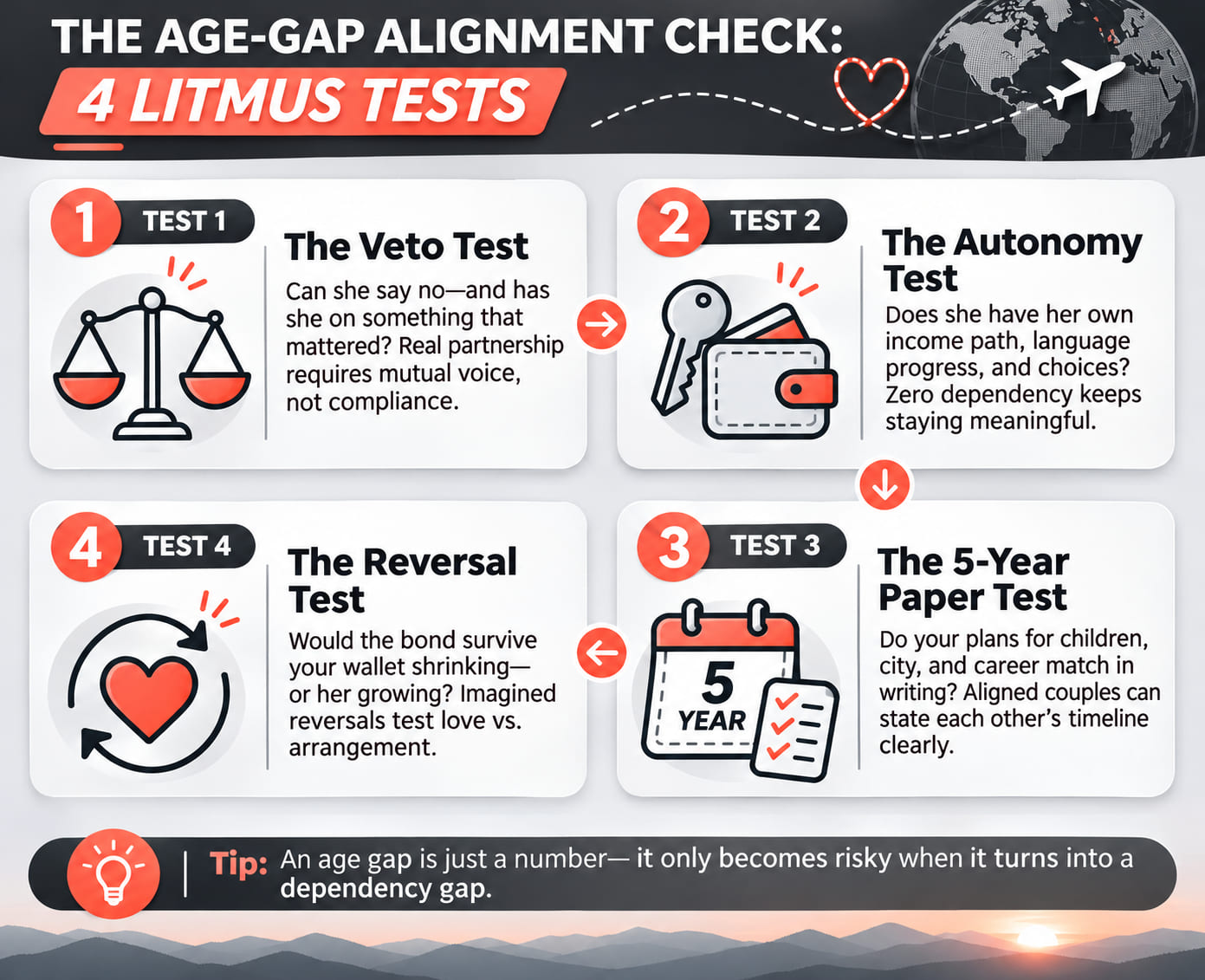
Healthy Partnership vs. Power Imbalance (The 4 Litmus Tests)
The research and the divorce files agree on one point: the number of years predicts very little; the structure of the relationship predicts almost everything. Four litmus tests separate partnership from dependency — and they work in both directions, on him and on her:
- The veto test. Can she say no — and has she, at least once, on something that mattered? A relationship with no recorded disagreement is not harmony; it is asymmetry wearing harmony's clothes.
- The autonomy test. Does she have her own income or income path, her own language progress, her own decisions? Dependency — financial, linguistic, legal — is where age gaps turn toxic, because it removes the exit that makes staying meaningful.
- The five-year paper test. Do your plans for children, city, and work match in writing? Couples who can each write the other's five-year plan from memory are aligned; couples who cannot are two strangers sharing a calendar.
- The reversal test. Would the relationship survive your wallet emptying — or her wallet growing? Imagined reversals expose which partner is investing in the person versus the arrangement.
And the mirror-image red flag deserves equal bluntness: a partner whose interest is purely transactional — the visa, the stipend, the exit — is also an imbalance, just with the leverage reversed. Transaction detection works both ways, and the evidence is the same: consistency between words, money flows, and behavior when nobody is watching.
An age gap becomes dangerous only when it converts into a dependency gap.
Keep the second at zero — and the first remains what it always was: a number on two passports.
Practical Life-Stage Alignment (Children, Retirement & Energy)
Here is where age gap marriage challenges stop being philosophical and start being calendar entries. Three conversations must happen before an engagement, precisely because they are uncomfortable:
Children. He may have adult children and a vasectomy history; she may want her first baby at 38. Fertility is biological, not cultural: agree on numbers, timing, and the medical buffer (including IVF budgeting) while the timeline is still generous. Then do the harder math out loud: he will be seventy when their youngest is sixteen. Is that a plan he can fund with energy, not just money?
Retirement and widowhood. His retirement date may land at her career peak; his life expectancy curve sits a decade left of hers. These facts are not morbid — they are insurance policies, estate documents, and pension modeling waiting to be signed. Couples who discuss widowhood at forty survive it at seventy; couples who don't leave the younger partner discovering the finances during grief.
Energy and health. The younger partner's pace — hiking trips, late nights, a second child's bedtime shifts — is a contract the older partner signs with his habits: sleep, training, checkups. In thriving gap couples, the older partner's health discipline is an act of love, and both say so.
None of this is unromantic. It is the most romantic genre there is: two people telling each other, in writing, "I plan to be here for your entire life — and here is how."
Case Study: Bridging a 16-Year Gap with Clear Life Plans
📋 Case Study: The Three-Page Memo That Ended Every Argument in Advance
Richard (52, Austin) and Sofia (36, Medellín) met on a verified platform and talked for fourteen months before meeting — and did something neither of their friends had seen: before the first flight, they wrote a "life plan memo." Three pages, both signatures, no lawyer required: two children, the first before she turns 39; her marketing career continuing remotely plus a Texas licensing plan; a joint account alongside her own income; a prenup she proposed; his retirement at 67 with the pension gap modeled; annual checkups and a life policy naming her. The memo was not romance's obituary — it was romance's architecture.
The social circle took longer than the paperwork. His friends joked for a month until the memo's children section became real at a baby shower; her mother resisted for two visits, then dissolved during a third week when Richard spent four evenings repairing her kitchen cabinets and practicing Spanish verbs at the wrong tense. The embassy interview lasted twelve minutes: the officer asked about the sixteen-year gap once, Richard handed over the memo and the evidence file — trips, joint accounts, family photos from both sides — and the question was never repeated. "The gap was never our problem," Sofia told us. "Vagueness is everyone's problem. We just removed ours in advance, on paper, while we still liked each other too much to argue."
Navigating Friends' Judgment and Embassy Interviews
Every age-gap couple faces two audiences: the social one and the institutional one. Both are manageable with scripts, not defensiveness.
Friends and relatives need one sentence, delivered once, with humor: "We want the same three things — kids, a home, and boring Sundays. The calendar math works; watch us." Report, don't defend. Defenses invite debates; reports invite curiosity, and curiosity ages into acceptance around month six.
Her family needs behavior, not sentences: proper introductions, respect protocols, and the written plan placed on the table like a document, because in collectivist households a plan is a love language. (The full etiquette for that first dinner lives in our family chapter of the cross-cultural series.)
The consulate needs evidence. Understand what an age difference visa interview actually measures: officers are not moral referees; they are transaction detectors. A large gap raises the question "what is being exchanged?", and the answer must be visible in the file — consistent relationship timeline, her independent profile (education, job, income), joint decisions documented over months, family introductions on both sides, and transparent money flows. Coached answers fail; lived reality passes. The complete evidence architecture — and the specific red flags that trigger secondary review at embassy interviews — is catalogued in our legal cluster's proof guide.
Frequently Asked Questions
What age gap is too big for a spouse or fiancé visa?
There is no legal age-gap limit in US, UK, Canadian, or Australian immigration law. Scrutiny scales with the gap and with other factors (short courtship, thin evidence, financial asymmetry), but a well-documented bona fide relationship neutralizes it. Officers verify transactions, not romance.
Do age-gap marriages actually last?
Research is mixed: the predictors of durability are the same as in any marriage — shared goals, equity, communication — while very large gaps add one extra risk factor: life-stage mismatch. That risk is addressable through explicit planning on children, career, retirement, and health before the engagement.
Is it wrong to prefer younger partners in international dating?
Preference is not ethics; behavior is. Agency, transparency, and equity decide whether a relationship is a partnership or a transaction. If the attraction is youth alone, real life exposes that within months — the four litmus tests in this guide surface it earlier and cheaper.
How do we handle her parents' opposition to our age gap?
With time, plans, and respect — not arguments. Meet properly, present your written life plan (children, housing, her career), and let her parents observe your behavior over several visits. Never triangulate through your partner: your consistency is the only argument that works.
Conclusion: The Number Is a Fact; The Plan Is the Love
Sixteen years between two passports is a fact. What a couple does with it — the veto respected, the autonomy protected, the memo written, the kitchen cabinets repaired — is the relationship. Society will keep its spotlight; consulates will keep their questions; friends will keep their jokes. None of that is your problem to solve. Your problem is smaller and far more serious: make sure the person across the table is an author of this life, not a passenger. Do that, and the age gap becomes exactly what mature love always makes its obstacles — a footnote with a good story attached.