This is the money chapter of our From Chat to Real Life roadmap (2026), the six-article series on turning verified connection into a shared address. Here we answer the question every reader eventually types into a search bar at 1 a.m.: how much does it cost to marry a foreigner — really, line by line, with the unglamorous items included?
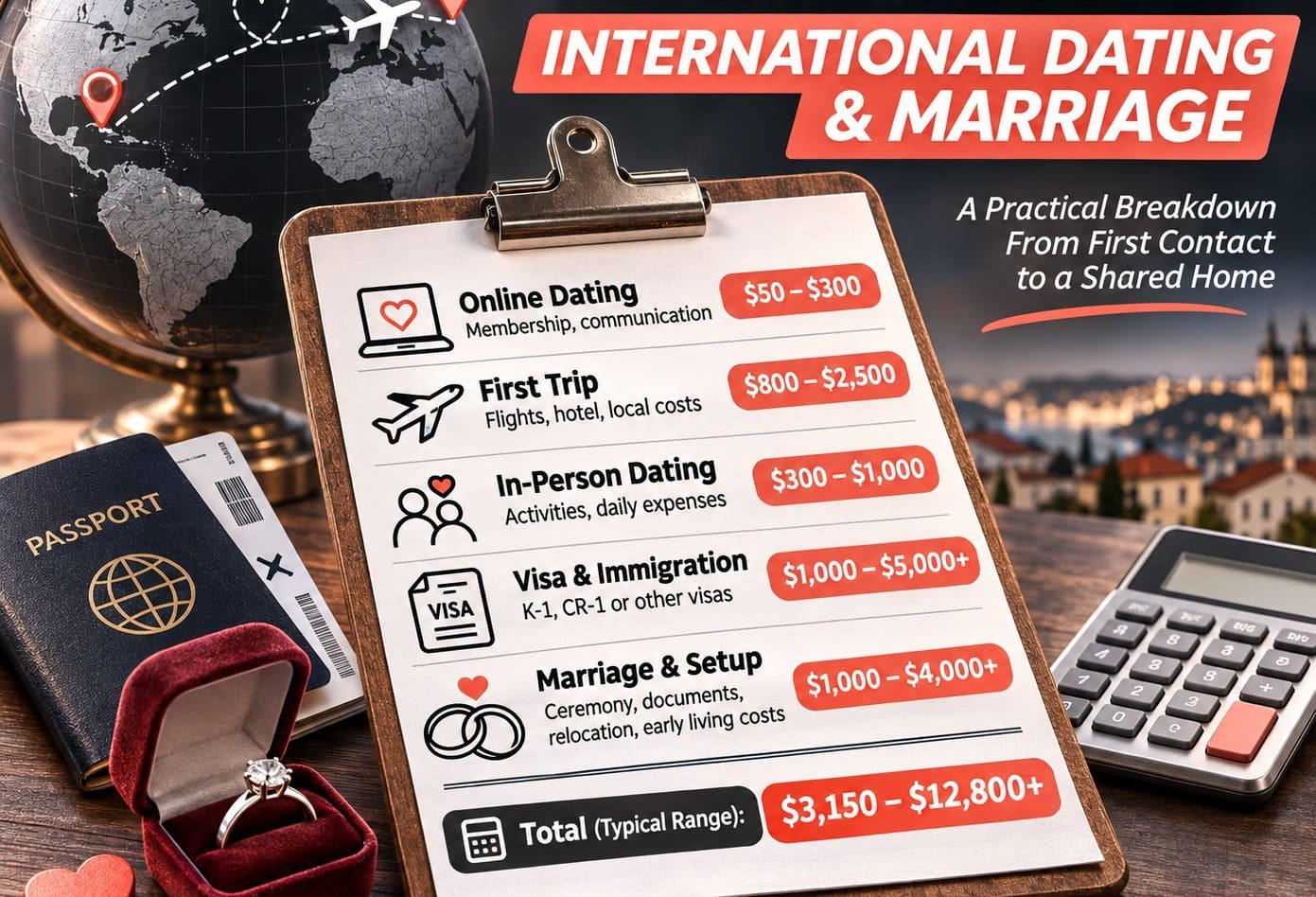
Start with the headline number, then earn it. Across our community's trip reports and budget sheets, the total cost of international dating from first verified hello to wedding day lands between $6,000 and $12,000 over eighteen to twenty-four months for most couples. That sentence deserves decomposition, because inside it live four distinct phases — each with its own logic, its own traps, and its own line in a well-kept spreadsheet.
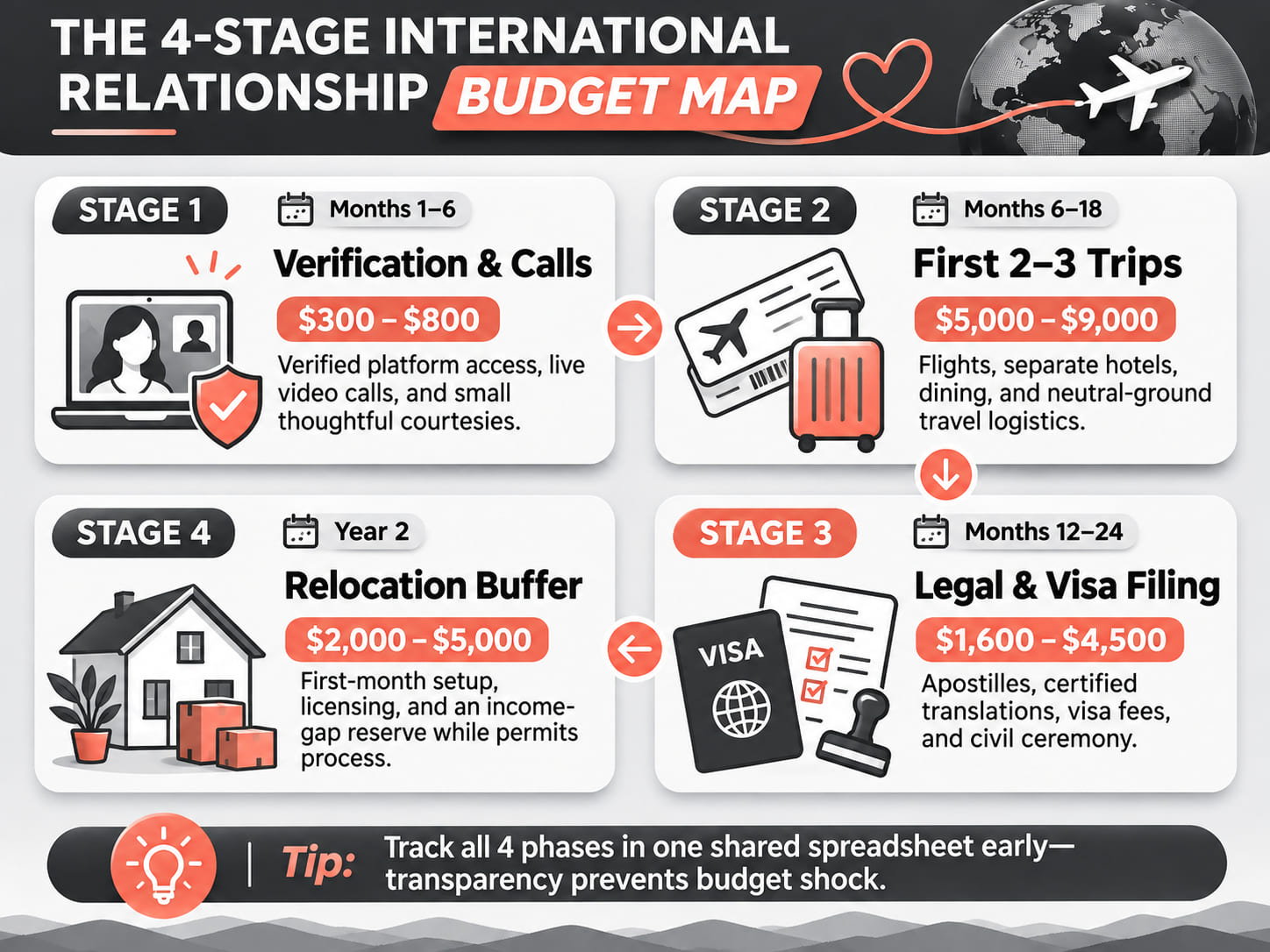
The Four Financial Phases of an International Relationship
Phase 1 — Verification and connection (months 1–6): $300–800. Platform subscription or credits on a verified service ($200–500), quality video-call setup, and small courtesies. This phase buys truth, not access: identity verification and moderation are the product you are paying for. Anyone offering this phase for free is selling your data or your attention instead.
Phase 2 — Meetings (months 6–18): $5,000–9,000. The heaviest visible phase: two to three trips at $2,500–4,500 each for intercontinental pairs (flights, a week of mid-range accommodation, dining, her intercity travel as courtesy). Your international relationship travel budget is decided here — and it is the phase where seasonality and jurisdiction choices move the total by thousands.
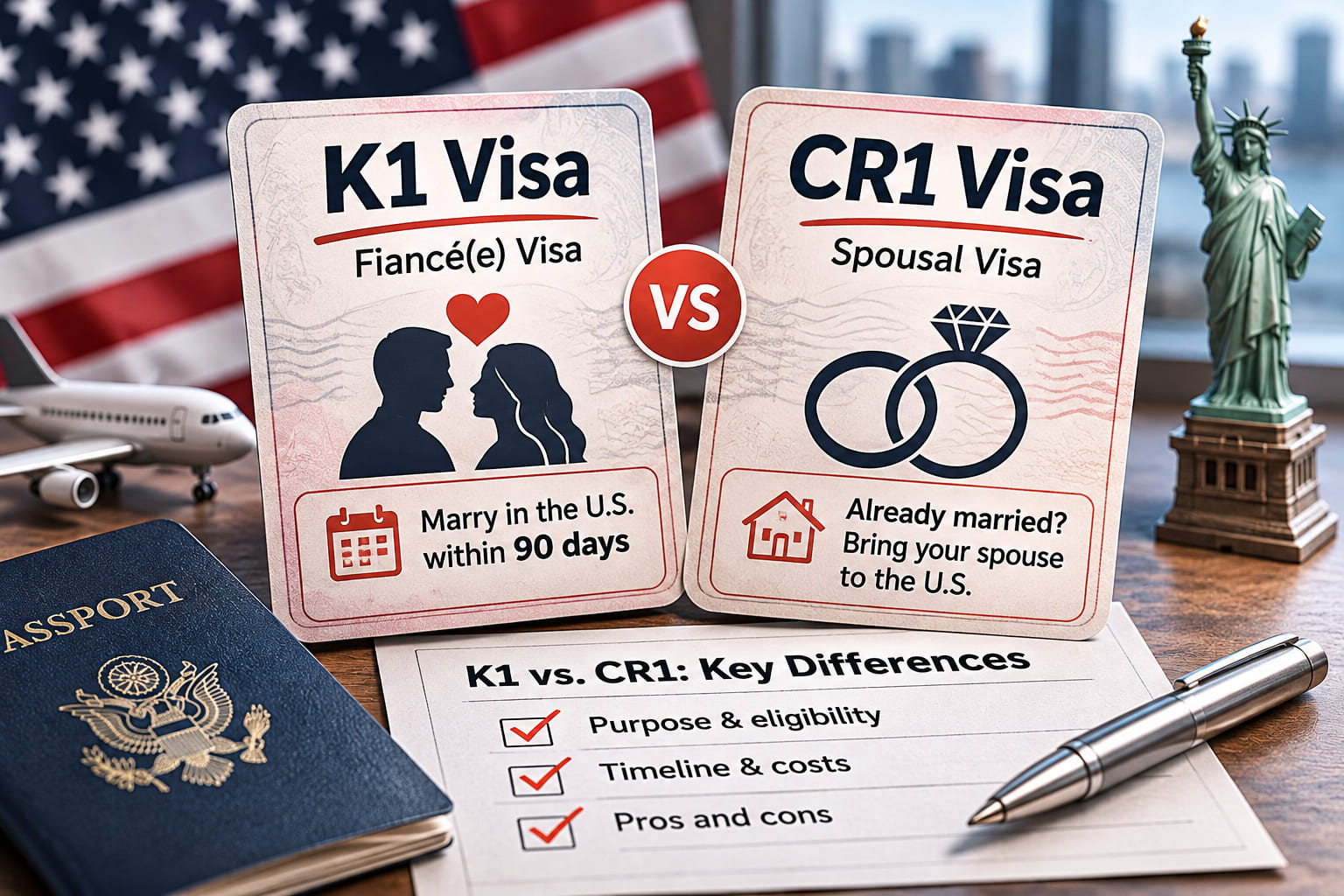
Phase 3 — Wedding and legalization (months 12–24): $1,600–4,500. Documents, apostilles, and certified translations ($300–600); government petition and visa fees by route ($1,000–3,500: a K-1 path totals roughly $2,200–2,900 including post-arrival adjustment, a CR-1 about $1,200–1,800, European family routes far less in fees but more in documents); plus the ceremony itself — from a $100 civil hall to a $3,000 dual celebration.
Phase 4 — Relocation buffer (year 2): $2,000–5,000. First-month deposits, a winter wardrobe for a tropical bride or a tropical wardrobe for a Nordic groom, license and credential starts, and the income-gap reserve while her work authorization matures. Couples who skip this phase in planning do not skip it in life — they just meet it without armor.
Notice the structural lesson: the phases overlap in time but never in logic. A spreadsheet with four tabs behaves like a plan; a spreadsheet with one total behaves like a wish.
Complete 2026 Cost Breakdown Table (By Region)
Geography moves every line except love. Three typical corridors, priced as our community actually spends them:
| Corridor | Round-Trip Flight | Accommodation / Week | Government & Visa Fees | Documents, Translations, Medical | Typical Total to Wedding (18–24 mo, 2–3 trips) |
|---|---|---|---|---|---|
| US → Eastern Europe (Ukraine via Poland hub, Moldova) | $800 – $1,500 | $700 – $1,500 | $2,200 – $2,900 (K-1 all-in) or $1,200 – $1,800 (CR-1) | $500 – $1,000 | $7,000 – $11,000 |
| US → Latin America (Colombia, Mexico, Brazil) | $450 – $900 | $500 – $1,200 | Same US routes: $1,200 – $2,900 | $400 – $900 (Hague apostille, fast registries) | $6,000 – $9,500 |
| Europe → Asia (e.g., Germany → Philippines) | $900 – $1,600 | $400 – $900 | Low: €75–300 visa fees (EU family route) | $600 – $1,400 (PSA certificates, translations, sometimes legalization chains) | $5,500 – $9,000 |
Read the table sideways and the strategy appears: the US–Latin corridor wins on flight price but often adds a trip because distances feel shorter; the Europe–Asia corridor wins on government fees but pays in document complexity; the US–Eastern Europe corridor sits in the middle of everything — which is exactly why it remains the most traveled route in international dating.
Hidden Costs Nobody Puts in the Spreadsheet
Now the section that separates budgeters from survivors. These six items appear in almost no online estimate and in almost every real couple's bank statement:
- The income-gap giant. On fiancé routes, she cannot work legally for 4–8 months after arrival while the work permit processes. For a dual-income plan, that is $8,000–20,000 of foregone or single-loaded income — bigger than every government fee combined. Spouse routes erase it; that difference belongs in your route decision, not in a footnote.
- Credential recognition. Her nursing license, teaching certificate, or law degree does not cross borders automatically: evaluations, bridge courses, and re-exams run $500–5,000 and six to eighteen months.
- Emergency flights. A grandparent's illness, a rescheduled interview, a forgotten original document: keep an $800–2,000 reserve and the emergencies stay events instead of becoming crises.
- Language and integration courses. $300–1,500 depending on country mandates (some European states require paid integration classes) and ambition.
- The second celebration. Most international couples marry twice: a civil act where the paperwork is easy, and a family celebration in her country later. Budget $1,500–4,000 for the second one or it will budget itself out of your savings.
- Setup costs. Phone plans, household doubling (second of everything), winter coats, visa photos at 3 a.m. prices: $500–1,500 of pure friction.
The visible budget decides whether you can start.
The hidden budget decides whether you can finish. Fund both, and cross border marriage expenses stop being a threat and become a schedule.
Case Study: How Tracking Every Dollar Prevented Budget Shock
📋 Case Study: "Fund 14.5" and the Two Shocks It Absorbed
Arthur (44, Toronto) and Mila (33, Bratislava) did something rare before their first flight: they opened a joint spreadsheet and a separate savings account named, without romance, "Fund 14.5" — $14,500, their pre-agreed ceiling for the entire journey to the wedding day. Every expense, from platform credits to a $4 airport pretzel, entered one of the four phase tabs. Once a month, a twenty-minute "finance date" reviewed the sheet with wine and zero blame.
The shocks came anyway, as shocks do. In month seven, Mila's grandmother suffered a stroke: an emergency flight to Bratislava, $1,400, unbudgeted. In month eleven, Mila's nursing credential evaluation invoice arrived eight months earlier than planned: $2,200. In most couples, either event would have detonated the silent ledger of resentment — "your family," "your career." In Fund 14.5, both fit inside the Phase 4 buffer line that Arthur had insisted on keeping fat "for exactly the things we can't imagine." They married in month eighteen at a civil hall in Bratislava with eleven guests, having spent $14,180. "The spreadsheet never caused a single fight," Mila told us. "Silence about money caused all of our earlier ones. This was just silence with the columns removed."
Smart Ways to Save Without Being Cheap
Frugality and cheapness differ in one test: frugality cuts waste, cheapness cuts protection. The moves below pass the test:
- Fly the dead seasons. February–March and October–November price 20–35% below summer and December. Fare alerts plus midweek departures stack the savings.
- Let points pay one leg. A single sign-up bonus on a travel card commonly covers one transatlantic round trip — put every relationship expense on one card and pay it in full, monthly, without exception.
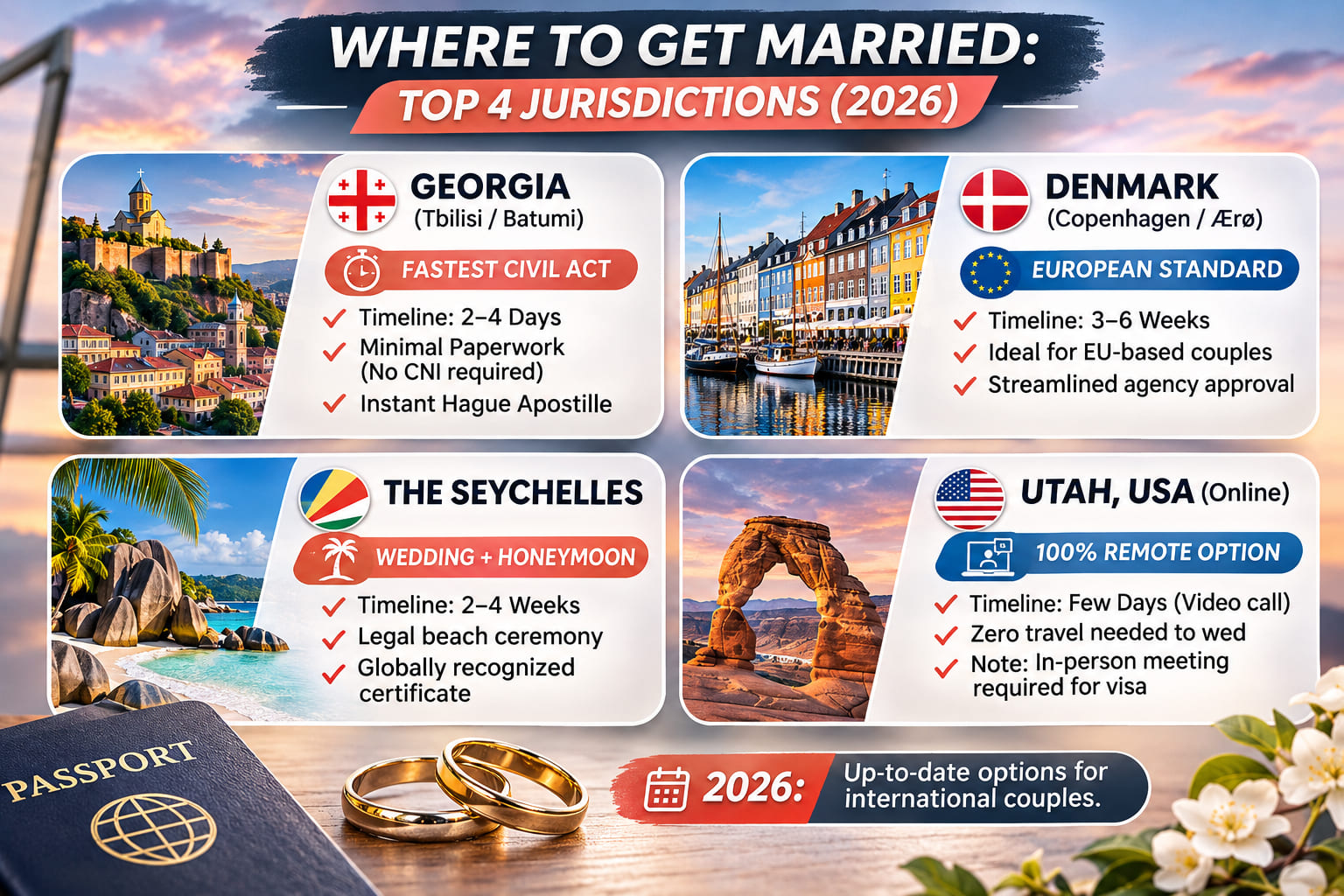
- Choose the registry, not just the destination. Marrying where bureaucracy is fast and cheap (Denmark, Georgia) versus where it is slow and layered can save $1,000+ in document chains and months of calendar. Our comparison of where to get married abroad with the least paperwork and cost prices each option honestly.
- Stack the trips. One ten-day visit combining family introduction, venue scouting, and document pickup beats two five-day visits — saving a flight, a hotel week, and a vacation request.
- Batch the bureaucracy. Order all apostilles and certified translations in a single batch with one accredited provider; certified copies reuse across embassy, registry, and employer files.
- Never save here: translation quality, travel insurance, platform verification, and legal help in complex cases (children, prior refusals). A $60 saving that voids a $3,000 filing is not saving; it is a donation to the bureaucracy.
Frequently Asked Questions
How much does it cost to marry a foreigner in total in 2026?
Most couples land between $6,000 and $12,000 from first verified contact to wedding day across 18–24 months, depending on route and region. Add a relocation buffer of $2,000–5,000 for the first year after arrival. The range is knowable in advance — which is exactly why budgeting it removes most of the stress.
What is the most expensive part of international dating?
Travel: two to three trips with flights and accommodation typically consume half the total budget. The largest hidden item is income loss during the post-arrival work-permit wait on fiancé routes — often bigger than every government fee combined. Visa fees themselves are smaller than most people fear.
Are cheap shortcuts worth it — unverified translators, DIY legalization, free platforms?
Almost never. A rejected translation or a stale apostille costs months, not dollars; free platforms cost data and safety instead of fees. Save on flight season, trip stacking, and marriage jurisdiction — never on document legality, insurance, or verification.
Should couples split the costs of international dating?
There is no universal rule, and culture shapes expectations strongly. What works across successful couples is transparency: many keep travel costs with the traveler and run a joint "legal fund" for documents and visa fees. Decide the split before the first invoice, not during it.
Conclusion: The Budget Is a Love Language
Nobody falls in love with a spreadsheet — but every couple in this series who finished the journey owned one. A shared budget is not accounting; it is the financial dialect of "we": two people naming their future in numbers before life names it for them in invoices. Build the four tabs, fund the buffer, track the pretzels, and keep the dead-season flights. Do that, and the question "how much does it cost?" stops being a fear and becomes what it was always meant to be — the first page of the plan two people write together.