
This is the logistics chapter of our complete guide to meeting abroad and long-distance relationships, the six-article series on turning verified online connection into real life. Here we settle the four arguments every couple has before the first flight: who flies, where each of you sleeps, how long the visit lasts, and what happens day by day — including the conversation most couples forget to schedule until the airport.
The stakes are asymmetric, and that is the reason this chapter exists. A bad first message costs you a reply. A bad first meeting — wrong city, wrong lodging, wrong length — costs thousands of dollars, weeks of vacation, and frequently the relationship itself. Meeting foreign girlfriend in person is not the reward for months of chatting; it is your first joint project. Projects need plans.
Who Flies First — and Why Neutral Ground Wins
The default answer is simple: the man flies first. The reasons are practical, not chivalrous. Her visa options are usually narrower — Schengen or US visitor visas demand income proof, ties, and weeks of processing — while her work schedule and family obligations rarely bend for a two-week experiment. And let us name the quiet third reason: a woman meeting a foreign man feels materially safer when the geography is hers or neutral.
But "the man flies" does not automatically mean "to her hometown." For meeting number one, her city carries hidden taxes: she is embedded in a web of relatives, neighbors, and reputation; you are a guest in an ecosystem you cannot read; and neither of you has a neutral exit if the chemistry needs space to recalibrate. That is why experienced couples often choose a third country — Istanbul, Tbilisi, Warsaw, Yerevan — where both passports enter easily (Ukrainian citizens cross into Turkey and Georgia with an ID card; US citizens enter visa-free), both book their own hotels, and neither is the host. Equal footing changes the psychology of the entire week.
| Meeting Format | Strengths | Weaknesses | Best For |
|---|---|---|---|
| He flies to her city | She is at ease; family introduction possible; deepest cultural immersion | You are fully the guest; her social audience everywhere; no neutral space | Visit #2–3, the family stage |
| She flies to his city | Strong intent signal; she sees your real world | Her visa burden and cost; reputation questions at home; high pressure | Rare; later stages, established trust |
| Neutral third country | Equal footing; visa-easy hubs; independent logistics; no audience | Extra travel for both; less family context | The first meeting (default) |
Her hometown still matters enormously — just not in week one. It becomes the stage of visit two or three, when the question shifts from "are we real?" to "how do I meet her mother?" — a transition with its own etiquette, covered in our family chapter of the series.
The Hotel Rule: Why Separate Accommodations Protect Romance
Now the question every forum argues: where to stay when meeting online date abroad? The answer is unromantic and non-negotiable for visit one: a hotel. Your hotel. Booked by you, in your name, refundable rate, central district, walking distance to your planned meeting points.
Five reasons, in order of how often they save relationships:
- Jet lag is a terrible roommate. After a fourteen-hour flight, cohabitation converts exhaustion into conflict. Separate beds let each of you sleep on your own schedule and meet at your best.
- Pressure kills chemistry. Sharing an apartment on night one forces intimacy neither of you has earned offline yet. Anticipation, it turns out, survives contact — if you give it a door of its own.
- Her reputation is real capital. In collectivist communities, a woman hosting a foreign man invites scrutiny she will pay for long after you fly home. A hotel protects her standing as carefully as her heart.
- The scam pattern dies here. "Stay at my cousin's apartment, just pay the deposit upfront" is one of the oldest extraction scripts in the industry. Independent lodging removes the entire genre.
- Autonomy is the foundation of consent. Both partners keeping a private retreat means every hour spent together is chosen, not scheduled by architecture.
When does cohabitation become reasonable? Visit two or three — after in-person trust exists, families know about you, and the relationship has survived at least one real disagreement in the same time zone.
The 5-to-7 Day Sweet Spot (Designing the Itinerary)
Length is the third decision, and the most miscalculated. Under four days is an interview: you meet, panic, and depart before reality begins. Over eight days is an endurance test: small frictions compound, budgets bleed, and the visit that was meant to confirm love starts auditing it. Five to seven days is the tested window — long enough for real life, short enough to stay hungry.
Here is the first international date itinerary blueprint our community couples actually run:
- Day 1 — Low-stakes arrival. You land, check in, rest. First meeting is ninety minutes maximum: coffee or a walk, daylight hours, public place. Early goodnight. Resist the urge to merge schedules immediately.
- Days 2–3 — Daytime exploration. Markets, museums, street food, the city's ordinary rhythm. Daytime dates reveal habits; evening dates reveal performances.
- Days 4–5 — Real-life rhythm. Groceries together, cooking in a rental kitchenette or her place (daytime), errands, maybe meeting her local friend. This is the normalcy test — the part photos never show.
- Day 6 — Space, then dinner. A half-day apart, deliberately. Then a longer dinner where the week is allowed to be discussed honestly, including its awkward parts.
- Day 7 — The next-step talk. Before checkout, not at the gate: what we felt, what happens next, which month the next visit lives in, which visa route we start. Written down, in a message thread, the same day.
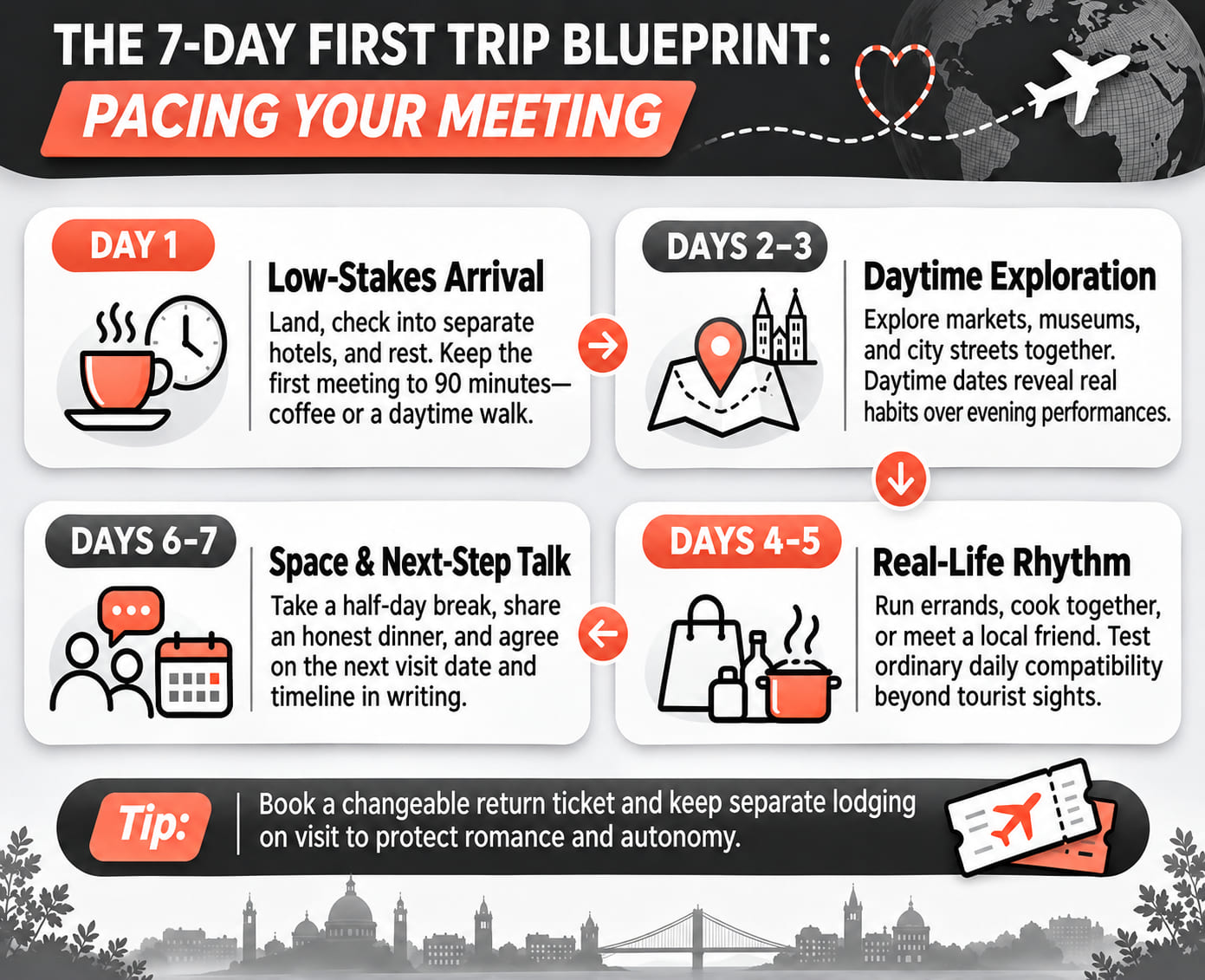
One logistical footnote that saves marriages: book a changeable return ticket. If the chemistry recalibrates slowly, you can extend; if it does not recalibrate at all, you can leave without negotiating an exit from someone's spare bedroom.
Case Study: Why Four Days in Istanbul Beat Two Weeks in One Apartment
📋 Case Study: The Plan That Was Rewritten Before the Flight
Trevor (43, Boston) and Nadia (34, Odesa) had been talking for eleven months when they finally set a date. The original plan was romantic on paper: fourteen days in Odesa, staying at her cousin's spare apartment "to save budget." Two weeks before the flight, Nadia confessed what the plan actually meant: daily family dinners, neighbors' questions, zero privacy, and her cousin's husband offering paid "guide services." Trevor, meanwhile, realized he would spend two weeks as a permanent guest in a household whose rules he could not read.
They rewrote everything in one evening: four days in Istanbul — visa-easy for both — two hotels in the same central district, and the day-by-day blueprint above. Day one was a ninety-minute coffee by the Bosphorus that ended, as planned, early. Days two and three were walking the old city and arguing productively about where to eat. Day four held the next-step talk on a ferry: by the time Trevor landed back in Boston, the September visit to Odesa — the family one — had a month, a flight budget, and a shared document. "Two weeks in that apartment would have ended us," Nadia told us later. "Four days in a neutral city gave us a future. Length is not intimacy. Structure is."
Pre-Flight Video Verification Protocol
Before any ticket is purchased, both partners run the same three-step protocol. It protects him from extraction scripts and her from catfishing and worse — safety is symmetric, and so is verification:
- Two unfiltered live calls, different settings. Different days, different backgrounds, different lighting. Ask for one spontaneous gesture per call ("show me today's date on paper," "wave with your left hand"). Pre-recorded loops fail spontaneous tests; real people pass them laughing.
- The consistency audit. Profile photos vs. live video vs. social footprint: faces, timelines, city details, job story. Platform-level ID verification badge checked. Any detail that changes between calls gets asked about calmly — and answered specifically.
- The money firewall. Zero cash requests of any kind before the first meeting: no emergencies, no visa fees, no deposits, no courier gifts. A single request before meeting one ends the process — not the conversation, the process. Flight and hotel details are shared only after steps one and two pass.
Verification is not distrust. It is the tax you pay once, so that every hour of the trip afterwards can be spent on trust instead of vigilance.
Frequently Asked Questions
Should I book a hotel or stay at her place during the first visit?
Book a hotel. Separate accommodations protect both partners: you keep autonomy and a pressure-free retreat after a long flight; she keeps privacy and reputation safety in her community. Cohabitation belongs to the second or third visit, once trust is a physical reality rather than a plan.
Is a neutral third country really better than her hometown for the first meeting?
For meeting number one, usually yes. Neutral hubs like Istanbul, Tbilisi, or Warsaw keep the footing equal, are visa-easy for both passports, give each partner independent logistics, and remove the social audience of her family circle. Her hometown becomes the right choice later — for the family-introduction visit.
How many video calls are enough before buying the ticket?
Run the three-step protocol: at least two unfiltered live video calls in different settings and times, a consistency audit between her profiles, video, and social footprint, and a zero-money-request firewall test. If any step fails, postpone the trip — not just the ticket.
What if the chemistry feels different offline than online?
That is exactly why the trip lasts five to seven days and why your return ticket should be changeable. Chemistry recalibrates over two to three days of real-life rhythm; judge it at the day-six dinner, not at hour three. A flexible itinerary turns an awkward first evening into data instead of a verdict.
Conclusion: Short Trip, Long Future
The best first meetings are not the longest or the most romantic — they are the most structured. Neutral ground keeps you equals; separate hotels keep you both safe and free; five to seven days keep you honest; and a scheduled next-step talk keeps you moving. Build the frame first, and the romance will fill it exactly the way it filled every couple story in this series: quietly, reliably, and one dated visit at a time.